An email survey of scooter riders in Salt Lake City would seem to make the case for more robust investment in high-quality active transportation infrastructure.


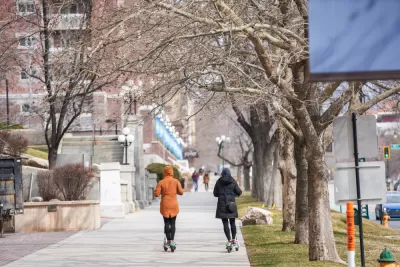
Taylor Stevens shares findings of a recent study conducted by Lime about scooter rider behavior in Salt Lake City.
"The email survey of 614 Lime users whose latest ride was in Salt Lake City found that sidewalk ridership increases by 310% when no bike lane is available; when one is, 82.2% say they ride in it," writes Stevens.
"Seven in 10 respondents said they would never ride on sidewalks if there were protected bike lanes, and more than 50% said painted bike lanes would help. Nearly half said greater enforcement of scooter regulations by police with a $50 ticket would have the same effect."
According to Stevens, sidewalk scooting has been one of the largest challenges reported with the four scooter share companies currently operating in the city. One hospital reported a 160 percent spike in emergency room visits involving electric scooters in September 2018 compared to the previous year (electric scooter companies weren't in operation during the same time period the previous year).
FULL STORY: Most scooter riders using the sidewalk are afraid of cars, new survey shows

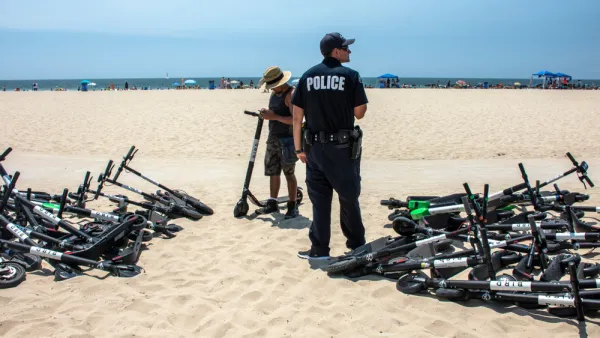
Scooter Media Brief: Safety, Security, and Business Models Raise Concerns
Recent news has revealed some cracks in the pavement below the speedy wheels of electric scooter share.
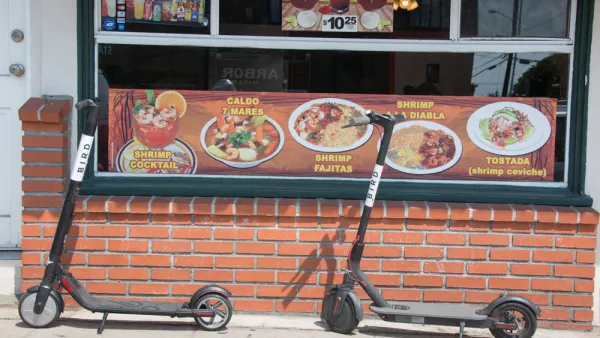
More Rights, Fewer Responsibilities, for Electric Scooter Riders in California
A bill that would toss the helmet requirement for adult e- scooter riders and allow them to ride on roads where the speed limit is 35 mph, up from the current limit of 25 mph, is on Governor Jerry Brown's desk. He has until Sept. 30 to decide.
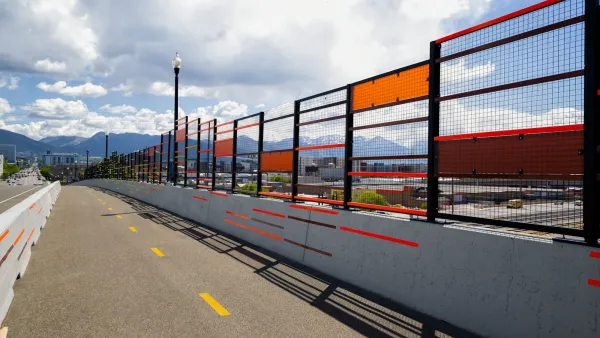
Salt Lake City opens protected bike path on viaduct trail
The 400 South Viaduct Trail features the state's longest continuous piece of public art.

The state-sanctioned urbicide of Austin
People don’t kill cities. Freeways do.

US to reduce Colorado River water deliveries to Mexico
A new Colorado Treaty amendment reduces Mexico’s Colorado River water allocation by 250,000 acre feet.

New Jersey’s second-largest city bans standalone data centers
Jersey City will continue to allow co-location facilities, such as those meant for research institutions that store their own data.

Amtrak not solely to blame for New Jersey commuter rail's unreliability, report finds
A new study from the Garden State Initiative found that NJ Transit’s budget grew 20% across a 4 year period, but reliability declined significantly over the same period.

EPA erases limits on planet-warming pollution from power plants
Under Monday’s plan, power plants would still have some limits on how much mercury, arsenic and other contaminants they can emit.

Phoenix announces new on-demand transit service, more frequent RAPID buses
Both new services will launch in October, and are part of Phoenix's Project Effective Access Solutions for Easing Congestion.

FREE Course: Walkable City 1: Why Walkability?
After describing his path towards focusing on walkability as the essence of good planning, Jeff Speck marches through his five principal reasons for making more walkable places.
Reinventing Malls: Planning Alchemy—Turning Gray Fields Into Gold
The course focuses on the opportunities and imperatives that shape reinvention of mall sites.

Eagle County Government
Harvard University Graduate School of Design
Nashville Planning Department
The Architects Foundation
University of Cincinnati Online
The Pocatello Development Authority
The Urban Renewal Agency of the City of Pocatello
Journal of the American Planning Association