Night School, planning to use school bus fleets to supplement late-night Bay Area transit, lost the regulatory fights Uber and Lyft handily won.


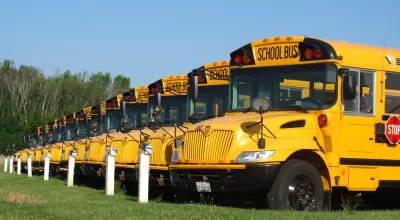
Susie Cagle reports on the dissolution of Night School, a start-up promising low-cost, late-night bus options in Bay Area neighborhoods under-served by public transit. Like its ride share brethren, Night School drew regulatory attention from the California Public Utilities Commission. But where ride-hailing services succeeded, Night School couldn't push through.
From the metro that brought us the infamous Google buses, using the off-hours school bus fleet as an affordable service was lauded at first. “Unlike Uber and Lyft, [Night School] was not a ‘platform,’ and never described itself as such—it was a private bus service with professional, insured, licensed drivers, regulated vehicles, clear routes, and consistent fares.”
Cagle suggests that the current regulatory environment favors start-ups with significant financial backing, even when they ride roughshod over the rules. Companies that “play nice” cannot compete, even when it might be in the public interest that they do so.
Read the full story: How a Start-Up That Wouldn't Break the Rules Was Forced to Fail

East Bay BRT Project Receives $81 Million in Federal Grants
Don't confuse East Bay Rapid Transit with Bay Area Rapid Transit: one's a bus, the other heavy rail. But calling it a bus does not do justice to what will be the Bay Area's first bus rapid transit (BRT) line composed primarily of dedicated lanes.

The Many Ongoing Public Transportation Projects of the Bay Area
The San Francisco Chronicle offers a round-up of 11 big transit projects, by Caltrans, BART, SFMTA, and others, making progress around the bay.
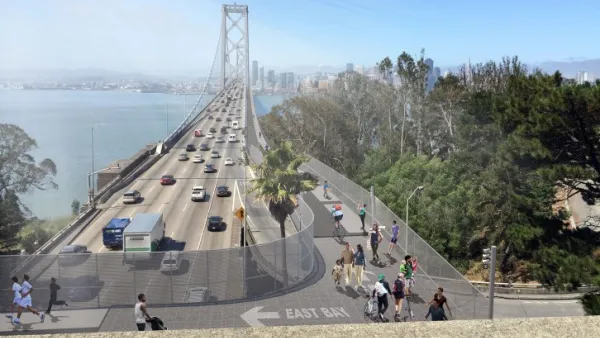
Planning Underway for New Bay Bridge Bike Path, and a Second Transbay BART Tube
In a distant and expensive future, there are two new ways to get across the San Francisco Bay without a car. One will have a much better view.

Planetizen Federal Action Tracker
A weekly monitor of how Trump’s orders and actions are impacting planners and planning in America.

California plans to bury El Niño’s downpour
If the state plays its cards right, it may be able to store a billion acre-feet of El Niño’s water in aquifers.

Chicago breaks ground on $3 billion megadevelopment
The new neighborhood, titled Foundry Park, will one day host 3,700 residences.

One of Denver’s busiest corridors to gain BRT
The project will span 18 miles and contain 74 bus rapid transit stations.

275,000 bus trips are at stake on Seattle's ballot
If passed, the Seattle Transit Measure would trigger a 0.3% sales tax and raise an average of $138 million per year to maintain and expand Seattle’s bus services.

Texas may pay Israeli company billions to ease water woes
Texas awarded IDE Technologies the contract for its Harbor Island project, which is slated to become the Western Hemisphere's largest desalination plant.

FREE Course: Walkable City 1: Why Walkability?
After describing his path towards focusing on walkability as the essence of good planning, Jeff Speck marches through his five principal reasons for making more walkable places.
Reinventing Malls: Planning Alchemy—Turning Gray Fields Into Gold
The course focuses on the opportunities and imperatives that shape reinvention of mall sites.

City of Rosemead
Rutgers University, Edward J. Bloustein School of Planning and Public Policy
One Hundred Miles
Hunter College, City University of New York (CUNY)
The Architects Foundation
University of Cincinnati Online
City of Cambridge
Montrose County
The Pocatello Development Authority