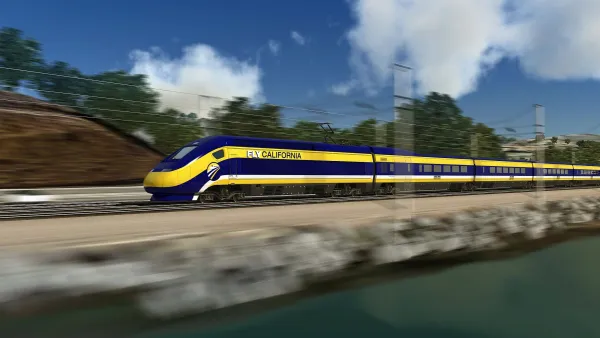
Faced with seven CEQA lawsuits from rail opponents threatening to delay the high-speed rail project, the California High-Speed Rail Authority sought preemption of the California environmental law. The Surface Transportation Board agreed.


"A three-member panel of presidential appointees has potentially derailed seven lawsuits challenging the California High-Speed Rail Authority’s (CHSRA) approval of its Fresno-Bakersfield bullet-train route [see PDF of map] and raised questions about how California environmental law will apply to other planned rail sections across the state," writes Tim Sheehan, reporter for The Fresno Bee.
The U.S. Surface Transportation Board (STB) in a ruling [PDF] issued late Friday, declared on a 2-1 vote that the California Environmental Quality Act, or CEQA, “is categorically pre-empted” in connection with the Fresno-Bakersfield route, which the federal panel OK’d for construction earlier this year.
The ruling is far-reaching. "(L)awsuits against the rail line — filed under CEQA by plaintiffs in Kings and Kern counties - are barred by a federal law that 'expressly pre-empts any state law attempts to regulate rail construction projects,'" writes Sheehan. CHSRA will still have to comply with the federal National Environmental Policy Act (NEPA).
However, this is by no means the end of litigation by the plaintiffs.
Kings County Counsel Colleen Carlson said the plaintiffs would advise Sacramento County Superior Court Judge Michael Kinney, who has been assigned to hear the Fresno-Bakersfield lawsuits, about the federal board’s ruling and seek his direction on the cases’ status. But, she added, the declaration “practically invites more litigation.”
Sheehan provides the background on the seven CEQA lawsuits and the petitioning by CHSRA to the STB in October. As for the segment the lawsuits are directed at, Sheehan notes that the "Fresno-Bakersfield section is the second piece of the statewide bullet-train system for which the rail authority has prepared environmental impact reports. The analysis for the first section, from Merced to Fresno [see PDF of map], was certified and a route approved in 2012."
On Jan. 6, the official groundbreaking for the $68 billion rail project will take place in Fresno to begin work on "a 29-mile stretch from Madera to Fresno" in the Merced to Fresno section, writes Sheehan in another article.
Condemnation "of property in Fresno and Madera counties by the state Public Works Board to make way for high-speed rail construction" is reported in a third Sheehan article. Finally! See prior post describing the delay.
Read the full story: U.S. board: Federal law on high-speed rail trumps state environmental lawsuits
California High-Speed Rail's Second Construction Contract: $1.36 Billion
A week after the groundbreaking ceremony for California's beleaguered high speed rail project, a second construction contract has been awarded. The rail authority will now build 29 miles north and 65 miles south of Fresno to the Kern County line.
High Speed Rail Opponents Appeal to California Supreme Court
Recall that recent 'great news' for the embattled High Speed Rail Authority? The appeals court ruling breathed new life into the $68 billion project as it released the lower court's hold on $9.95 billion in bond funds. Opponents are not deterred.
Major Court Victory for California High-Speed Rail Authority
Plaintiffs suing the state of California over a 2016 law that allowed the High-Speed Rail Authority to tap a $9.9 billion bond measure, passed by voters a decade ago to pay for construction on "usable segments," came up short for the second time.

Planetizen Federal Action Tracker
A weekly monitor of how Trump’s orders and actions are impacting planners and planning in America.

Washington state to charge fee to drivers with fuel-efficient cars
Revenue from the fee will go towards supporting the state’s highways.

Study reveals best places in the U.S. for cycling, walking
New research from Streetlight Data examines bicycle and pedestrian miles per capita in the 100 largest U.S. cities by population.

Mamdani unveils his ‘most ambitious bus lane project’ so far
The city has added two new bus lanes, which it expects to speed up tens of thousands of bus riders’ commutes.

New Jersey and New York suggest $10.3 billion budget for transit
Some of the budget is dedicated to replacing Manhattan's Midtown Bus Terminal.

States split over EPA’s proposal to drop greenhouse gas rules for power plants
The proposed rule drew over 165K comments, including from officials, health and environmental groups, and private citizens.

FREE Course: Walkable City 1: Why Walkability?
After describing his path towards focusing on walkability as the essence of good planning, Jeff Speck marches through his five principal reasons for making more walkable places.
Reinventing Malls: Planning Alchemy—Turning Gray Fields Into Gold
The course focuses on the opportunities and imperatives that shape reinvention of mall sites.

City of Charlotte
City of Rosemead
Rutgers University, Edward J. Bloustein School of Planning and Public Policy
University of Michigan School for Environment and Sustainability (SEAS)
Hunter College, City University of New York (CUNY)
The Architects Foundation
University District Partnership
City of Cambridge
The Pocatello Development Authority