Steve Kroft of 60 Minutes reviews road, rail, bridges, and ports to see how much investment is needed to improve the country's infrastructure, beginning in Pittsburgh and ending at a key Amtrak rail bridge in New Jersey.


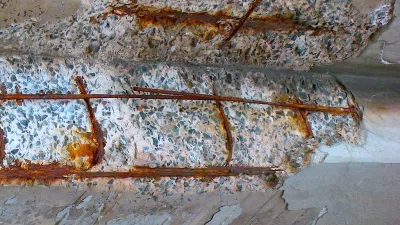
In case you missed Sunday's "60 Minutes", no worry - you can watch the first 14 minutes devoted to the country's failing infrastructure below:
Kroft has a frank talk with former Transportation Secretary Ray LaHood, now co-chairman of Building America's Future who addresses structurally deficient bridges and the failure to pass a gas tax increase to fix or replace them.
In one of the more memorable illustrations of a bridge in disrepair, Ed Rendell, former governor of Pa. and also of Building America's Future, tells Kroft that if it were not for a sausage sandwich, an I-95 overpass in Philadelphia might have collapsed.
In 2008, two contractors from the state Department of Transportation stopped to get sausage sandwiches. They parked under an overpass of I-95 and discovered a "pier with an eight-foot gash in it, about five inches wide", Rendell tells Kroft, that caused them to immediately shut down the bridge for three days to repair it [at 4:46 minutes].
To understand Congress' inability to tackle the problem, Kroft attempted unsuccessfully to speak with House Transportation and Infrastructure Chairman Bill Shuster and Ways and Committee Chairman Dave Camp whose committee has to finance the transportation reauthorization bill).
Kroft is able to interview Rep. Earl Blumenauer (D-Ore.) of the House Transportation and Infrastructure Committee [at 9:17 minutes] who asserts that the last time Congress passed a major transportation bill was 1997 (the Transportation Equity Act for the 21st Century or TEA-21). Since then, he states they have passed 21 short term extensions, including the current patch bill that is subsidizing the Highway Trust Fund through May .
After learning that "in Chicago, it can take a freight train nearly as long to go across the city as it would to go from Chicago to Los Angeles," [11:15] Kroft interviews Amtrak President Joe Boardman by the Portal Bridge over the Hackensack River in N.J.. An excerpt can be viewed here.
"This is the Achilles Heel we have on the Northeast Corridor," proclaims Boardman on the 104-year old bridge that carries almost 500 trains daily, "busiest in the Western Hemisphere for train traffic." And it's obsolete, he states. Worse yet, the swing bridge regularly fails to lock when 'swung back into place' after opening for barge traffic, causing further delays.
If you had already watched the show on Sunday, consider watching "60 Minutes Overtime" [video], "The politics of infrastructure." Kroft and his producer are interviewed on many aspects of his report in addition to the failure of America's politicians to comprehensively address the problem.
We learn of Kroft's personal reasons for wanting to cover the story and issues that surprised him, such as the "bridge below the bridge" in Pittsburgh that exists merely to catch debris [3:33 minutes] from falling into the highway below it.
Read the full story: Falling apart: America's neglected infrastructure


Funding Approved for Key Rail Connection Between New Jersey and New York
The Portal Bridge is a key component of the larger Gateway Program that includes tunnels under the Hudson River. Fixing the Portal Bridge across the Hackensack River will provide tremendous relief to NJ Transit and Amtrak commuters.
$1.7 Billion Project to Replace Critical Rail Crossing in New Jersey Underway
New Jersey's 107-year-old Portal Bridge has been a symbol of the region's crumbling rail infrastructure. A $1.7 billion project to replace the bridge, launched this week, is designed to improve the situation.
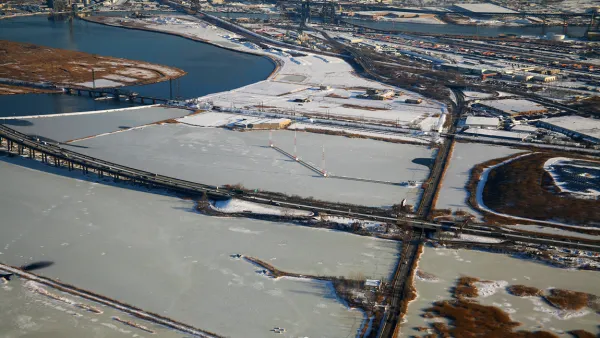
Amtrak's Achilles Heel, Infrastructurally Speaking
Aging, obsolete, and deteriorating bridges affect both road and rail. The 104-year-old Portal Bridge, a swing bridge over the Hackensack River in New Jersey that frequently fails to close properly, tops Amtrak's list for replacement.

Planetizen Federal Action Tracker
A weekly monitor of how Trump’s orders and actions are impacting planners and planning in America.

California plans to bury El Niño’s downpour
If the state plays its cards right, it may be able to store a billion acre-feet of El Niño’s water in aquifers.

Chicago breaks ground on $3 billion megadevelopment
The new neighborhood, titled Foundry Park, will one day host 3,700 residences.

Want to study the Missouri River? Soon, you may need unanimous approval from 10 states
Legislation would require 10 governors’ permission to study or build projects moving water outside the basin.

Desperate measures: Advocates weigh draining Lake Powell to fill Colorado River
Draining the reservoir could reduce evaporation losses by a couple hundred thousand acre-feet.

This road in NYC is infamously dangerous — and Mamdani can't fix it
New York City's Ocean Parkway is known for reckless driving, but the power to implement safety measures lies with the state rather than the city.

FREE Course: Walkable City 1: Why Walkability?
After describing his path towards focusing on walkability as the essence of good planning, Jeff Speck marches through his five principal reasons for making more walkable places.
Reinventing Malls: Planning Alchemy—Turning Gray Fields Into Gold
The course focuses on the opportunities and imperatives that shape reinvention of mall sites.

City of Rosemead
Rutgers University, Edward J. Bloustein School of Planning and Public Policy
One Hundred Miles
Hunter College, City University of New York (CUNY)
The Architects Foundation
University of Cincinnati Online
City of Cambridge
Montrose County
The Pocatello Development Authority