Aging, obsolete, and deteriorating bridges affect both road and rail. The 104-year-old Portal Bridge, a swing bridge over the Hackensack River in New Jersey that frequently fails to close properly, tops Amtrak's list for replacement.


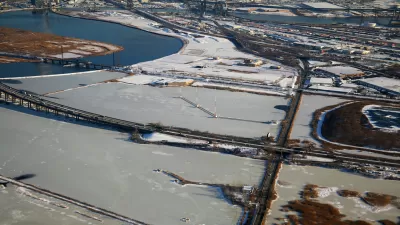
With the Portal Bridge in the background, Amtrak President Joseph H. Boardman told 60 Minutes' reporter Steve Kroft in a recent show on failing infrastructure, "This is the Achilles Heel we have on the Northeast Corridor (and it's) the busiest in the Western Hemisphere for train traffic." The bridge is located between the New Jersey towns of Kearny and Secaucus.
David Porter of the Associated Press (appearing in The Washington Post) notes that between Amtrak and NJ Transit, up to 200,000 passengers are subjected to delays two or three times a week when the trains are delayed when the bridge swings open to accommodate passing barge traffic on the Hackensack River below them. The delays are exacerbated due to the bridge's age as the rails don't connect exactly when swung back, according to Drew Galloway, Amtrak’s chief of planning and performance for the corridor.
"At the end of the day it’s a choke point or a lifeline to the region, a region that produces 20 percent of GDP for the nation,” said Sen. Robert Menendez, a New Jersey Democrat and current chairman of the Senate subcommittee on housing, transportation and community development.
In 2012, one delay was for two hours, "stranding passengers on scores of trains," wrote Matt Sledge of the Huffington Post. "The incident highlighted Amtrak's dependence on aging bridges pressed into service well past their expiration dates along its much traveled Northeast Corridor line."
Unlike major projects such as the Amtrak Gateway tunnels under the Hudson River (under another life known as Access to the Region's Core or ARC) estimated to cost $16 billion and take seven years at a minimum to build, the Portal Bridge replacement can be had for a mere $940 million, though an earlier New York Times article pegs the price at $900 million, and take less than four years to build according to Porter.
Unlike ARC, which Gov. Chris Christie (R-N.J.) canceled in Oct. 2010, the governor said the following year that "he had let federal officials know that New Jersey was prepared to contribute a 'significant amount of money' toward a new bridge," wrote Patrick McGeehan of The New York Times in September.
While Porter writes, "Hope may be on the horizon," this reader doesn't feel convinced.
Read the full story: New Jersey’s Portal Bridge, bane of the Northeast Corridor, is due for upgrade


Funding Approved for Key Rail Connection Between New Jersey and New York
The Portal Bridge is a key component of the larger Gateway Program that includes tunnels under the Hudson River. Fixing the Portal Bridge across the Hackensack River will provide tremendous relief to NJ Transit and Amtrak commuters.
Northeast Rail Corridor Woes Extend Far Beyond Hudson River Tunnels
While Amtrak's century-old Hudson River rail tunnels may capture the public's attention, particularly when they are closed, infrastructure problems on the Northeast Corridor also plague the line from Rhode Island to Washington, D.C.
$1.7 Billion Project to Replace Critical Rail Crossing in New Jersey Underway
New Jersey's 107-year-old Portal Bridge has been a symbol of the region's crumbling rail infrastructure. A $1.7 billion project to replace the bridge, launched this week, is designed to improve the situation.

Planetizen Federal Action Tracker
A weekly monitor of how Trump’s orders and actions are impacting planners and planning in America.

Amtrak, CN end decades-long dispute with eight-year agreement
The new operating agreement establishes an updated framework for the companies to work together, including processes to resolve disputes.

Judges permit Denver to divert 77,000 acre feet from the Colorado River for reservoir expansion
Overuse and climate change have caused the Colorado River’s water levels to plummet.

NYC DOT wants faster, more permanent street upgrades
The city is examining ways to build more concrete infrastructure without getting entangled in 'decades-long' projects.

'Something we’ve never seen before:' rising utility rates could strain city finances nationwide
Data centers, climate change and other factors have caused utility rates in the United States to increase by 38% since 2020.

Trump to overrule local leaders, lease millions of acres of America’s Pacific Island territories’ seafloors to mining companies
International law says that the Indigenous people of America’s territories have a right to prior and informed consent regarding projects that impact their countries.

FREE Course: Walkable City 1: Why Walkability?
After describing his path towards focusing on walkability as the essence of good planning, Jeff Speck marches through his five principal reasons for making more walkable places.
Reinventing Malls: Planning Alchemy—Turning Gray Fields Into Gold
The course focuses on the opportunities and imperatives that shape reinvention of mall sites.

Harvard University Graduate School of Design
KFH Group Inc.
Greater Baltimore Committee
The Architects Foundation
University of Cincinnati Online
The Pocatello Development Authority
The Urban Renewal Agency of the City of Pocatello