The city continues to reclaim space for pedestrians and cyclists.


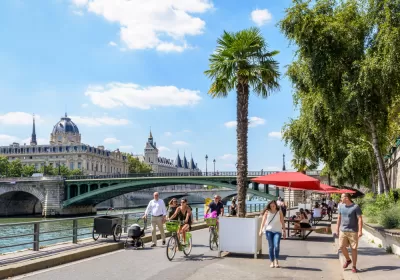
During her tenure as mayor of Paris, "Anne Hidalgo has opened linear parks in the old highways along the Seine, phased out diesel cars in the city, opened bus lanes, raised parking meter prices, and plowed bike lanes down hundreds of streets." The city eliminated cars from even more areas as the pandemic hit, and there are plans to pedestrianize the famous Champs-Elysées.
Henry Grabar interviews David Belliard, Paris's adjunct mayor for transportation and public space, the city's "point man for many of these endeavors," including "establishing car-free zones outside schools and enforcing the capital’s new speed limit of 30 kilometers per hour—a notch below 20 mph."
Discussing the city's history, Belliard says "[w]hen the car arrives, we transform what we can call public space, and this public space becomes automobile space, with the logical system of the car imposing itself in Paris. And public space is completely devoured, eaten away, and in a certain way privatized to one single, unique use." Since then, the city has worked to improve facilities for cyclists and pedestrians, with some projects expedited by the pandemic. According to Belliard, "COVID permitted us to accelerate certain things, especially with respect to the bicycle."
Defending the city's policy to limit parking and the entry of private cars in the central part of Paris, Belliard asserts that "[e]ighty percent of trips between Paris and the suburbs are by public transit." As Belliard sees it, "[t]he redistribution of public space is a policy of social redistribution."
FULL STORY: The Liberation of Paris From Cars Is Working

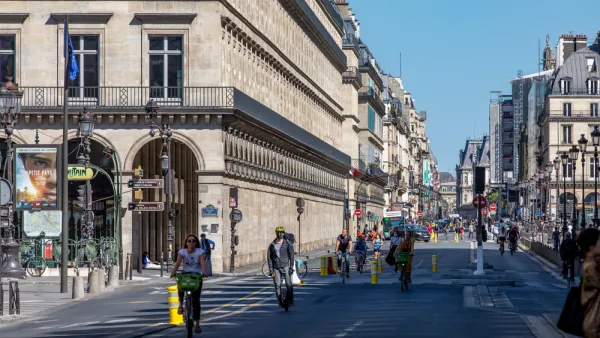
Paris Plans to Become a '100 Percent Cyclable' City
Mayor Anne Hidalgo continues her commitment to making Paris more bikeable with a new plan that will improve bike parking and facilities in the French capital.
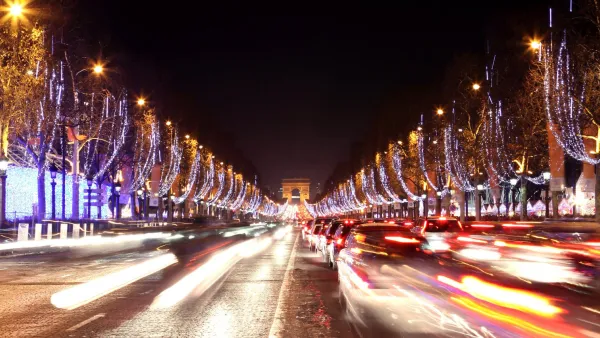
'The World's Most Beautiful Avenue' Getting A Green Makeover
Paris Mayor Anne Hidalgo approved a new plan to revitalize the Champs Élysées ahead of the 2024 Summer Olympics.
Witness a Car-Free Paris
We call them Open Streets events. In French it's Journée Sans Voiture. On September 27, the world saw a car-free Paris.

The state-sanctioned urbicide of Austin
People don’t kill cities. Freeways do.

US to reduce Colorado River water deliveries to Mexico
A new Colorado Treaty amendment reduces Mexico’s Colorado River water allocation by 250,000 acre feet.

New Jersey’s second-largest city bans standalone data centers
Jersey City will continue to allow co-location facilities, such as those meant for research institutions that store their own data.

Amtrak not solely to blame for New Jersey commuter rail's unreliability, report finds
A new study from the Garden State Initiative found that NJ Transit’s budget grew 20% across a 4 year period, but reliability declined significantly over the same period.

EPA erases limits on planet-warming pollution from power plants
Under Monday’s plan, power plants would still have some limits on how much mercury, arsenic and other contaminants they can emit.

Phoenix announces new on-demand transit service, more frequent RAPID buses
Both new services will launch in October, and are part of Phoenix's Project Effective Access Solutions for Easing Congestion.

FREE Course: Walkable City 1: Why Walkability?
After describing his path towards focusing on walkability as the essence of good planning, Jeff Speck marches through his five principal reasons for making more walkable places.
Reinventing Malls: Planning Alchemy—Turning Gray Fields Into Gold
The course focuses on the opportunities and imperatives that shape reinvention of mall sites.

Eagle County Government
Harvard University Graduate School of Design
Nashville Planning Department
The Architects Foundation
University of Cincinnati Online
The Pocatello Development Authority
The Urban Renewal Agency of the City of Pocatello
Journal of the American Planning Association