Having completed a pilot program last year, the Washington State Transportation Commission will hear a report in October and vote in December on phasing out its 49.4 cents per gallon gas tax, fourth highest in the nation but not indexed to inflation.


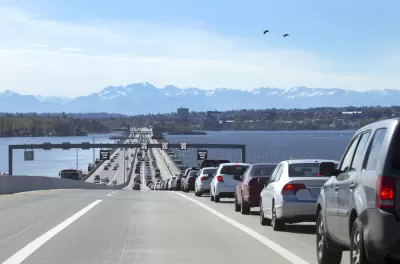
"As Washington state weighs whether to phase out its gas tax in favor of a pay-per-mile charge, Oregon offers several lessons learned," reports James Drew for the Tacoma News Tribune.
Oregon's road usage charge, called OReGO, the nation's only such charge in operation, began on July 1, 2015, and is limited to 5,000 volunteers by the authorizing 2013 state legislation. In short, Oregon has been the living laboratory for the rest of the nation when it comes to vehicle miles traveled fee programs
The Washington State Transportation Commission expects to receive a report in October from a panel that has studied the pay-per-mile tax, which they call the road usage charge. The commission is set to vote Dec. 17 on its recommendations to the Legislature, which convenes in January.
It’s too early to say how the commission will vote, said chairman Jerry Litt," Drew reported on July 17. "He said he expects many state residents would pay more under... a road usage charge."
Litt participated in a pilot project [from February 2018 to January 2019] to gauge how state residents would feel about replacing the gas tax with one based on how far people drive. Consultants hired by the state to run the year-long project set a rate of 2.4 cents per mile, so participants could figure out how much they would have to pay compared to the state portion of the gas tax, which is 49.5 cents [sic] per gallon.
On [July 16], D’Artagnan Consulting presented its findings to the transportation commission ... to gauge what state residents think about moving to a pay-per-mile system. About 2,000 people participated in the project by reporting their mileage, which enabled them to determine if they paid more or less than under the gas tax.
As for 'lessons learned' from Oregon, a major focus of the Aug. 4 source article, Drew writes:
Top of the list is that charging drivers based on how many miles they drive must be mandatory if you want a lot of people doing it and generating revenue, say some state officials and motorists.
OReGO flaws
There's a good reason for that recommendation – only 611 motorists have enrolled in OReGO, observes Drew, a paltry 12 percent of what the Oregon Department of Transportation (ODOT) wanted. Why so few?
Unlike the "mock payments" made by participants in the Washington, California, and Colorado pilot projects, OReGO is not a pilot program (ODOT conducted two of them from 2006-2007 and 2012-2013: See Chapter 4 in The OReGO Program | Final Report [pdf]) but a 4+-year ongoing program approved by statute. It's the real deal, albeit for a limited number of participants, which means enrollees must pay their mileage bills.
People who stand to pay the most tax are not going to sign up; you can’t have a voluntary tax program,” said Michelle Godfrey, a spokeswoman for the Oregon Department of Transportation. “It has to be a mandatory program for revenue to be gained from it.
Mileage bills are not just determined by miles driven multiplied by 1.7 cents. Participants record their gas purchases, and the 34-cents per gallon state gasoline excise tax they paid is credited toward their bill. Of course, with EVs, the credit is zero. With gas guzzlers, it's substantial, and can even result in credit rather than a bill.
The legislature approved a phased 10-cents per gallon fuel tax increase two years ago but it is not indexed for inflation. The 4-cents per gallon gas tax increase on Jan. 1, 2018 (it will increase six more cents by 2024), triggered a slight increase in the road usage charge, from 1.5 cents-per-mile to 1.7 cents, as ODOT explained:
Because OReGO credits state fuels tax for drivers enrolled in the program, the per-mile rate was also increased to keep the road-charge-to-fuels-tax-credit ratio intact.
OReGO changes take effect on January 1, 2020
House Bill 2881, signed by Gov. Kate Brown (D) on June 20, will take away fuel tax refunds for OReGO participants driving low fuel efficiency vehicles effective Jan. 1, 2020, and give EV owners a $110 incentive to participate by waiving the new EV fee (in HB 2017) should they decide to participate, reported KTVZ News.
Washington state gas tax flaw
"Sen. Rebecca Saldana [D], vice chairwoman of the Senate Transportation Committee, said the state is considering a pay-per-mile charge because more fuel-efficient vehicles have eroded the state’s ability to rely long term on the gas tax for transportation needs," reported Drew last month.
Saldana said if the Legislature supports a pay-per-mile system, it would have to be phased in over 10 to 25 years because the state has sold bonds for transportation projects based on revenue from the gas tax. Those bonds would have to paid off before the state replaced the gas tax completely with a pay-per-mile system.
Indeed, increased fuel efficiency is one of two majors reasons given by mileage-based user fee advocates to switch to charging motorists for the miles they drive rather than taxing the gallons of fuel they burn. It was just over four years ago that the legislature approved an 11.6 cents tax increase, giving the Evergreen State the nation's second-highest fuel tax on July 1, 2016, just one cent less than Pennsylvania's.
However, like Oregon, it didn't index the gas tax to inflation, a primary design flaw of fuel taxes, unlike 21 states and the District of Columbia that have variable fuel tax rates as of April 11, according to the National Conference of State Legislatures. Washington now has the nation's fourth-highest fuel tax after California and Illinois hiked their fuel taxes in 2017 and on July 1, respectively, and both are indexed.
As for the other reason to switch from taxing fuel to taxing miles driven, ensuring that electric vehicles, which do not burn gas and thus pay no fuel taxes, pay their fair share in road costs, that is indeed a legitimate reason to consider transitioning to a road usage charge, but one should also consider the very low percentage of battery-electric light-duty vehicles (LDV) in the fleet. While last year saw a record increase of plug-in electric vehicles (including plug-in hybrids), it was still < 2 percent of total LDV sales.
Utah to join Oregon on January 1, 2020
Like Oregon, Utah will add an incentive to its road usage charge. However, it's only targetting alternative fuel vehicles.
"In 2018, Senate Bill 136 directed the [Utah Department of Transportation] UDOT to implement a [road usage charge] RUC program for alternative fuel vehicles by January 1, 2020," explains a brief UDOT overview [pdf] of the program. An image shows the new fees for battery-electric vehicles, plug-in hybrid EVS, and conventional hybrid fees effective 2019, and the increases in 2020 and 2021, ranging from $15 to $90 next year.
As posted on February 25, 2019:
"Beginning Jan. 1, 2019, electric cars will begin paying a $60 fee, plug-in hybrids will pay $26 and gas hybrids will pay $10," according to Lee Davidson of The Salt Lake Tribune. "The fees increase a bit each year until 2021, when electric cars will pay $120, plug-in hybrids will pay $52 and gas hybrids will pay $20."
"UDOT hopes to initially get 400 to 500 hybrid and electric vehicle owners to sign up for the program in January," reported Dennis Romboy for Desert News on June 19.
The state would waive the annual flat fee for those vehicles and charge them 1.5 cents per mile driven. The per-mile charge would be capped to not exceed the annual fee, said Teri Newell, UDOT deputy director.
A final word to Hawaii which hopes to initiate a road usage charge pilot next year.
Related in Planetizen:
-
Federal Lawmakers Target Electric Vehicles in Transportation Reauthorization, July 15, 2019 [See section on Utah's Road Usage Charge]
-
Seven State DOTs Awarded $10 Million to Study Gas Tax Alternatives, February 25, 2019 [See Utah program]
-
The Slow Transition from Gas Taxes to Mileage Fees, January 17, 2018 [See 'Oregon update']
-
Oregon's $3 Billion Transportation Funding Legislation Has a Tax for Almost Everyone, July 7, 2017 [See 'Future of Landmark Road Usage Charge?']
-
Over $14 Million Awarded to Eight Projects to Find Alternatives to Gas Taxes, September 6, 2016 [See section on Washington state].
-
An Unexpected Advocate for Utah's Vehicle-Miles-Traveled Fee, July 25, 2015
- Inflation, not Fuel Efficiency, Is Main Flaw of Gas Tax, June 25, 2015 [ITEP analysis of Road Usage Charge]
Hat tip to AASHTO Daily Transportation Update, Aug. 5.
FULL STORY: Pay per mile for using the roads? Oregon can teach Washington a few things

Utah Officials Want to Replace the State Gas Tax
The state auditor and the transportation chief argue that the gas tax is an unsustainable funding source caused by a projected increase in electric vehicle adoption and an increase in fuel efficiency of gas-powered vehicles.
Oregon's $3 Billion Transportation Funding Legislation Has a Tax for Almost Everyone
The package, which doesn't tax walking and running shoes, went to the legislature on June 30. It includes a ten cents per gallon gas tax, a 0.10 percent payroll tax, a $15 tax on new bikes costing at least $200, and a potential toll on I–205.
Over $14 Million Awarded to Eight Projects to Find Alternatives to Gas Taxes
The U.S. Department of Transportation is funding ways to transition from the gas tax to other user-based revenue mechanisms to fund transportation infrastructure. The federal gas tax hasn't keep pace with transportation expenditures since 2008.

Planetizen Federal Action Tracker
A weekly monitor of how Trump’s orders and actions are impacting planners and planning in America.

The state-sanctioned urbicide of Austin
People don’t kill cities. Freeways do.

US to reduce Colorado River water deliveries to Mexico
A new Colorado Treaty amendment reduces Mexico’s Colorado River water allocation by 250,000 acre feet.

5 New England states march closer to 800 megawatt wind energy project
Securing federal approval for the project may be complicated under the Trump administration, which has historically been hostile towards domestic wind power.

Baltimore to break ground on $50 million Transit Priority Project
The project will bring faster bus trips, safer streets and better bike connections to Baltimore.

Airbnb launches $250 million 'last-dollar financing' housing accelerator, makes first investment in Austin
The company will put $6.4 million towards affordable housing development in Texas’ capital.

FREE Course: Walkable City 1: Why Walkability?
After describing his path towards focusing on walkability as the essence of good planning, Jeff Speck marches through his five principal reasons for making more walkable places.
Reinventing Malls: Planning Alchemy—Turning Gray Fields Into Gold
The course focuses on the opportunities and imperatives that shape reinvention of mall sites.

Eagle County Government
Harvard University Graduate School of Design
Nashville Planning Department
The Architects Foundation
University of Cincinnati Online
The Pocatello Development Authority
The Urban Renewal Agency of the City of Pocatello
Journal of the American Planning Association