Securing federal approval for the project may be complicated under the Trump administration, which has historically been hostile towards domestic wind power.


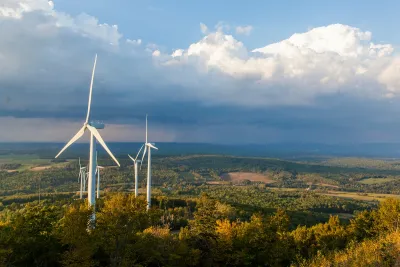
After over a decade of attempts, New England is one step closer to a major investment in wind energy. Maine’s Public Utilities Commission has selected a developer to build 800 megawatts of new onshore wind energy in Northern Maine, and a second developer to build a transmission line able to carry up to 1,200 megawatts of power down to Southern Maine and New England.
Maine is collaborating on the wind energy project with Vermont, Rhode Island, Connecticut and Massachusetts, “whose residents will help pay for the transmission line via charges on their utility bills, even as two of those states elected not to sign long-term deals for the new power,” Nathaniel Eisen writes for Inside Climate News.
Before construction can commence, project leaders must secure all local, state and federal approvals. “Federal approvals remain dicey under the presidential administration of Donald Trump, which has used every tool at its disposal to block the development of domestic wind power,” Inside Climate News reports. If all goes well, PUC Chair Phil Bartlett said power will flow through the new transmission line in the early 2030s.
FULL STORY: New England Affirms Faith in Wind Energy’s Future

Through ‘questionable’ means,Trump is paying to make offshore wind power disappear
The East Coast is in need of renewable energy, but wind farm developers face permit revocations and stop-work orders from the Trump administration.

Op-ed: Federal austerity is funding what kills us
Tracing the backstory of the last year of cuts to multimodal transportation reveals an alarming definition of road safety that only serves one mode.
EPA erases limits on planet-warming pollution from power plants
Under Monday’s plan, power plants would still have some limits on how much mercury, arsenic and other contaminants they can emit.

Planetizen Federal Action Tracker
A weekly monitor of how Trump’s orders and actions are impacting planners and planning in America.

The state-sanctioned urbicide of Austin
People don’t kill cities. Freeways do.

US to reduce Colorado River water deliveries to Mexico
A new Colorado Treaty amendment reduces Mexico’s Colorado River water allocation by 250,000 acre feet.

5 New England states march closer to 800 megawatt wind energy project
Securing federal approval for the project may be complicated under the Trump administration, which has historically been hostile towards domestic wind power.

Baltimore to break ground on $50 million Transit Priority Project
The project will bring faster bus trips, safer streets and better bike connections to Baltimore.

Airbnb launches $250 million 'last-dollar financing' housing accelerator, makes first investment in Austin
The company will put $6.4 million towards affordable housing development in Texas’ capital.

FREE Course: Walkable City 1: Why Walkability?
After describing his path towards focusing on walkability as the essence of good planning, Jeff Speck marches through his five principal reasons for making more walkable places.
Reinventing Malls: Planning Alchemy—Turning Gray Fields Into Gold
The course focuses on the opportunities and imperatives that shape reinvention of mall sites.

Eagle County Government
Harvard University Graduate School of Design
Nashville Planning Department
The Architects Foundation
University of Cincinnati Online
The Pocatello Development Authority
The Urban Renewal Agency of the City of Pocatello
Journal of the American Planning Association