Conventional thinking is that the auto industry, wanting to sell more fuel-gulping SUVs, are pushing for weaker fuel economy standards, but Hiroko Tabuchi, climate reporter for The New York Times, exposes Big Oil's stealth campaign.


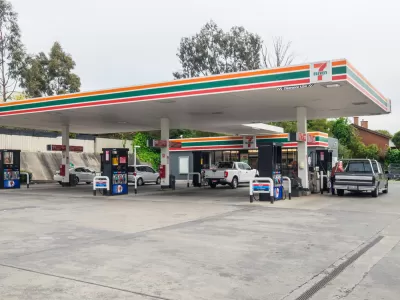
"In Congress, on Facebook and in statehouses nationwide, Marathon Petroleum, the country’s largest refiner, worked with powerful oil-industry groups and a conservative policy network financed by the billionaire industrialist Charles G. Koch to run a stealth campaign to roll back car emissions standards, a New York Times investigation has found," reports Hiroko Tabuchi.
The logic is simple: Lower standards means more gasoline sales. "The campaign’s main argument for significantly easing fuel efficiency standards is that the United States is so awash in oil it no longer needs to worry about energy conservation."
The campaign proved effective, as parts are reflected in the rule proposed by the Trump administration in August, the Safer Affordable Fuel Efficient (SAFE) Vehicles Proposed Rule for Model Years 2021-2026.
In recent months, Marathon Petroleum also teamed up with the American Legislative Exchange Council (ALEC), a secretive policy group financed by corporations as well as the Koch network, to draft legislation for states supporting the industry’s position.
Its "Resolution In Support Of The Reconsideration Of Corporate Average Fuel Economy (CAFE) Standards," points to the historical underpinning of the U.S Department of Transportation's fuel economy standards, "implemented largely in response to the 1973 oil embargo in an effort to reduce foreign imports of petroleum," takes aim at changes made under the Obama administration.
In 2010, the U.S. Environmental Protection Agency and the California Air Resources Board joined the National Highway Traffic Safety Administration (NHTSA, a division of USDOT) to regulate tailpipe emissions as well as fuel economy, a result of the 2007 U.S. Supreme Court's decision in Massachusetts v. EPA that affirmed that the Clean Air Act gives authority to EPA and California to regulate greenhouse gas emissions. The three agencies agree to a "One National Program," also called “Single National Standard.”
The energy industry’s efforts also help explain the Trump administration’s confrontational stance toward California, which, under federal law, has a unique authority to write its own clean-air rules and to mandate more zero-emissions vehicles.
Legislation was proposed last year by Rep. Roger Williams (R-Tex.) to abandon fuel economy standards altogether.
Why Marathon Petroleum?
[F]or gasoline producers like Marathon, a shift toward more efficient vehicles poses a grave threat to the bottom line. In October, the company acquired a rival, Andeavor [formerly Tesoro], making it the biggest refiner in the United States, with sales of 16 billion gallons of fuel a year.
Andeavor also surfaced in a recent Planetizen post showing the influence of Big Oil, but in an overt, not stealthy, manner. Andeavor, BP America, and Phillips 66 were identified as the largest contributors to the successful campaign to defeat a Washington carbon fee initiative, setting a Washington state fundraising record.
FULL STORY: The Oil Industry’s Covert Campaign to Rewrite American Car Emissions Rules

Royal Dutch Shell: Big Oil with a Conscience?
Big Oil companies are not all alike. Royal Dutch Shell is the first one to part ways with a major oil industry trade group over differences on climate change. It's also linking executive pay to goals to reduce the company's carbon footprint.

White House Ends Talks with California Over Fuel Efficiency Standards
Ending the talks means litigation will have to settle the conflict over the two standards: California and 12 other states continue to use the Obama-era standard of 36 mpg by 2025, while the administration's rule freezes standards at 2020, or 29 mpg.
Trump Administration Clashes on Vehicle Emissions Standards Rollback
It's the U.S. EPA, under the new acting administrator, against two top officers in the Department of Transportation. Both agencies (along with California) determine fuel efficiency standards. Guess which wants to proceed cautiously in the rollback?

The state-sanctioned urbicide of Austin
People don’t kill cities. Freeways do.

US to reduce Colorado River water deliveries to Mexico
A new Colorado Treaty amendment reduces Mexico’s Colorado River water allocation by 250,000 acre feet.

New Jersey’s second-largest city bans standalone data centers
Jersey City will continue to allow co-location facilities, such as those meant for research institutions that store their own data.

Amtrak not solely to blame for New Jersey commuter rail's unreliability, report finds
A new study from the Garden State Initiative found that NJ Transit’s budget grew 20% across a 4 year period, but reliability declined significantly over the same period.

EPA erases limits on planet-warming pollution from power plants
Under Monday’s plan, power plants would still have some limits on how much mercury, arsenic and other contaminants they can emit.

Phoenix announces new on-demand transit service, more frequent RAPID buses
Both new services will launch in October, and are part of Phoenix's Project Effective Access Solutions for Easing Congestion.

FREE Course: Walkable City 1: Why Walkability?
After describing his path towards focusing on walkability as the essence of good planning, Jeff Speck marches through his five principal reasons for making more walkable places.
Reinventing Malls: Planning Alchemy—Turning Gray Fields Into Gold
The course focuses on the opportunities and imperatives that shape reinvention of mall sites.

Eagle County Government
Harvard University Graduate School of Design
Nashville Planning Department
The Architects Foundation
University of Cincinnati Online
The Pocatello Development Authority
The Urban Renewal Agency of the City of Pocatello
Journal of the American Planning Association