Despite a statewide ban approved by the Texas State Legislature in 2019, four Texas cities still have active contracts with photographic enforcement companies.


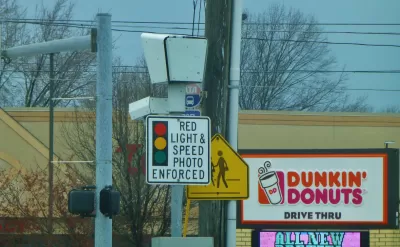
Opponents of red-light cameras in Texas, whose lobbying efforts led to a statewide ban on photographic enforcement at intersections in 2019, are zeroing in on four cities that had grandfathered contracts with red-light camera companies. As Dug Begley reports in the Houston Chronicle, "The 2019 ban allowed for any city that had a contract with a photo enforcement company that did not include termination language related to statewide bans to keep them."
Lawmakers now want to end the remaining contracts, but state law doesn't allow cities to "simply void contracts they do not like." Ending the red-light camera contracts, writes Begley, could cost cities like Humble $50,000 a month, "a sum the small city cannot simply absorb."
Opponents have criticized red-light cameras as vulnerable to corruption in what has been termed "privatized law enforcement," but others argue that the programs save lives by reducing right-angle crashes and reducing the need for traffic safety by the police. "In response to opponents, lawmakers over the years have stripped virtually all the penalties for not paying red-light camera violations. Failure to pay cannot be reported to a credit agency, it has no effect on renewing a vehicle or driver’s license and it cannot land the person in civil court."
FULL STORY: Lawmakers who banned red light cameras, except where they didn't, try to finish the job

Despite Stay-at-Home Orders, U.S. Traffic Deaths Rose in 2020
Dangerous behaviors picked up during the early, low-traffic days of the pandemic are partly to blame.
Traffic deaths rise by 15% on major album release days
Enjoy those new tracks, but don't forget to keep your eyes on the road.
Commentary: Counting Road Deaths by VMT Minimizes the Harm and Normalizes Traffic Violence
When measured per capita, traffic fatalities in the United States far outstrip those in peer countries.

Planetizen Federal Action Tracker
A weekly monitor of how Trump’s orders and actions are impacting planners and planning in America.

The state-sanctioned urbicide of Austin
People don’t kill cities. Freeways do.

US to reduce Colorado River water deliveries to Mexico
A new Colorado Treaty amendment reduces Mexico’s Colorado River water allocation by 250,000 acre feet.

5 New England states march closer to 800 megawatt wind energy project
Securing federal approval for the project may be complicated under the Trump administration, which has historically been hostile towards domestic wind power.

Baltimore to break ground on $50 million Transit Priority Project
The project will bring faster bus trips, safer streets and better bike connections to Baltimore.

Airbnb launches $250 million 'last-dollar financing' housing accelerator, makes first investment in Austin
The company will put $6.4 million towards affordable housing development in Texas’ capital.

FREE Course: Walkable City 1: Why Walkability?
After describing his path towards focusing on walkability as the essence of good planning, Jeff Speck marches through his five principal reasons for making more walkable places.
Reinventing Malls: Planning Alchemy—Turning Gray Fields Into Gold
The course focuses on the opportunities and imperatives that shape reinvention of mall sites.

Eagle County Government
Harvard University Graduate School of Design
Nashville Planning Department
The Architects Foundation
University of Cincinnati Online
The Pocatello Development Authority
The Urban Renewal Agency of the City of Pocatello
Journal of the American Planning Association