Paradise is the largest incorporated city west of the Mississippi River lacking a public sewer system. The town of of 27,000 relies on septic systems, now potentially damaged. Without sewers, multi-family housing construction becomes more difficult.


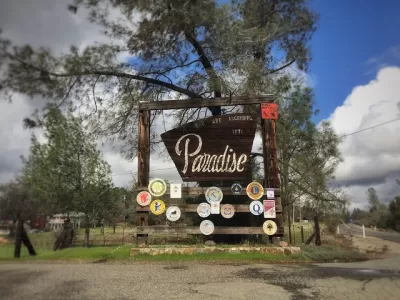
The lack of sewers hampers economic and housing development and threatens water supplies with pollution from failing septic systems. A sewer project feasibility report was released two years ago, something that will have to be considered in the rebuilding efforts. But the first order of business is cleanup from California's largest and deadliest wildfire.
"The colossal effort to clear Butte County of the rubble, and make way for recovery of the town of Paradise and its neighbors, is expected to last at least a year," reports Kurtis Alexander for the San Francisco Chronicle. "The trucks and trains being mobilized for the work are prepared to take out as much as 8 million tons of material — almost four times what was removed from last year’s Northern California fires."
Alexander describes various aspects of dealing with all the hazardous materials caused by the Camp Fire, which killed at least 85 people, including "how potentially damaged septic systems in Paradise could harm the landscape."
“It appears that Paradise is the largest incorporated city west of the Mississippi that is wholly dependent on septic systems,” the town’s then-vice mayor, Jody Jones, who is now mayor, told Chico City Council members at their meeting on Sept. 1, 2015, reported Robert Speer for the Chico News and Review. “This is not something to be proud of.”
Hooking up with the Chico sewer system was the Paradise Town Council's preferred alternative among three listed.
Dealing with potentially damaged septic systems and the lack of sewers is also covered by Chronicle reporter J.K. Dineen in a comprehensive article on the major obstacles to rebuilding in Butte County. By all accounts, it's going to take a long time for the 13,972 homeowners who lost their residences in the fire which destroyed 18,804 structures.
[F]or those who decide to rebuild, it may be years, even a decade, before construction workers show up to pour a foundation and hammer 2-by-4s.
In addition to determining whether to rebuild in the wildland–urban interface (see AP interview with retiring Cal Fire Director Ken Pimlott), Paradise needs to consider whether to replace its septic systems where appropriate. According to a description of the July 2017 final feasibility report for the sewer project:
As the town has grown and evolved, the need for a better means of wastewater collection and treatment, particularly in the higher density and use, commercial areas, has become more urgent. This issue has been demonstrated within the town’s more developed downtown and other commercial areas where septic system failures are increasing and available land for replacement leach fields is constrained, or non-existent.
The lack of sewers constrains housing as well as economic development:
Additionally, a central sewer system would provide more housing options, including multi-family residential units. With the addition of a sewer, parcels that have been unsuitable for multi-family developments due to their wastewater usage would have that option opened to them. This would help the Town in its efforts to provide adequate affordable housing for Paradise families.
"The challenges of having only individual septic systems for treatment and disposal have been apparent to the Town for 30 years," states the webpage. Now would seem like the right time for the town to act. Five options are listed. Hopefully, they won't opt for the last one: "No Project."
-
When will California listen to the experts and stop building in fire prone areas? Not today.
FULL STORY: Camp Fire: Crews begin massive cleanup of hazardous materials left in wake of blaze

An Unexpected Turn for California's New State Population Report
Population data released May 1 by the Department of Finance reveals the Golden State's lowest population growth rate on record, at 0.47 percent.
California's Fastest Growing City: Paradise
Paradise, California—devastated by the deadly Camp Fire of 2018—is attracting new and returning residents as the city rebuilds its housing stock.
Paradise Was Prepared for the Camp Fire, Report Says. It Wasn't Enough.
Sobering findings from a thorough examination of the causes of the 2018 Camp Fire.

Planetizen Federal Action Tracker
A weekly monitor of how Trump’s orders and actions are impacting planners and planning in America.

The state-sanctioned urbicide of Austin
People don’t kill cities. Freeways do.

US to reduce Colorado River water deliveries to Mexico
A new Colorado Treaty amendment reduces Mexico’s Colorado River water allocation by 250,000 acre feet.

Baltimore to break ground on $50 million Transit Priority Project
The project will bring faster bus trips, safer streets and better bike connections to Baltimore.

Airbnb launches $250 million 'last-dollar financing' housing accelerator, makes first investment in Austin
The company will put $6.4 million towards affordable housing development in Texas’ capital.

Guerilla urbanists are building DIY bus stop benches in Chicago
A before-and-after of one of the bus stops with a new bench. The new benches are not officially sanctioned or permitted, but the residents who placed them hope they will be the start of a network of DIY benches across the city.

FREE Course: Walkable City 1: Why Walkability?
After describing his path towards focusing on walkability as the essence of good planning, Jeff Speck marches through his five principal reasons for making more walkable places.
Reinventing Malls: Planning Alchemy—Turning Gray Fields Into Gold
The course focuses on the opportunities and imperatives that shape reinvention of mall sites.

Eagle County Government
Harvard University Graduate School of Design
Nashville Planning Department
The Architects Foundation
University of Cincinnati Online
The Pocatello Development Authority
The Urban Renewal Agency of the City of Pocatello
Journal of the American Planning Association