Sobering findings from a thorough examination of the causes of the 2018 Camp Fire.


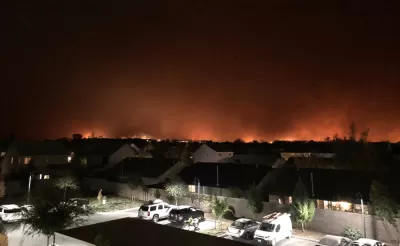
Dale Kasler and Ryan Sabalow shares news of the findings of a report published on Monday by the federal government’s National Institute of Standards and Technology in cooperation with Cal Fire that presents "arguably the most exhaustive look at the deadliest wildfire in California’s history."
"The report paints a sobering picture for every forested community in California and for PG&E Corp., with its thousands of miles of power lines and transformers, as they work to clear trees, build defenses and adequately prepare for the next round of wildfires," according to Kasler and Sabalow. Paradise had already taken numerous steps to limit the damage of a potential wildfire prior to the Camp Fire. "The Butte County town had an evacuation plan and emergency-notification systems. Paradise, neighboring communities and the county had undertaken 'vegetation management' programs to reduce wildfire hazards."
The National Institute of Standards and Technology is planning on releasing a follow up report to address evacuation preparedness and other emergency-related issues. Meanwhile, PG&E, the investor owned utility that owns the transmission tower that caused the fire, unveiled its 2021 wildfire-safety plan on Friday of last week, "but acknowledged that fire risks remain high even as it accelerates efforts to eliminate hazardous trees and replace vulnerable power equipment," according to the article.
Read the full story: Paradise was ‘well-prepared’ for deadly Camp Fire. But it wasn’t enough, new study finds

LA Times: Poor Planning Sealed Paradise's Fate
The planning history of Paradise, California is blamed for the destruction of the city in the Camp Fire. Can planners find new models for both limiting carbon emissions and preparing for the effects of climate change?

Rebuilding Paradise: Time to Consider Sewers
Paradise is the largest incorporated city west of the Mississippi River lacking a public sewer system. The town of of 27,000 relies on septic systems, now potentially damaged. Without sewers, multi-family housing construction becomes more difficult.
Planning for the Worst May Have Saved Thousands in the Camp Fire
The city of Paradise was prepared for the Camp Fire when it ripped through the town last week, and it still wasn't enough to save everyone.

Planetizen Federal Action Tracker
A weekly monitor of how Trump’s orders and actions are impacting planners and planning in America.

California plans to bury El Niño’s downpour
If the state plays its cards right, it may be able to store a billion acre-feet of El Niño’s water in aquifers.

Desperate measures: Advocates weigh draining Lake Powell to fill Colorado River
Draining the reservoir could reduce evaporation losses by a couple hundred thousand acre-feet.

After public outcry, Massachusetts city releases housing development tracker
Cambridge’s tracker currently shows 250 housing projects in various stages of development.

40 years after approval, Chicago breaks ground on new park
The park honors Jean Baptiste Point du Sable, the city’s first permanent non-native settler.

‘Hoodwinked:’ New Mexico bill aimed at microgrids paves way for data center development
In an interview with High Country News, Padilla said the legislation “ignited” New Mexico's economy.

FREE Course: Walkable City 1: Why Walkability?
After describing his path towards focusing on walkability as the essence of good planning, Jeff Speck marches through his five principal reasons for making more walkable places.
Reinventing Malls: Planning Alchemy—Turning Gray Fields Into Gold
The course focuses on the opportunities and imperatives that shape reinvention of mall sites.

City of Rosemead
Rutgers University, Edward J. Bloustein School of Planning and Public Policy
One Hundred Miles
Hunter College, City University of New York (CUNY)
The Architects Foundation
University of Cincinnati Online
City of Cambridge
Montrose County
The Pocatello Development Authority