Gov. Jerry Brown, Peninsula congresswomen, including House Minority Leader Nancy Pelosi, and state legislative leaders gathered in Millbrae with shovels-in hands to mark the beginning of a four-year construction project to electrify Caltrain.


“A country is great when it can come together and build for the future," stated Gov. Brown to the invited guests on July 21 that had come to the Caltrain–BART station in northern San Mateo County to celebrate the groundbreaking of the 51-mile, $1.98 billion Peninsula Corridor Electrification Project. "That’s what we’re doing right here on the Peninsula.”
The project's future looked uncertain after the state's GOP House delegation wrote Transportation Secretary Elaine Chao in February to defer the $647 million capital investment grant, not because they opposed electrification of the commuter rail line but because the track would be shared by California High-Speed Rail, the focus of their animus.
Chao complied, and Caltrain was forced to spend $20 million to extend construction contracts that had already been signed, with no guarantee that a federal full funding grant agreement would be signed by Chao.
State leaders, including the governor, the congressional delegation, including three representatives shown in the photo at Friday's ceremony, and business leaders lobbied hard to get Chao to change her mind, which she did in May.
In addition to the environmental benefits of greatly reducing (but not eliminating for reasons explained below) carbon and criteria pollutant emissions, including toxic diesel particle pollution, electrification is projected to expand "capacity from its current 65,000 weekday riders to 110,000 passengers," reports Samantha Weigel for The Daily Journal.
More work, more funds needed
Carl Guardino, CEO of the Silicon Valley Leadership Group, remarked on how the work is not over as noted additional money is needed to replace all of Caltrain’s crowded diesel cars with electric locomotives.
Yes, by early 2021,16 new, Swiss-built (assembled in Utah) Stadler double-decker electric multiple-unit trains, each composed of six cars, will be transporting passengers to and from Silicon Valley and San Francisco, and all Peninsula cities in between. However, that will still leave 25 percent of Caltrain's existing diesel locomotives in operation, reports Weigel.
The state legislature is considering three bills that would benefit Caltrain:
- SB 797 by Sen. Jerry Hill (D-San Mateo) would directly help Caltrain with a one-eighth-cent sales tax to be paid by residents of the three counties in the Caltrain corridor: San Francisco, San Mateo, and Santa Clara, subject to supermajority approval by the electorate.
- SB 595 by Sen. Jim Beall (D-San Jose), also known as Regional Measure 3, would permit voters in all nine Bay Area counties to increase tolls on the seven state-owned Bay Area toll bridges, subject to a majority threshold. While Caltrain would likely receive some funding, it is intended to primarily benefit trans-bay commutes.
- AB 1613 by Assemblyman Kevin Mullin (D-So.S.F.) would fund transportation projects in San Mateo County via a half-cent sales tax subject to supermajority approval by voters.
All three bills are aiming for their funding options to be placed on the ballot next year. First they have to clear the legislature and be signed by the governor.
One downside of the electrification project that weekend travelers that weekend travelers noticed on July 15 is that the Saturday and Sunday schedules were curtailed 22 percent and 25 percent respectively.
The bottom line goes to Assemblyman Kevin Mullin, who stated at the ceremony: "Electrification builds the foundation for the future." Indeed!
Read the full story: Officials celebrate Caltrain electrification project start

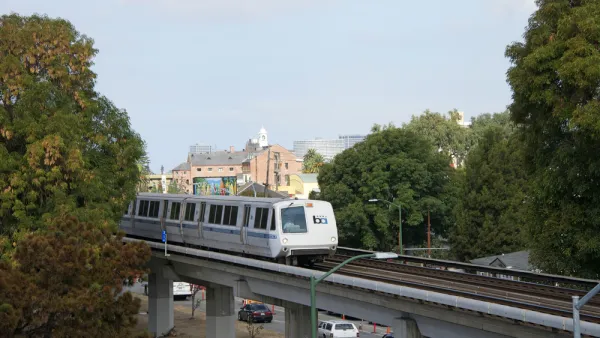
Three Transportation Ballot Measures Could Be Headed to Bay Area Voters Next Year
The California Legislature approved bills to allow voters to decide on hiking sales taxes and tolls for regional transportation. Gov. Jerry Brown already signed a bill to allow San Mateo County voters to hike sales taxes for transportation.
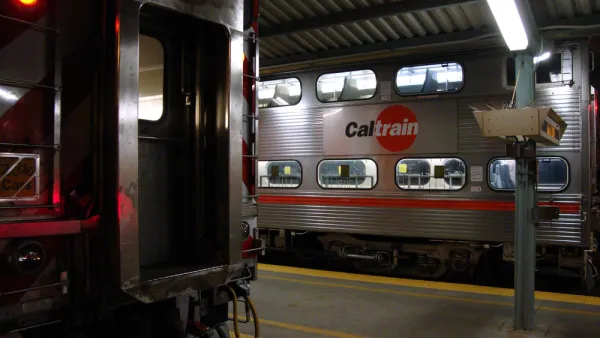
Three Bay Area Counties May Decide Whether to Support Caltrain with Sales Tax Measure
The oldest commuter rail line west of the Mississippi is also unique in another way—it lacks a dedicated source of operating revenue. Legislation has been introduced to allow Peninsula counties to vote to increase sales taxes by 0.125 percent.
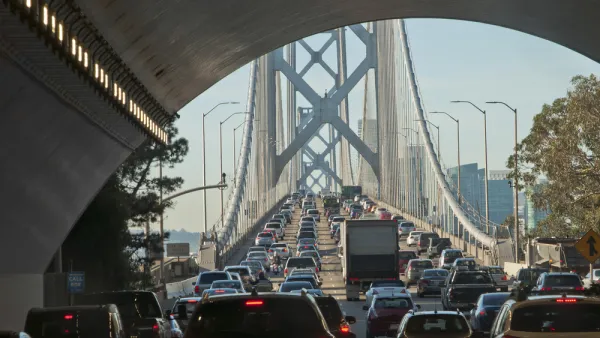
Increased Tolls for Bay Area Bridges Headed for a Vote
It is now up to the Bay Area's transportation planning agency to determine when to ask voters to hike tolls on seven Bay Area bridges, by how much, and whether to phase the increase. A bill to allow voters to fund Caltrain was also signed.

Planetizen Federal Action Tracker
A weekly monitor of how Trump’s orders and actions are impacting planners and planning in America.

Northwest rail fans eager for Sept. 30 debut of Amtrak’s Airo fleet
Get ready for that new train smell and more seats. But they won’t go faster or run more frequently on the Cascades route in Washington and Oregon.

Trump is considering data centers on 6 states' public land — some state officials say they had no idea
If the administration approves the proposed projects, data center and data center-related developments will cover 17,600 acres of public land.

After decades of planning, Sacramento gains new light rail station
Trains will arrive every 15 minutes during peak hours and every 30 minutes during non-peak hours.

Massive tunnel-boring machine breaks ground on Gateway Project
The Trump administration revoked funding for the project in October 2025, and then restored it earlier this year.

Airo trainsets begin service on Amtrak Cascades route
The trains feature panoramic windows, complementary wifi and over 300 seats per train set.

FREE Course: Walkable City 1: Why Walkability?
After describing his path towards focusing on walkability as the essence of good planning, Jeff Speck marches through his five principal reasons for making more walkable places.
Reinventing Malls: Planning Alchemy—Turning Gray Fields Into Gold
The course focuses on the opportunities and imperatives that shape reinvention of mall sites.

City of Thousand Oaks
City of Wisconsin Rapids
Harvard University Graduate School of Design
The Architects Foundation
University of Cincinnati Online
Northern Illinois Transit Authority (NITA)
The Pocatello Development Authority
The Urban Renewal Agency of the City of Pocatello