President Trump is going out of his way to ensure that the Hudson River Tunnel and other projects in the Amtrak Gateway Program don't receive federal funding in the next omnibus spending bill Congress must approve by March 23 to avoid a shutdown.


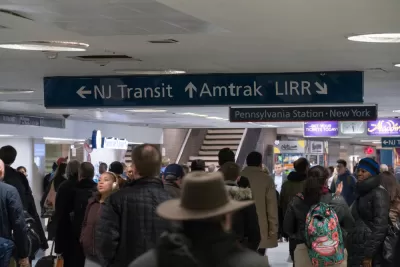
First, the U.S. Department of Transportation cast doubt on New York and New Jersey's financing plans to use federal loans to pay their share (along with the Port Authority of New York and New Jersey) of the Gateway Project, and even rejected the financial plan [pdf] itself. Then the Federal Transportation Administration downrated the program, scoring two of the projects in their second-lowest priority category. And now Mike DeBonis and Josh Dawsey of The Washington Post report on March 2 what the President did in an effort to kill the project.
"President Trump is pushing congressional Republicans not to fund a crucial infrastructure project — a long-delayed plan to build a new rail tunnel between Manhattan and New Jersey — setting up a confrontation that could complicate passage of a massive government spending bill this month," report DeBonis and Dawsey.
Trump personally appealed to House Speaker Paul D. Ryan (R-Wis.) this week to target federal funding for the $30 billion Gateway project [sic] which would construct a tunnel into New York’s Penn Station to supplement two aging tubes that are at risk of failing in the coming years.
Amtrak's Gateway Program website shows only three components of the $30 billion program: the Hudson Tunnel Project, Portal Bridge Replacement Project, and Hudson Yard Right-of-Way Preservation Project. Wikipedia shows all of them, though it lists a price tag of $20 billion.
[A]ccording to four officials familiar with the discussions, Trump has taken a personal interest in making sure no federal dollars flow to a project that is considered critical to his hometown’s long-term economic prosperity.
DeBonis and Dawsey suggest the sabotage may be political retribution for Senate Minority Leader Charles Schumer (D-N.Y.) who he blames for having stalled confirmation of "several Trump nominees, including his pick to head the Federal Railroad Administration, to protest the administration’s failure to support the [Gateway Program]."
However, it's not clear that Congress will abide by the President's wishes. The chairman of the House Appropriations Committee, Rodney Frelinghuysen (R-N.J.), "represents thousands of suburban constituents who rely on the Hudson River rail tunnels for their daily commutes to and from Manhattan." Frelinghuysen is also retiring this year.
Congressional appropriators ... are looking to spend at least $950 million in federal funds on the Gateway project in the coming omnibus spending bill. Lawmakers are expected to pass the legislation ahead of a March 23 government shutdown deadline.
The chairman of the House Appropriations Subcommittee on Transportation, Rep. Mario Diaz-Balart (R-Fla.), expressed strong support for the project. However, the projects also face opposition from other GOP congress members, and most notably, Transportation Secretary Elaine Chao.
Michael D. Shear and Patrick Mcgeehan of The New York Times also report on March 2 on the president's attempt to deny funding for the critical rail infrastructure program.
Hat tip to Mark Boshnack.
Read the full story: Trump pushes Republicans to oppose crucial New York-New Jersey tunnel project
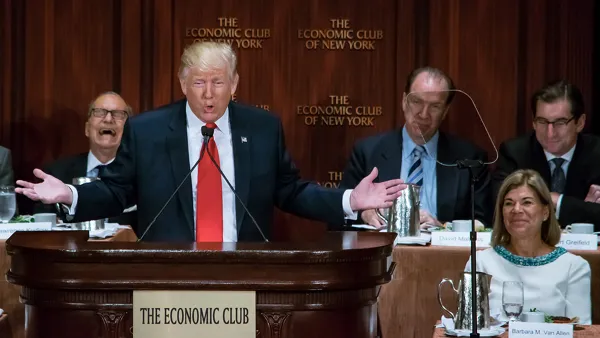
Trump Threatens Government Shutdown if Congress Funds Amtrak Gateway Tunnel
Trump's animus towards using federal funds to replace a century-old, hurricane-damaged rail tunnel under the Hudson River is so strong that he warned Congress he will veto a spending bill they must pass by March 23 to keep the government operating.
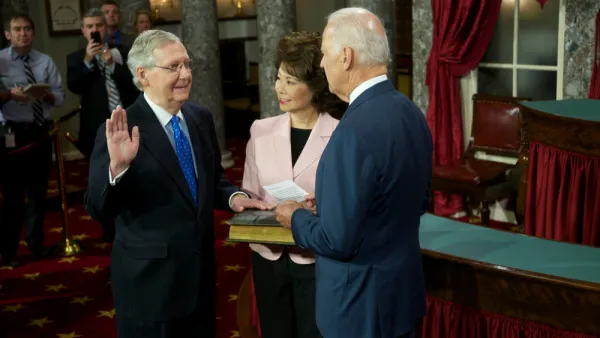
Transportation Secretary's Resignation Announcement Greeted With Derision
Transportation Secretary Elaine Chao became the first cabinet secretary to announce her resignation due to the storming of the Capitol by Trump supporters, but at least one high-profile member of congress has derided the announcement.
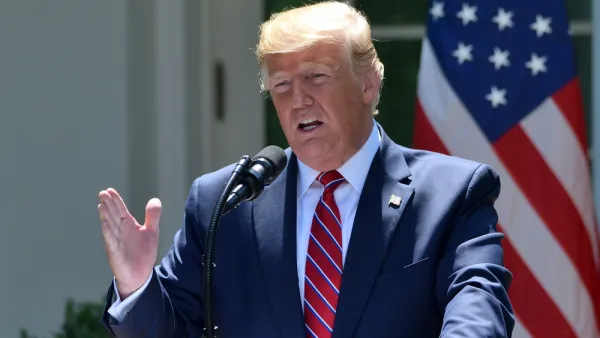
White House Could End 'Slow the Spread' Coronavirus Guidelines
President Trump signaled that he was considering lifting the public health guidelines at the end of the 15-day period on March 30 due to the severe economic impacts caused by containment strategies despite mounting deaths caused by the pandemic.

Planetizen Federal Action Tracker
A weekly monitor of how Trump’s orders and actions are impacting planners and planning in America.

California plans to bury El Niño’s downpour
If the state plays its cards right, it may be able to store a billion acre-feet of El Niño’s water in aquifers.

Desperate measures: Advocates weigh draining Lake Powell to fill Colorado River
Draining the reservoir could reduce evaporation losses by a couple hundred thousand acre-feet.

Chicago voters approve permanent festival grounds, penalty for vacant property owners
Currently, major summer and fall festivals take over public parks for weeks at a time, drawing criticism from nearby residents

NYC votes to cut outdoor dining red tape, speed up permitting
New York City also voted to allow the Department of Transportation to begin work on urgent projects before notifying elected officials.

California appears to reject Prop. 45
The proposition would have expanded the projects that qualify for a streamlined environmental review, effectively paring down the California Environmental Quality Act.

FREE Course: Walkable City 1: Why Walkability?
After describing his path towards focusing on walkability as the essence of good planning, Jeff Speck marches through his five principal reasons for making more walkable places.
Reinventing Malls: Planning Alchemy—Turning Gray Fields Into Gold
The course focuses on the opportunities and imperatives that shape reinvention of mall sites.

City of Rosemead
Rutgers University, Edward J. Bloustein School of Planning and Public Policy
One Hundred Miles
Hunter College, City University of New York (CUNY)
The Architects Foundation
University of Cincinnati Online
City of Cambridge
Montrose County
The Pocatello Development Authority