The president's Fiscal Year 2019 Budget cuts the critical Capital investment Grants program run by the Federal Transit Administration. Projects lacking a full-funding grant agreement, like the Sacramento Streetcar, may fall victim.


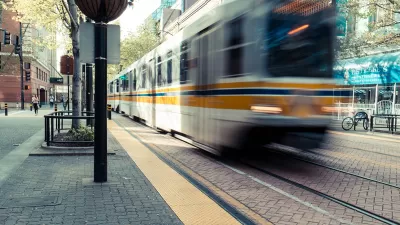
Cuts to vital transit programs included in Trump's $4.4 trillion budget for Fiscal Year 2019, unveiled Feb. 12 (along with his infrastructure plan), threaten the financial viability of the four-mile Downtown/Riverfront Streetcar Project (see map), reports Tony Bizjak for The Sacramento Bee on Feb. 13.
The city has a preliminary agreement with the federal government for $50 million, about half the amount Sacramento has been hoping the federal government will ultimately provide for the proposed $200 million streetcar.
Local property owners in Sacramento have agreed to kick in a share, along with the cities of Sacramento and West Sacramento.
The streetcar project has lots of company in seeing its federal grant eliminated in Trump's 2019 Budget proposal "that would cut the Federal Transit Administration's annual capital improvement grants by nearly $1.4 billion, eliminate the Transportation Investment Generating Economic Recovery or TIGER grant program that Congress usually funds at $500 million a year, and slash $757 million in funding for Amtrak's intercity passenger trains while pushing states to make up the difference for long-distance service in their areas," according to Paul Skoutelas, President and CEO of the American Public transportation Association (APTA).
[See Planetizen: "Downtown Pittsburgh to Oakland BRT Moving Forward, With or Without Federal Money," Feb. 16.]
What makes streetcar backers nervous is that the project lacks a signed full-funding grant agreement. "[C]ity officials are pushing for that to happen before the end of this federal fiscal year when the Trump budget would go into effect if passed by Congress," adds Bizjak.
Trump made a similar proposal in his 2017 budget. Congress, however, chose to continue funding city rail projects. The recent passage of federal tax cuts, though, is expected to put pressure on Congress to reduce spending.
Bizjak also describes how Trump's budget also threatens Regional Transit's light rail extension to the Sacramento International Airport. In addition, the Trump administration, when they unveiled their long-awaited infrastructure plan, also on Feb. 12, "indicated it wants to provide only 20 percent of the funding for major transportation projects," adds Bizjak.
“I think this is the future of federal participation,” Sacramento Area Council of Governments head James Corless said on Monday. “The writing is on the wall for us as a region to get more creative with our local funding sources.”
In 2016, [Measure B,] a half-cent sales tax increase for Sacramento County transportation fell [0.96 percent] shy of the two-thirds support necessary to pass.
Hat tip to AASHTO Journal.
FULL STORY: How Trump’s new budget threatens Sacramento’s streetcar future

Omnibus Spending Bill Will Save Transit Grant Programs—for Five Months*
Congress passed a $1.1 trillion omnibus spending bill to keep the government operating through September that also restores funding to transportation programs that the president had eliminated or greatly reduced. Trump signed the bill Friday.
Business Owners Vote to Fund Sacramento Streetcar Operations
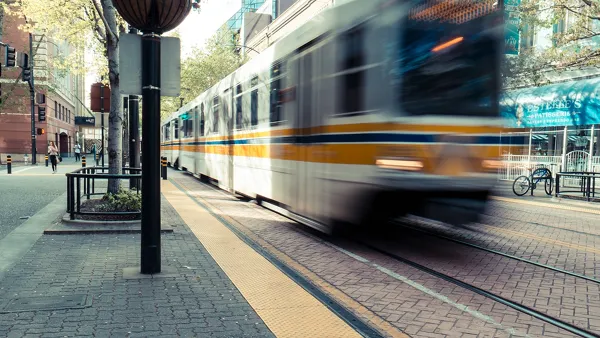
The two-thirds threshold proved to be no obstacle for Sacramento streetcar proponents in a special election held June 21, when at least *250 businesses owners voted to tax themselves to fund operations of the proposed streetcar.
Funds Directed to Transit Projects in 2017 Budget May Not Be Allocated
Funding for Caltrain electrification, which Transportation Secretary Chao approved May 22, is one of 21 transit projects receiving funding in the omnibus spending bill that may be contingent on approval from the Trump Administration.

Planetizen Federal Action Tracker
A weekly monitor of how Trump’s orders and actions are impacting planners and planning in America.

The state-sanctioned urbicide of Austin
People don’t kill cities. Freeways do.

US to reduce Colorado River water deliveries to Mexico
A new Colorado Treaty amendment reduces Mexico’s Colorado River water allocation by 250,000 acre feet.

Mamdani overhauls NYC's Vision Zero plan with 100 new policy goals
The overhaul aims to reduce traffic deaths and make streets safer for pedestrians, cyclists and drivers through lower speed limits, new safety infrastructure and more.

Amtrak not solely to blame for New Jersey commuter rail's unreliability, report finds
A new study from the Garden State Initiative found that NJ Transit’s budget grew 20% across a 4 year period, but reliability declined significantly over the same period.

EPA erases limits on planet-warming pollution from power plants
Under Monday’s plan, power plants would still have some limits on how much mercury, arsenic and other contaminants they can emit.

FREE Course: Walkable City 1: Why Walkability?
After describing his path towards focusing on walkability as the essence of good planning, Jeff Speck marches through his five principal reasons for making more walkable places.
Reinventing Malls: Planning Alchemy—Turning Gray Fields Into Gold
The course focuses on the opportunities and imperatives that shape reinvention of mall sites.

Eagle County Government
Harvard University Graduate School of Design
Nashville Planning Department
The Architects Foundation
University of Cincinnati Online
The Pocatello Development Authority
The Urban Renewal Agency of the City of Pocatello
Journal of the American Planning Association