Excessive speed is thought to be the cause of the deadly derailment on Dec. 18. Positive train control, which likely would have slowed down the train, was installed on the tracks and locomotive but was not yet operational.


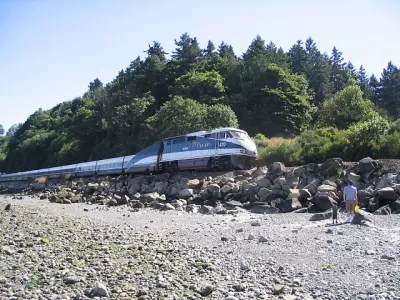
Another deadly passenger train derailment and once again, the spotlight turns to the GPS-enabled railroad safety technology known as positive train control, or PTC, that potentially could have prevented it.
In Monday's fatal crash on a highway overpass above Interstate 5 in Dupont, Wash., 50 miles south of Seattle, Amtrak #501, on its maiden trip for the new Seattle-to-Portland route of the Amtrak Cascades service, was traveling at 80 mph as it entered a curve with a 30 mph speed limit leading into the overpass.
Three people died in the derailment, including rail advocates James Hamre, 61, and Zack Willhoite, 35, his close friend. Over 70 people were injured, which includes those traveling on Interstate 5, one of the busiest highways on the West Coast. The 12-car Talgo train was carrying 80 passengers, five crew members, and one technician.
"The National Transportation Safety Board [NTSB], in preliminary findings based upon event recorder data, identified the cause of the wreck as an overspeed condition," report Stuart Chirls and William C. Vantuono for Railway Age on Dec. 20. "NTSB also cited a lapse in situational awareness [i.e., distraction] on the part of the engineer as a possible contributing factor, as there was a second person in the cab."
Positive Train Control had been installed on the right-of-way, but wasn't operational, said Geoff Patrick, spokesman for Sound Transit, which owns the right-of-way.
The locomotive, as well as the tracks, must be equipped with the GPS technology for it to work to prevent derailments and crashes. According to Washington State Department of Transportation, which administered locomotive acquisition for the Bypass of Point Defiance project, the new Siemens Charger locomotives were equipped with PTC and would be used "once the system is activated corridor-wide in 2018."
"The Amtrak Cascades train service is jointly owned by the Washington State Department of Transportation and the Oregon Department of Transportation," according to WSDOT. "Amtrak operates the service for the two states as a contractor, and is responsible for day to day operations."
[Monday] was the first day of public use of the tracks, after weeks of inspection and testing.
"To date, Amtrak has equipped 49% of its locomotives and control cars, according to Federal Railroad Administration data from the second quarter of 2017," add Chirls and Vantuono for Railway Age.
Monday's derailment comes after several high-profile derailments involving passenger rail. According to Michael Sisak and Michael Balsamo of The Associated Press, PTC had the potential to prevent at least 25 crashes over the last 20 years, including:
- Sept. 29, 2016: One dead after a New Jersey Transit train crashes into Hoboken Terminal. NTSB determined that the engineer had accelerated the train.
- May 6, 2015: Eight deaths in Amtrak 188 derailment outside of Philadelphia. Loss of situational awareness was determined to be the chief cause by NTSB.
- Dec. 1, 2013: Four deaths on a Metro-North commuter train near Spuyten Duyvil in the Bronx.
The thrust of the AP piece is that Amtrak, and presumably its partner agencies, Washington State Department of Transportation and Oregon Department of Transportation, were in too much of a rush to begin service on the new route, potentially to meet deadlines set by the American Recovery and Reinvestment Act of 2009 for funding the $180.7 million bypass project.
WSDOT is investing nearly $800 million of ARRA High Speed High-Speed Intercity Passenger Rail funds throughout the state.
Railroads, both freight and passenger, are required to have PTC installed by "December 31, 2018, with the possibility for two additional years if certain requirements are met," according to the Federal Railroad Administration.
Hat tips to Clyde Anderson and Los Angeles County Metropolitan Transportation Authority Research Library & Archive:
FULL STORY: UPDATED DEC. 20: Overspeed cause of Amtrak Cascades fatal derailment


The state-sanctioned urbicide of Austin
People don’t kill cities. Freeways do.

US to reduce Colorado River water deliveries to Mexico
A new Colorado Treaty amendment reduces Mexico’s Colorado River water allocation by 250,000 acre feet.

New Jersey’s second-largest city bans standalone data centers
Jersey City will continue to allow co-location facilities, such as those meant for research institutions that store their own data.

Amtrak not solely to blame for New Jersey commuter rail's unreliability, report finds
A new study from the Garden State Initiative found that NJ Transit’s budget grew 20% across a 4 year period, but reliability declined significantly over the same period.

EPA erases limits on planet-warming pollution from power plants
Under Monday’s plan, power plants would still have some limits on how much mercury, arsenic and other contaminants they can emit.

Phoenix announces new on-demand transit service, more frequent RAPID buses
Both new services will launch in October, and are part of Phoenix's Project Effective Access Solutions for Easing Congestion.

FREE Course: Walkable City 1: Why Walkability?
After describing his path towards focusing on walkability as the essence of good planning, Jeff Speck marches through his five principal reasons for making more walkable places.
Reinventing Malls: Planning Alchemy—Turning Gray Fields Into Gold
The course focuses on the opportunities and imperatives that shape reinvention of mall sites.


Eagle County Government
Harvard University Graduate School of Design
Nashville Planning Department
The Architects Foundation
University of Cincinnati Online
The Pocatello Development Authority
The Urban Renewal Agency of the City of Pocatello
Journal of the American Planning Association