Disaster struck New Jersey Transit commuters at 8:38 AM on Sept. 29 when train #1614 failed to stop at the end ot the track and slammed into the wall, then the ceiling of the historic station, killing at least one person and injuring up to 100.


"The cause of the crash at [Hoboken Terminal] was not immediately known," reports Berkeley Lovelace Jr. for CNBC. "NBC New York said authorities believe the crash may have resulted from operator error but stressed that the investigation was preliminary."
The New Jersey Transit was not equipped with the positive train control technology that slows down trains when they exceed the speed limit, NBC News reported. Initial reports indicated that the train did not slow down as it entered the station.
The National Transportation Safety Board said Thursday officials will be looking into the positive train control technology and also for similarities between Thursday morning's crash and one in 2011 at the same station, Reuters reported. [NTSB briefing via YouTube].
However, the 2011 crash involved a Port Authority Trans-Hudson (PATH) subway train, not a commuter train, reports J.D. Durkin for Mediaite.com.
The historic station is the second busiest transportation facility in the Garden State after Newark Airport. Passengers arriving on the New Jersey Transit Pascack Valley Line train from Spring Valley, along with passengers from seven other NJ Transit commuter lines [see map] and one Metro-North line, could transfer to:
- NY Waterway Hudson River Ferries to New York
- Hudson-Bergen Light Rail
- Two Port Authority Trans-Hudson (PATH) heavy rail lines to New York
- NJ Transit buses
"The landmark Hoboken Terminal, one of the metropolitan's major transportation hubs, underwent a $115 million renovation project 10 years ago," reports Ron Zeitlinger of The Jersey Journal.
The building, built in 1907 and owned by New Jersey Transit, underwent more renovations after it was flooded in superstorm Sandy in 2012.
This morning's crash caused major damage to the interior of the terminal and there was a partial roof collapse as well.
According to a NJ Transit commuter alert, "All [commuter] rail service into and out of Hoboken Terminal remains suspended. All Hudson Bergen Light Rail service into and out of Hoboken station remains suspended."
A PATH press release indicates that service will resume at 3 PM on Thursday, Sept. 29.
NJ Transit operates the second busiest commuter rail system in the U.S. after the Long Island Rail Road. Direct rail service to New York Penn Station is available from Secaucus Junction. See map below.
Related Planetizen coverage:
- Railroads Given Three More Years to Install Positive Train Control, October 24, 2015
- Positive Train Control Set to Revolutionize Railroad Safety, February 14, 2012

Read the full story: Hoboken train crash kills 1, injures 108, Gov. Chris Christie says
Black Box Showed What, but Not Why, for the New Jersey Transit Crash
The National Transportation Safety Board has determined that the minute before the Sept. 29 crash, the engineer suddenly accelerated, hurling the train into the wall of Hoboken Terminal, killing one person. They will work to find out why.
Amtrak Crash Shuts Down Northeast Corridor Service on Sunday Morning
An Amtrak train that originated in Boston and headed to Savannah, Ga. struck a backhoe working on tracks about 15 miles southwest of Philadelphia. Two Amtrak construction workers in or near the backhoe were killed; 31 train passengers were injured.
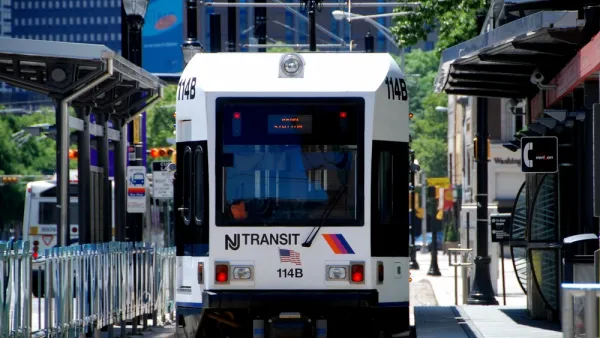
The Recent Decline of New Jersey Transit's Commuter Rail Operations
The New York Times looks into the decline of New Jersey Transit commuter railroad, rated as outstanding only nine years ago. Much of the decline can be traced to decisions by the Christie administration beginning in 2010.

Planetizen Federal Action Tracker
A weekly monitor of how Trump’s orders and actions are impacting planners and planning in America.

Eastern Nebraska is running out of electricity
Data centers and electrification are straining eastern Nebraska’s grid, throttling economic development.

Move over, LA: St. Louis gears up for Olympics, invests millions in downtown redevelopment
The Missouri city will host the 2028 Olympic soccer group stage and knockout matches.

Dallas releases zoning code overhaul to officials
The drafted overhaul is over 400 pages long.

NYC renovations for dangerous, ‘mercilessly crammed’ street delayed until 2027
Construction was supposed to begin this fall.

San Diego’s Midway Rising project gets greenlight from city council
The project looks to become the largest affordable housing development in California's history.

FREE Course: Walkable City 1: Why Walkability?
After describing his path towards focusing on walkability as the essence of good planning, Jeff Speck marches through his five principal reasons for making more walkable places.
Reinventing Malls: Planning Alchemy—Turning Gray Fields Into Gold
The course focuses on the opportunities and imperatives that shape reinvention of mall sites.

City of Rosemead
Rutgers University, Edward J. Bloustein School of Planning and Public Policy
One Hundred Miles
University of Michigan School for Environment and Sustainability (SEAS)
Hunter College, City University of New York (CUNY)
The Architects Foundation
City of Cambridge
The Pocatello Development Authority
The Urban Renewal Agency of the City of Pocatello