This story begins and ends with a freeway.


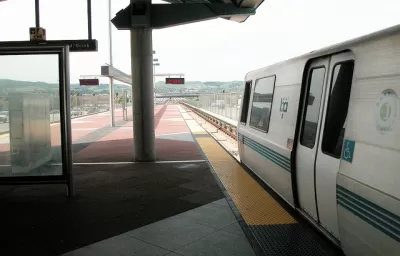
Alon Levy critiques the plan for a new BART extension proposed for the city of Livermore, located on the suburban fringe of the East Bay Area. According to Levy's argument, the new extension continues BART's focus on suburban service, which limits ridership relative to the other U.S. rail transit system of comparative scope (i.e., the Metrorail system of the Washington, D.C. region).
In 2006, transit expert Christof Spieler, now serving on the board of Houston METRO, compared the two systems, writing that BART mostly serves the suburbs, whereas the Washington Metro serves both the suburbs and the urban core. Unfortunately, BART's plans for expansion keep prioritizing suburban service. The best example of this is the extension to Livermore, for which BART released the environmental reviews on Monday.
According to Levy's critique, the Livermore BART extension's fatal mistake is in its route down the I-580 Freeway. According to Levy, "[f]reeway running is not common on the highest-performance urban rail systems, because nobody wants to live, work, or play right next to a freeway. People prefer living a few minutes by car from the freeway for easy access." It's freeway alignment means this BART extension is already doomed to low ridership, especially in off-peak hours.
But low expected ridership is not the only flaw Levy finds with the Livermore BART extension, there's also high costs—per rider, the cost is expected to be four times as expensive as the recently completed Second Avenue Subway in New York City.
Read the full story: Livermore BART is the Most Expensive Disaster Ever

BART Extension Kerfluffle: East Bay Officials Pushing for New Rail Authority
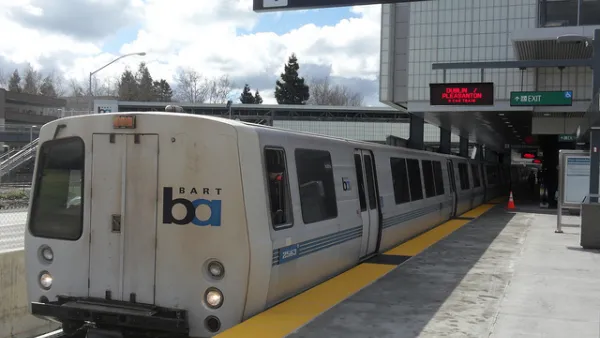
If the city of Livermore and several state legislators gets their way, a proposed extension of BART to the city of Livermore would be planned and built by the Tri Valley-San Joaquin Valley Regional Rail Authority.
BART’s Phase II Extension Into San Jose Ready to Go
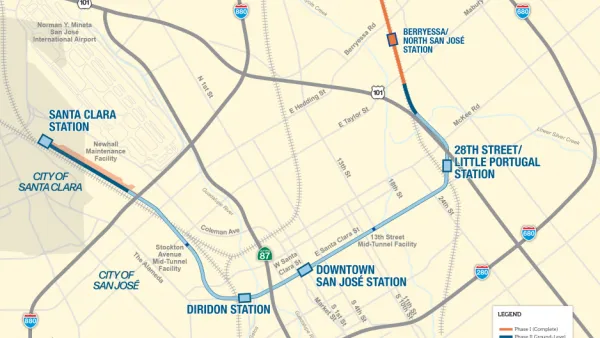
A long-awaited extension of the Bay Area’s regional rail transit system is finally coming into view, with an expected completion date of 2030.
BART Board of Directors Votes Down Livermore Extension
A controversial vote sets a "fix it first" agenda for regional transit planning—the implications of this decision could potentially reach far beyond the scope of this single project.

Planetizen Federal Action Tracker
A weekly monitor of how Trump’s orders and actions are impacting planners and planning in America.

‘Going backwards:’ Baltimore mayor, students rally against state's transit funding plan
Maryland's proposed six-year plan provides no funding for Baltimore’s BMORE bus program and reduces its road maintenance funding.

Detroit to transform waterfront with $2.2 billion investment
Developers will convert about 18 acres of unused parking lot space into civic spaces.

Newsom vetoes high-speed rail supervision bill after agency receives condemnatory audit
The audit found the CHSRA approved almost $600,000 in unallowable travel expenses.

Nation sees first electric plane-boat hybrid take off in public demo
The Viceroy Seaglider can fly at speeds of 180mph for up to 180 miles.

One of nation’s poorest counties to receive $6 billion data center
The developers estimate the project will create 200 permanent jobs and 1,000 temporary construction jobs.

FREE Course: Walkable City 1: Why Walkability?
After describing his path towards focusing on walkability as the essence of good planning, Jeff Speck marches through his five principal reasons for making more walkable places.
Reinventing Malls: Planning Alchemy—Turning Gray Fields Into Gold
The course focuses on the opportunities and imperatives that shape reinvention of mall sites.

City of Thousand Oaks
City of Wisconsin Rapids
Harvard University Graduate School of Design
The Architects Foundation
University of Cincinnati Online
Northern Illinois Transit Authority (NITA)
The Pocatello Development Authority
The Urban Renewal Agency of the City of Pocatello