A week ago, Secretary of Transportation Elaine Chao indicated she would not sign-off on the $647 million federal grant for the $2 billion Caltrain electrification project. On Monday, she changed her mind.


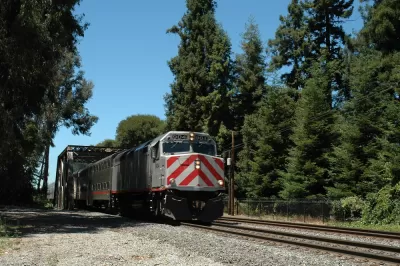
Back in February, California's GOP congressional delegation wrote the U.S. Department of Transportation asking them to delay a vital $647 million grant needed to electrify the 51-mile, San Francisco-to-San Jose commuter line on which 92 diesel-powered commuter trains operate daily. The reason: high-speed rail, a project they uniformly detest, would share the tracks.
It worked—Transportation Secretary Elaine Chao deferred signing the full funding federal grant agreement (FFGA).
While Congress directed the DOT to approve the electrification project and designated $100 million in the $1.1 trillion omnibus spending bill signed by President Trump on May 5, it was still contingent on Chao signing the FFGA. And last week, at a May 17 hearing of the Senate Environment and Public Works committee, she showed no change of mind, and referred back to the Republican delegation's letter for one of the reasons, reported Casey Tolan for The Mercury News.
“It is an issue I think the California delegation needs to come together and discuss, because there seems to be split opinions on this project.”
But on May 22, Chao saw the light, and "[l]ocal leaders applauded the decision," report Tolan and Katy Murphy for The Mercury.
“This is all the major holidays wrapped into one with a beautiful Caltrain bow around it," remarked Silicon Valley leadership Group CEO Carl Guardino.
Both the Silicon Valley Leadership Group and the Bay Area Council, another business group, were among the state's leaders, including Gov. Jerry Brown, the state's Democratic congressional delegation, and Bay Area elected officials that Jim Hartnett, General Manager and CEO of Caltrain, thanked in a statement.
“This is a win for everyone involved,” Sen. Dianne Feinstein, D-California, said in a statement. “Caltrain’s fleet of diesel trains are at the end of their useful life. Now is the time to replace these outdated, dirty diesel trains with a cleaner, modern electric fleet.”
On May 15, Senator Feinstein had warned that she would "oppose the confirmation of every Transportation Department nominee until the Trump administration funds California's electric train," reported the Los Angeles Times. But the next day, Jeffrey A. Rosen was confirmed as deputy secretary of U.S. Department of Transportation.
With Chao's signature, the aforementioned $100 million will be sent to Caltrain, and the remaining $547 million will be included in future Congressional appropriations.
As to why the change of heart, one can only speculate, but the reasons for approving it were evident from the get-go: It's a "shovel-ready" project producing almost 10,000 jobs throughout the United States, just the type of project that would fit into Trump's infrastructure plan.
Work in the corridor is set to begin this summer. Caltrain was forced to spend $20 million to extend contracts with engineering firms to June 30 after Chao deferred signing the FFGA in February, notes Samantha Weigel for the San Mateo Daily Journal.
Modernizing the rail line will nearly double ridership capacity to 110,000 and save an estimated 619,000 vehicle miles every day by removing cars off the increasingly congested Highway 101 and Interstate 280, according to Caltrain. It will also reduce commute times from San Jose to San Francisco by nearly 15 percent.
"The first electric trains are anticipated to be in service end of 2020 / early 2021," according to Caltrain. It's about time for the line that traces back to 1863.
FULL STORY: Feds approve grant for Caltrain electrification project

Caltrain Electrification Broke Ground on Friday
Gov. Jerry Brown, Peninsula congresswomen, including House Minority Leader Nancy Pelosi, and state legislative leaders gathered in Millbrae with shovels-in hands to mark the beginning of a four-year construction project to electrify Caltrain.
Trump's California Double Play: Potential Fatal Blow to Commuter and High-Speed Rail
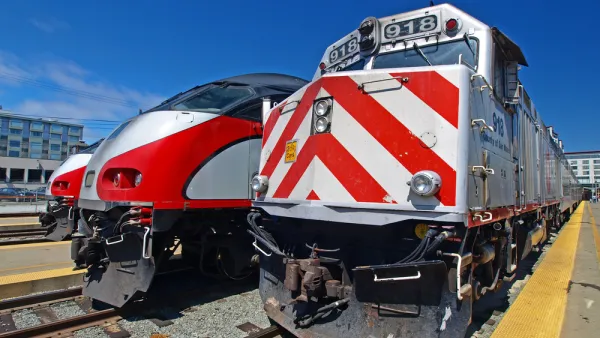
In one of her first major decisions, Transportation Secretary Elaine Chao deferred a decision on a critical $647 million federal grant to electrify the 51-mile San Francisco to San Jose Caltrain line, which would also be used by high-speed rail.
Three Bay Area Counties May Decide Whether to Support Caltrain with Sales Tax Measure
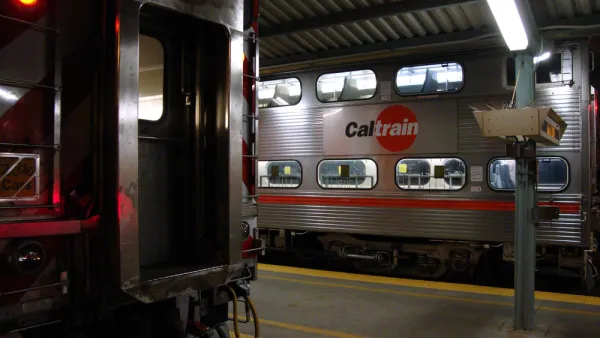
The oldest commuter rail line west of the Mississippi is also unique in another way—it lacks a dedicated source of operating revenue. Legislation has been introduced to allow Peninsula counties to vote to increase sales taxes by 0.125 percent.

The state-sanctioned urbicide of Austin
People don’t kill cities. Freeways do.

US to reduce Colorado River water deliveries to Mexico
A new Colorado Treaty amendment reduces Mexico’s Colorado River water allocation by 250,000 acre feet.

New Jersey’s second-largest city bans standalone data centers
Jersey City will continue to allow co-location facilities, such as those meant for research institutions that store their own data.

Amtrak not solely to blame for New Jersey commuter rail's unreliability, report finds
A new study from the Garden State Initiative found that NJ Transit’s budget grew 20% across a 4 year period, but reliability declined significantly over the same period.

EPA erases limits on planet-warming pollution from power plants
Under Monday’s plan, power plants would still have some limits on how much mercury, arsenic and other contaminants they can emit.

Phoenix announces new on-demand transit service, more frequent RAPID buses
Both new services will launch in October, and are part of Phoenix's Project Effective Access Solutions for Easing Congestion.

FREE Course: Walkable City 1: Why Walkability?
After describing his path towards focusing on walkability as the essence of good planning, Jeff Speck marches through his five principal reasons for making more walkable places.
Reinventing Malls: Planning Alchemy—Turning Gray Fields Into Gold
The course focuses on the opportunities and imperatives that shape reinvention of mall sites.

Eagle County Government
Harvard University Graduate School of Design
Nashville Planning Department
The Architects Foundation
University of Cincinnati Online
The Pocatello Development Authority
The Urban Renewal Agency of the City of Pocatello
Journal of the American Planning Association