Legislation proposed by San Francisco Assemblyman David Chiu would authorize a red camera pilot program to last five years and apply only to the two cities. California lacks laws permitting automated speed enforcement.


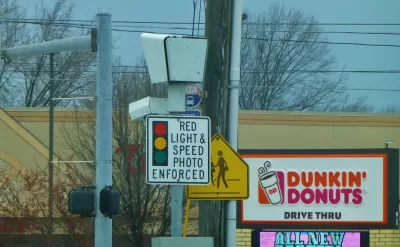
Speaking at San Francisco General Hospital on Feb. 8, "where five victims of car collisions are treated daily," according to Michael Cabanatuan of the San Francisco Chronicle, Assemblymember David Chiu, D-San Francisco, was joined by San Francisco Mayor Ed Lee, San Jose Mayor Sam Liccardo, the San Francisco Municipal Transportation Agency (SFMTA), traffic injury victims, surviving family members, and other officials and advocates to announce Assembly Bill 342, the Safe Streets Act of 2017.
"Chiu said automated speed enforcement, which is already used in 142 other communities across the country, has been proven to reduce speeding, change driver behavior and reduce crashes leading to injuries and deaths," reports Vic Lee for ABC 7 News.
"Speed is the single biggest factor in predicting whether someone will survive a vehicle crash", Chiu said.
According to the Governors Highway Safety Association, "12 states, plus the District of Columbia and the U.S. Virgin Islands have speed cameras currently operating in at least one location."
While California law allows the operation of red light cameras, it is one of 28 states that have no laws addressing speed cameras, according to GHSA.
"This measure would amend the California Vehicle Code to authorize on a pilot basis the use of Automated Speed Enforcement (ASE) in both the City and County of San Francisco and the City of San Jose," according to Chiu's office. "The goal of the program is to address excessive speeding as a major factor in traffic injuries and deaths."
"As a county, San Francisco ranks highest in per capita traffic collision fatalities and per capita severe traffic injuries in California," according to the San Francisco Municipal Transportation Agency. "Excessive speeding is largely to blame for this."
Speed cameras would help Vision Zero SF and Vision Zero San Jose meet their goals of eliminating traffic fatalities by 2024.
Mayor Lee had advocated for automated speed enforcement last year but was unable to find a legislator to propose legislation, according to The Chronicle's Matier & Ross (posted here).
"San Jose previously operated an automated speed enforcement camera program from 1996 to 2007, but suspended the program in the face of legal challenges and a lack of support from state legislators," adds ABC's Lee.
"How ironic, that here in the heart of Silicon Valley, the law does not allow us to use this critical technology," Mayor Sam Liccardo said.
Where does your state stand with automated traffic enforcement laws? Scroll down the GHSA webpage to click on your state to see if it has laws permitting the operation of:
- Red light cameras
- Speed cameras
- Rail crossing cameras
According to GHSA, "13 states have passed laws that prohibit (with very narrow exceptions) the use of speed cameras."
Read the full story: San Francisco, San Jose May Use Automated Speed Enforcement Cameras

Virginia to Launch Innovative New Anti-Speeding Pilot Program
The state of Virginia's new traffic safety program will focus on speeding as fatal factor in automobile collisions and could eventually provide a model for similar programs around the country.
Gov. Cuomo Signs Street Safety Legislation For New York City on Mother's Day
Gov. Andrew M. Cuomo took his mother to work on Sunday so she could join him in a panel where he signed life-saving, street safety legislation to reinstate and expand the school zone speed camera program in New York City.
As San Francisco Debates Idaho Stop, Gov. Brown Gives All Cyclists a Break
Regardless of how San Francisco's proposed Bike Yield Law fares, all California cyclists who are ticketed for not stopping at stop signs may have the option to pay a reduced fine if they opt to attend bike school thanks to a new law signed Sept. 21.

Planetizen Federal Action Tracker
A weekly monitor of how Trump’s orders and actions are impacting planners and planning in America.

California plans to bury El Niño’s downpour
If the state plays its cards right, it may be able to store a billion acre-feet of El Niño’s water in aquifers.

Chicago breaks ground on $3 billion megadevelopment
The new neighborhood, titled Foundry Park, will one day host 3,700 residences.

California High-Speed Rail Authority CEO resigns after $600,000 scandal
Under Ian Choudri, the authority used taxpayer dollars to fund first class flights and trips to nightclubs.

Want to study the Missouri River? Soon, you may need unanimous approval from 10 states
Legislation would require 10 governors’ permission to study or build projects moving water outside the basin.

Desperate measures: Advocates weigh draining Lake Powell to fill Colorado River
Draining the reservoir could reduce evaporation losses by a couple hundred thousand acre-feet.

FREE Course: Walkable City 1: Why Walkability?
After describing his path towards focusing on walkability as the essence of good planning, Jeff Speck marches through his five principal reasons for making more walkable places.
Reinventing Malls: Planning Alchemy—Turning Gray Fields Into Gold
The course focuses on the opportunities and imperatives that shape reinvention of mall sites.

City of Rosemead
Rutgers University, Edward J. Bloustein School of Planning and Public Policy
One Hundred Miles
Hunter College, City University of New York (CUNY)
The Architects Foundation
University of Cincinnati Online
City of Cambridge
Montrose County
The Pocatello Development Authority