Gov. Andrew M. Cuomo took his mother to work on Sunday so she could join him in a panel where he signed life-saving, street safety legislation to reinstate and expand the school zone speed camera program in New York City.


In an email titled, "To all the mothers in New York," sent, appropriately, on Mother's Day, the New York State governor writes, "Earlier today my mother joined me to sign life-saving legislation to expand camera speed zones in New York City."
"Speed cameras work - it is just undeniable," states Gov. Andrew M. Cuomo in the video of the panel discussion on May 12 that preceded his signing two bills, S.4331 by Sen. Andrew Gounardes (D-Brooklyn) and A.6449 by Assemblymember Deborah J. Glick (D-Manhattan), to continue and expand the operation of photo speed violation monitoring systems in school speed zones in New York City.
Since the activation of the cameras, the number of people killed or severely injured in crashes in school zones with speed cameras declined by 21 percent, and the rate of daily violations for excessive speeding has declined by over 60 percent.
"This bill will increase the number from 140 to 750 speed cameras in the city, extend the hours of operation of the speed cameras and will mandate that the city prioritize placement of the cameras by speed and crash data," states Cuomo.
A 2015 post about a study on the effectiveness of speed cameras in Montgomery County, Md., confirms Cuomo's afore-mentioned assertion.
“Speed cameras get drivers to ease off the accelerator, and crashes are less likely to be deadly at lower speeds,” said Insurance Institute for Highway Safety President Adrian Lund. “This study connects the dots to show that speed cameras save lives.”
The governor's press release (source article) recounts the legislative history of this particular type of automated traffic enforcement.
This legislation reinstates and expands a bill signed by the Governor in 2013 authorizing the city to develop the program using camera technology to record and enforce speeding violation in school zones. Upon the program's expiration in July 2018, and after the Republican-controlled Senate failed to extend the authority before the end of the legislative session, Governor Cuomo signed an executive order [declaring a "state of emergency"] allowing the city to impose the same fines authorized under the expired law and access data from the DMV to carry out the program for the 2018-19 school year.
Also on the panel was Amy Cohen, a safe streets activist who lost her 12-year-old son in a traffic crash in 2013 in Park Slope, Brooklyn, and now works with Families for Safe Streets and Transportation Alternatives to fight for safer streets.
"This is a historic moment recognizing that traffic violence is preventable, and it could never have happened without the leadership of Gov. Cuomo," said Cohen.
California bill stalled
On the West Coast, speed camera legislation that would have authorized a pilot program in Northern California's two largest cities, San Jose and San Francisco, was DOA at its second committee hearing in January 2018. California lacks laws permitting automated speed enforcement, notes an earlier post on the bill.
Related on Planetizen:
-
San Francisco and San Jose Propose Joint Pilot Program for Speed Cameras, February 11, 2017
-
Speed Cameras Have Proven Record of Reducing Speeding, New Study Says, September 3, 2015

San Francisco and San Jose Propose Joint Pilot Program for Speed Cameras
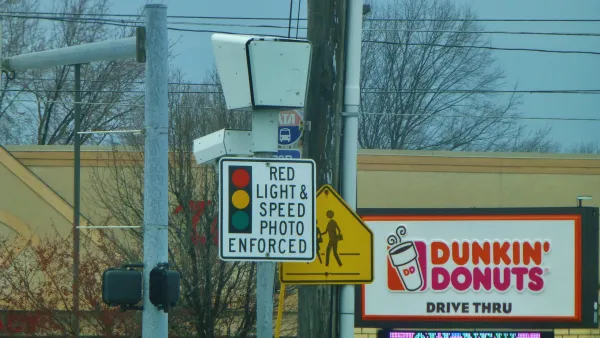
Legislation proposed by San Francisco Assemblyman David Chiu would authorize a red camera pilot program to last five years and apply only to the two cities. California lacks laws permitting automated speed enforcement.
Speed Cameras Have Proven Record of Reducing Speeding, New Study Says
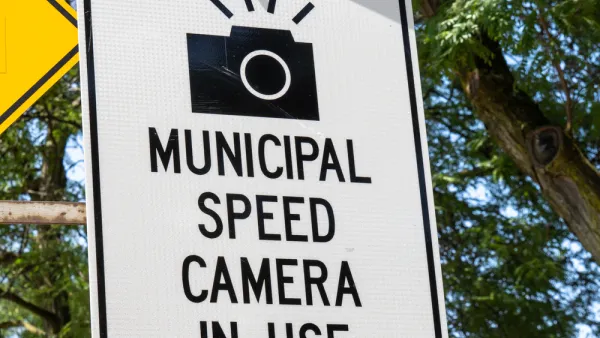
A study released by the Insurance Institute for Highway Safety on September 1 showed steep reductions in speeding in Montgomery County, Maryland, where speed cameras has been in effect since 2007, reducing fatalities and severity of injuries.
More Evidence That Speed Cameras Slow Traffic Speeds
File under: not a cash grab.

Planetizen Federal Action Tracker
A weekly monitor of how Trump’s orders and actions are impacting planners and planning in America.

The state-sanctioned urbicide of Austin
People don’t kill cities. Freeways do.

US to reduce Colorado River water deliveries to Mexico
A new Colorado Treaty amendment reduces Mexico’s Colorado River water allocation by 250,000 acre feet.

Baltimore to break ground on $50 million Transit Priority Project
The project will bring faster bus trips, safer streets and better bike connections to Baltimore.

Airbnb launches $250 million 'last-dollar financing' housing accelerator, makes first investment in Austin
The company will put $6.4 million towards affordable housing development in Texas’ capital.

Guerilla urbanists are building DIY bus stop benches in Chicago
A before-and-after of one of the bus stops with a new bench. The new benches are not officially sanctioned or permitted, but the residents who placed them hope they will be the start of a network of DIY benches across the city.

FREE Course: Walkable City 1: Why Walkability?
After describing his path towards focusing on walkability as the essence of good planning, Jeff Speck marches through his five principal reasons for making more walkable places.
Reinventing Malls: Planning Alchemy—Turning Gray Fields Into Gold
The course focuses on the opportunities and imperatives that shape reinvention of mall sites.

Eagle County Government
Harvard University Graduate School of Design
Nashville Planning Department
The Architects Foundation
University of Cincinnati Online
The Pocatello Development Authority
The Urban Renewal Agency of the City of Pocatello
Journal of the American Planning Association