Will a carbon tax have a better chance of success at the federal level if Republicans propose it? We're about to find out.


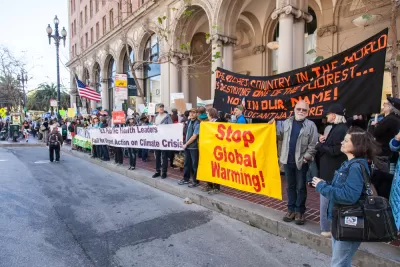
"A group of Republican elder statesmen are calling for a tax on carbon emissions to fight climate change," reports John Schwartz.
"The group, led by former Secretary of State James A. Baker III, with former Secretary of State George P. Shultz and Henry M. Paulson Jr., a former secretary of the Treasury, says that taxing carbon pollution produced by burning fossil fuels is 'a conservative climate solution' based on free-market principles," adds Schwartz.
As for the political clout the group holds in today's Washington, D.C., Baker is scheduled to meet with Trump Administration advisors at the White House to discuss the proposal this week.
"The Baker proposal would substitute the carbon tax for the Obama administration’s Clean Power Plan," according to Schwartz in offering more details on the proposal. "At an initial price of $40 per ton of carbon dioxide produced, the tax would raise an estimated $200 billion to $300 billion a year, with the rate scheduled to rise over time."
As mentioned by Schwartz, another prominent former White House official, former presidential candidate and Vice President Al Gore, is also a proponent of the carbon tax as a means to address the threats of climate change. Another former presidential candidate, Mitt Romney, chimed in on the proposal as well.
Thought-provoking plan from highly respected conservatives to both strengthen the economy & confront climate risks: https://t.co/U6kmrQTPth
— Mitt Romney (@MittRomney) February 8, 2017
Read the full story: A Conservative Climate Solution:’ Republican Group Calls for Carbon Tax
Washington Voters Keep Carbon Tax
An initiative that would have ended the state’s “cap and invest” program failed, leaving the program in place.

America’s 10 ‘Greenest’ Cities
A new analysis ranks cities based on their environmental quality, energy consumption and production, transportation, density, and other factors.
Supreme Court Guts the U.S. EPA’s Ability to Limit Carbon Emissions
The consequences of this ruling have long been foretold. With the U.S. Environmental Protection Agency now officially barred from the fight against climate change, Congress will have to act to reduce carbon emissions.

Planetizen Federal Action Tracker
A weekly monitor of how Trump’s orders and actions are impacting planners and planning in America.

Eastern Nebraska is running out of electricity
Data centers and electrification are straining eastern Nebraska’s grid, throttling economic development.

Washington state to charge fee to drivers with fuel-efficient cars
Revenue from the fee will go towards supporting the state’s highways.

Instead of building new housing, LA developers are turning mansions into mega-mansions
In the richest areas, the number of houses valued at $30 million with demolition permits has skyrocketed since 2018.

Illinois considers spending $1 billion in taxpayer money on data center
A quantum computing campus and data center are currently under construction in Chicago.

As development costs rise, Boston moves to lessen affordable housing requirements
The Boston Zoning Commission and the City Council still need to approve Boston Mayor Michelle Wu’s proposed changes

FREE Course: Walkable City 1: Why Walkability?
After describing his path towards focusing on walkability as the essence of good planning, Jeff Speck marches through his five principal reasons for making more walkable places.
Reinventing Malls: Planning Alchemy—Turning Gray Fields Into Gold
The course focuses on the opportunities and imperatives that shape reinvention of mall sites.

City of Charlotte
City of Rosemead
Rutgers University, Edward J. Bloustein School of Planning and Public Policy
University of Michigan School for Environment and Sustainability (SEAS)
Hunter College, City University of New York (CUNY)
The Architects Foundation
City of Cambridge
The Pocatello Development Authority
The Urban Renewal Agency of the City of Pocatello