One of the key assumptions of a new partnership between the planning and public health professions is that transit encourages more active mobility than possible with a car-centric lifestyle. But new research casts doubt on those assumptions.


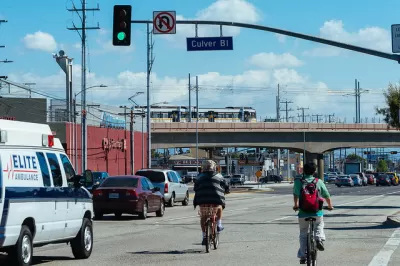
"New findings by the University of Southern California and UC Irvine published in Transportation Research should give 'walkability' proselytizers some pause," according to an article by Laura Bliss. "This is one of the most comprehensive studies to date examining how access to light rail influences physical activity, and it found that having rapid transit nearby can boost steps for some—but can decrease them for others."
The study focused on physical activity by 200 participants living near Phase I of the new Expo Line in Los Angeles, which opened in 2012. According to Bliss, researchers found that although transit use increased after the new line opened, "there didn’t seem to be a significant jump in how physically active they were." When controlling for how physically active the subjects were to begin with, "individuals who were already pretty active turned out to be somewhat negatively affected by light rail access."
Bliss provides additional details on the finding of the study, and also noted how the experimental approach of this study differs from the cross-sectional approach of many previous studies that "found strong correlations between physical activity and transit use."
Read the full story: When Light Rail Opens, Do People Really Get More Exercise?


How Long Covid Changes the Transportation Conversation
People living with long Covid symptoms can find themselves unable to make the same mobility choices they used to.

Federal Plan Takes Aim at Transportation Emissions
The U.S. National Blueprint for Transportation Decarbonization is designed to guide federal investment and regulations, focusing on electrification with a nod to transit investment and walkability.
Comparing the Progress of Cities in Providing Alternatives to the Car Commute
A new online tool allows cities to measure progress in providing access to alternative forms of transportation.

Planetizen Federal Action Tracker
A weekly monitor of how Trump’s orders and actions are impacting planners and planning in America.

Amtrak, CN end decades-long dispute with eight-year agreement
The new operating agreement establishes an updated framework for the companies to work together, including processes to resolve disputes.

Judges permit Denver to divert 77,000 acre feet from the Colorado River for reservoir expansion
Overuse and climate change have caused the Colorado River’s water levels to plummet.

NYC DOT wants faster, more permanent street upgrades
The city is examining ways to build more concrete infrastructure without getting entangled in 'decades-long' projects.

'Something we’ve never seen before:' rising utility rates could strain city finances nationwide
Data centers, climate change and other factors have caused utility rates in the United States to increase by 38% since 2020.

Trump to overrule local leaders, lease millions of acres of America’s Pacific Island territories’ seafloors to mining companies
International law says that the Indigenous people of America’s territories have a right to prior and informed consent regarding projects that impact their countries.

FREE Course: Walkable City 1: Why Walkability?
After describing his path towards focusing on walkability as the essence of good planning, Jeff Speck marches through his five principal reasons for making more walkable places.
Reinventing Malls: Planning Alchemy—Turning Gray Fields Into Gold
The course focuses on the opportunities and imperatives that shape reinvention of mall sites.

Harvard University Graduate School of Design
KFH Group Inc.
Greater Baltimore Committee
The Architects Foundation
University of Cincinnati Online
The Pocatello Development Authority
The Urban Renewal Agency of the City of Pocatello