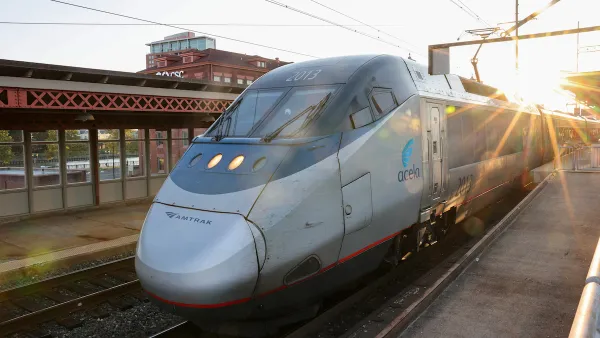
Amtrak will replace, rather than overhaul, aging Acela trains with new, 186-mph trains from French manufacturer, Alstom, though they won't exceed 160 mph. The agreement was announced Friday by VP Joe Biden at Biden Station, Wilmington, Del.


"This loan is a key step to providing investments needed to help keep high speed trains moving throughout the region, and to help all commuters in the Northeast Corridor," Vice President Biden said. "We need these kinds of investments to keep this region – and our whole country – moving, and to create new jobs."
It is the largest loan made by the U.S. Department of Transportation, financed through the Federal Rail Administration's Railroad Rehabilitation & Improvement Financing program.
The trains are named "Avelia Liberty, the latest development of Alstom’s high-speed train range Avelia," according to Alstom. "The new trainset will be able to carry up to 33% more passengers than the current Acela trains."
Another key feature is the train’s articulated architecture, which provides greater stability and passenger comfort while enhancing safety. The train also includes Alstom’s innovative Tiltronix anticipative tilting technology, which allows the train to manoeuvre curves safely and more comfortably at high speeds.
"Officials said about $2 billion would be spent on the new trains," reports Michael D. Shear, White House correspondent for The New York Times. "The rest of the loan will be used to upgrade several stations, including those in New York and Washington, and to improve track reliability and safety."
Anthony R. Coscia, Amtrak’s chairman, said the railroad service was “responding to a change in the United States of people moving into the cities, of people looking for city-to-city connections.”
The trains will be manufactured at Alstom's Hornell, N.Y plant, which comes as "no surprise," reports William C. Vantuono, Editor-in-Chief for Railway Age, due to Sen. Chuck Schumer’s (D-N.Y.) very public visit [there] on Sept. 21, 2015. Vantuono adds that station and track improvements "will benefit both Acela Express riders and other Amtrak and regional commuter rail passengers."
"Amtrak plans to put the first of 28 new trains into service in about five years," adds Shear.
Once they are fully deployed, officials expect the Acela to depart every half-hour between Washington and New York and every hour between New York and Boston. That should increase passenger capacity by about 40 percent, they said. Amtrak expects increased revenue from the more frequent Acela service to help it pay back the loan.
The Acela trains have become one of the most successful parts of the Amtrak system. Over the last decade, they have helped train service displace airplanes as the most popular mode of travel in the Northeast Corridor. Acela trains carry about 3.4 million passengers a year between the three major cities.
Hat tip to Mark Boshnack.
Read the full story: Amtrak’s Answer for Aging Acela Fleet: 160 M.P.H. Trains

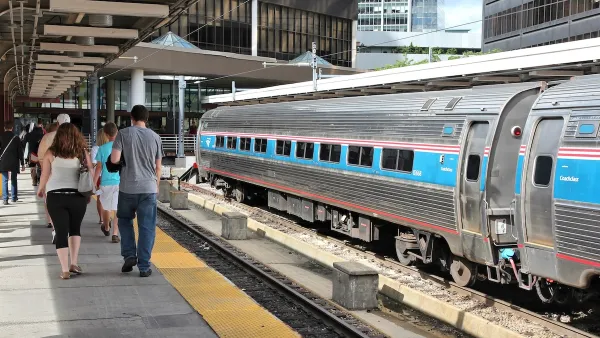
Amtrak Service Dominates D.C. to Boston Travel Market
Long lines at airport security and weather delays have contributed to Amtrak's commanding travel mode share between D.C. and NYC, and majority share between NYC and Boston, but the lead is threatened by the competition and aging infrastructure.
Proposed NYC-to-Boston HSR Would Cut Trip to Under Two Hours
The proposed project would use a mix of new and old rail lines and bypass some cities to speed up the trip.
The Passenger Rail Revival Is Here
For the first time in decades, multiple rail projects are moving forward that could have a transformative impact on train travel in the United States.

Planetizen Federal Action Tracker
A weekly monitor of how Trump’s orders and actions are impacting planners and planning in America.

California plans to bury El Niño’s downpour
If the state plays its cards right, it may be able to store a billion acre-feet of El Niño’s water in aquifers.

Desperate measures: Advocates weigh draining Lake Powell to fill Colorado River
Draining the reservoir could reduce evaporation losses by a couple hundred thousand acre-feet.

How a Chicago-sized wind farm beat the odds and powered on
The project spanned five presidential administrations and a standoff with a U.S. military base.

MTA gives itself 30 days to transform pit into basketball court
The site has been under construction since 2022; the city originally estimated it would finish the court in 2024.

Non-stop party: Chicago voters weigh permanent festival grounds
A stable place for bleachers, stages and drainage may streamline the setup and teardown of large events.

FREE Course: Walkable City 1: Why Walkability?
After describing his path towards focusing on walkability as the essence of good planning, Jeff Speck marches through his five principal reasons for making more walkable places.
Reinventing Malls: Planning Alchemy—Turning Gray Fields Into Gold
The course focuses on the opportunities and imperatives that shape reinvention of mall sites.

City of Rosemead
Rutgers University, Edward J. Bloustein School of Planning and Public Policy
One Hundred Miles
Hunter College, City University of New York (CUNY)
The Architects Foundation
University of Cincinnati Online
City of Cambridge
Montrose County
The Pocatello Development Authority