In the 1950s, southern Orange County, California was a place of open hills, citrus groves, and scattered towns. The I-5 Freeway changed that, paving the way for today's subdivisions.


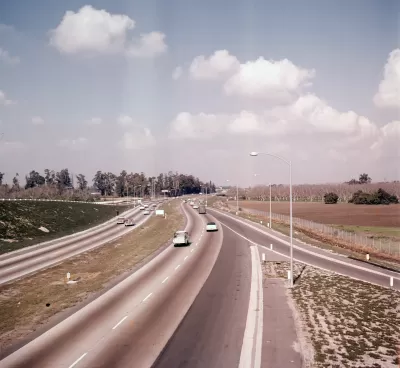
Running parallel to the coast through the heart of the county, the I-5 Freeway follows the path of the El Camino Real, a famed route from California's Spanish period. "If Orange County had a skeleton, the 5 freeway would be its spine. [...] No other piece of infrastructure so thoroughly binds together the spatial structure of Orange County."
Nathan Masters gives us photos and advertisements from the 1950s, when the freeway was extended past a sparkling new Disneyland, opening up the "Southland." Unlike some L.A. County freeways, the 5 didn't displace residents. "[...] for much of its length, construction crews paved over orange groves, bean fields, and cattle pastures rather than residential neighborhoods; when construction began, Orange County was a decidedly rural place, an agricultural landscape dotted by a few small towns, distinct from the Los Angeles metropolis."
"Its backbone in place, Orange County soon evolved from its rural, embryonic form (1950 population: 216,224) into the fully realized postmodern metropolis (2010 population: 3,010,232) we know today." The 5, also known as the Santa Ana Freeway, now runs the length of the country from Mexico to Canada.
Read the full story: How the 5 Freeway Made Orange County Suburban
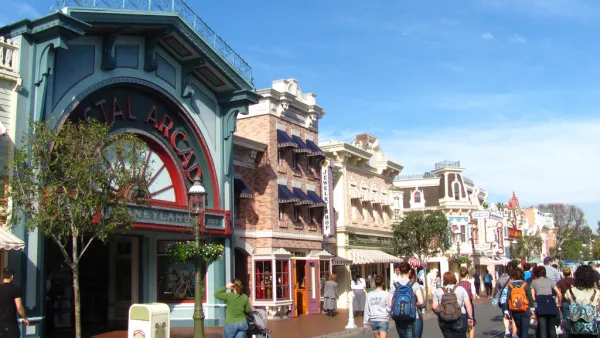
What Will Disneyland Be Like When it Reopens?
According to a study, Disneyland could comfortably accommodate 50% of the 110-acre theme park’s pre-COVID-19 attendance capacity.
Plans Advance for Orange County Streetcar
The $289 million streetcar would serve the cities of Santa Ana (population 329,00), county seat and second densest in California after San Francisco, and Garden Grove (population 170,000) on a 4.1-mile route. Service could begin 2020.
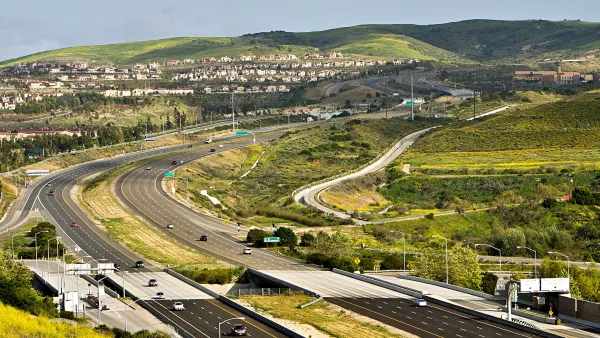
A Pedestrian's Perspective on Sprawling Orange County
Southern California's Orange County isn't exactly known for its walkability. Frank H. Wu decided to test that notion on a recent carless visit.

Planetizen Federal Action Tracker
A weekly monitor of how Trump’s orders and actions are impacting planners and planning in America.

Eastern Nebraska is running out of electricity
Data centers and electrification are straining eastern Nebraska’s grid, throttling economic development.

Move over, LA: St. Louis gears up for Olympics, invests millions in downtown redevelopment
The Missouri city will host the 2028 Olympic soccer group stage and knockout matches.

Dallas releases zoning code overhaul to officials
The drafted overhaul is over 400 pages long.

NYC renovations for dangerous, ‘mercilessly crammed’ street delayed until 2027
Construction was supposed to begin this fall.

San Diego’s Midway Rising project gets greenlight from city council
The project looks to become the largest affordable housing development in California's history.

FREE Course: Walkable City 1: Why Walkability?
After describing his path towards focusing on walkability as the essence of good planning, Jeff Speck marches through his five principal reasons for making more walkable places.
Reinventing Malls: Planning Alchemy—Turning Gray Fields Into Gold
The course focuses on the opportunities and imperatives that shape reinvention of mall sites.

City of Rosemead
Rutgers University, Edward J. Bloustein School of Planning and Public Policy
One Hundred Miles
University of Michigan School for Environment and Sustainability (SEAS)
Hunter College, City University of New York (CUNY)
The Architects Foundation
City of Cambridge
The Pocatello Development Authority
The Urban Renewal Agency of the City of Pocatello