Two Texas universities received a federal grant to embed sensors in road asphalt to create renewable electricity from the wind created by passing vehicles to power roadside lights and traffic signals.


"Researchers at The University of Texas at San Antonio (UTSA) and the Texas A&M Transportation Institute (TTI) have been awarded a $1.32 million contract from the Texas Department of Transportation (TxDOT) as part of the jointly funded Federal Highway Administration's (FHWA) state research program," according to Energy Harvesting Journal.
Its premise is to design and develop a system to harvest energy created by the movement of vehicles along the state's roadways and convert it into low-cost renewable electric power.
(T)he research team will develop piezoelectric sensors that can be placed under asphalt layers. Those sensors will use the energy generated from moving vehicles to power roadside lights, traffic signals, billboards, charging stations for electric cars and roadway monitoring sensors.
The grant funds only the first phase of the project, which will take 18 months. "If the subsequent phases of this project get the go-ahead, the researchers anticipate having a complete, functional harvesting and sensing system ready for implementation within three-and-a-half years."
Piezoelectric sensors and other devices including pneumatic tubes and inductive loops are used for more conventional purposes such as counting traffic according to Highway Performance Monitoring System. [See"Intrusive Data Collection Equipment".]
Read the full story: Sensors that could harvest clean energy from traffic on Texas roads

Rural Texans Air Objections to High Speed Rail
Parts of rural Texas sound a bit like the outspoken high speed rail opponents in California's Central Valley in their reaction to the Texas Central Railway's bullet train which maintains strong support at the terminal cities of Houston and Dallas.

Swapping your gas car for an EV is greener than keeping it, research shows
An EV repays the 'carbon debt' caused by building it after 4,400 miles.
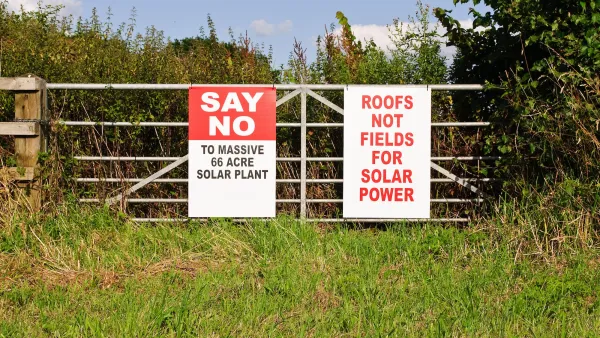
Misinformation and 'AI slop' are hamstringing rural solar development
False claims about the potential drawbacks of solar farms are prompting some communities to reject potentially lucrative energy projects.

Planetizen Federal Action Tracker
A weekly monitor of how Trump’s orders and actions are impacting planners and planning in America.

Data reveals that NYC’s bet on congestion pricing has paid off
After almost two years of the program, reports show positive impacts on traffic and air quality and no disruptions to parking.

HUD modernizes 50-year-old manufactured housing framework
The Next Generation Manufactured Housing Action Plan establishes new energy-efficiency standards for manufactured homes, and new guidelines for anchoring them.

Small single-family homes are illegal in most of MA. Voters can change that
Most land zoned for single-family housing in Massachusetts requires at least 40,000 square feet of land per house.

Public steps inside U.S.’s first battery-powered train
Metra’s groundbreaking train feature modern seats and a futuristic battery car.

Companies show off AI technology, new innovation hubs at APTA Expo
Nearly 700 companies attended the American Public Transportation Association’s Expo last week, which happens once every three years.

FREE Course: Walkable City 1: Why Walkability?
After describing his path towards focusing on walkability as the essence of good planning, Jeff Speck marches through his five principal reasons for making more walkable places.
Reinventing Malls: Planning Alchemy—Turning Gray Fields Into Gold
The course focuses on the opportunities and imperatives that shape reinvention of mall sites.

One Hundred Miles
County of Mendocino
planning NEXT
The Architects Foundation
University of Cincinnati Online
Montrose County
Northern Illinois Transit Authority (NITA)
The Pocatello Development Authority