New York City and San Jose have expanded or added rules that temporarily close some of their streets to automobile traffic. This continues a string of successes for the open streets movement.


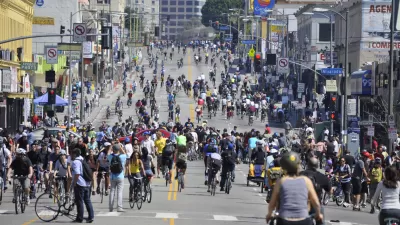
Joining a movement that began in Colombia, American cities are finding new opportunities to temporarily restrict car traffic, giving pedestrians and cyclists the freedom of the streets. "This fall, the City of San Jose and Silicon Valley Bike Coalition will close off six miles of streets from cars — leaving the road open for biking, walking, playing and skating. The inaugural 'Viva CalleSJ,' announced this week, will take place on October 11th."
The west coast and Latin America have a good track record for these kinds of events. "San Jose is joining a number of other cities that have already hosted open streets events, including Los Angeles, Guadalajara, Mexico, and Bogota, Colombia." Los Angeles' CicLAvia is one of the more well-known open streets events in the United States.
And now, the movement is gaining momentum on the other side of the country, especially in conjunction with New York's Vision Zero plan to reduce traffic fatalities. "On the East Coast, New York Mayor Bill de Blasio announced [...] that he will close large parts of Prospect Park and Central Park to vehicles on weekdays."
Read the full story: Closing Streets to Cars for Walkers and Cyclists Is Getting More Popular by the Minute
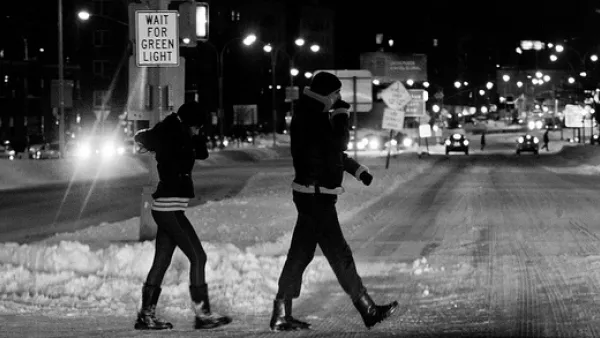
A Vision Zero Success Story in New York
The 300-foot wide Queens Boulevard has been known as the Boulevard of Death. Since 1990, it has claimed 186 lives, 74 percent being pedestrians, including 18 in 1997 alone. A series of safety improvements have brought fatalities to zero since 2014.
Statistics Show NYPD Enforcing Vision Zero Pedestrian Safety Initiative
The law enforcement results are in from the first year of Vision Zero policy in New York City.
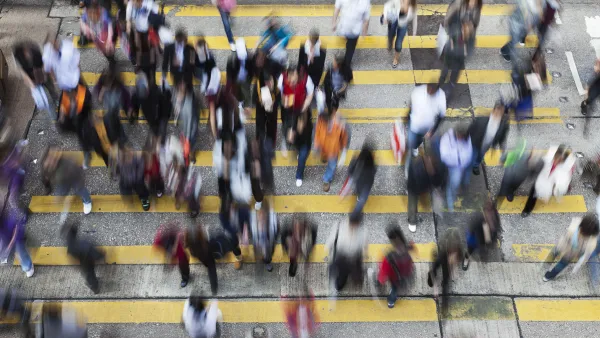
Big Cities Make Pedestrian Safety a Priority
New data released Dec. 19 by NHTSA shows increased safety for those traveling by car, but pedestrian fatalities are 15% higher than in 2009. Plans by San Francisco, Los Angeles, New York, and Chicago to increase ped safety are described by the WSJ.

Desperate measures: Advocates weigh draining Lake Powell to fill Colorado River
Draining the reservoir could reduce evaporation losses by a couple hundred thousand acre-feet.

Eastern Nebraska is running out of electricity
Data centers and electrification are straining eastern Nebraska’s grid, throttling economic development.

Malls are becoming the midtowns of the future
Mall and office park redevelopments are a generational opportunity to create new nodes of urbanity.

NYC breaks ground on anti-flooding infrastructure project
New York City's new system will reduce stormwater flows to local sewers by 90%.

One Kentucky town’s secret to affordable housing
The Smoketown Community Land Trust has already built seven affordable homes for community members.

Houston gains petal-shaped cooling infrastructure to make streets more ‘delightful’
The city has installed the pavilions along 15 blocks in Houston.

FREE Course: Walkable City 1: Why Walkability?
After describing his path towards focusing on walkability as the essence of good planning, Jeff Speck marches through his five principal reasons for making more walkable places.
Reinventing Malls: Planning Alchemy—Turning Gray Fields Into Gold
The course focuses on the opportunities and imperatives that shape reinvention of mall sites.

City of Rosemead
Rutgers University, Edward J. Bloustein School of Planning and Public Policy
One Hundred Miles
University of Michigan School for Environment and Sustainability (SEAS)
Hunter College, City University of New York (CUNY)
The Architects Foundation
City of Cambridge
Montrose County
The Pocatello Development Authority