The parking-protected bike lane on Reseda Boulevard in the Northridge neighborhood of the city of Los Angeles opened to bicycles on April 2. Also, Detroit broke ground on its first protected bike lanes—with or without the parking protection.


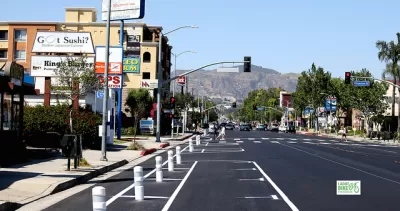
The United States' second largest city has been slow to get on the cycle track. With the opening of Reseda Boulevard in Northridge, hopefully Figueroa Street will follow soon.
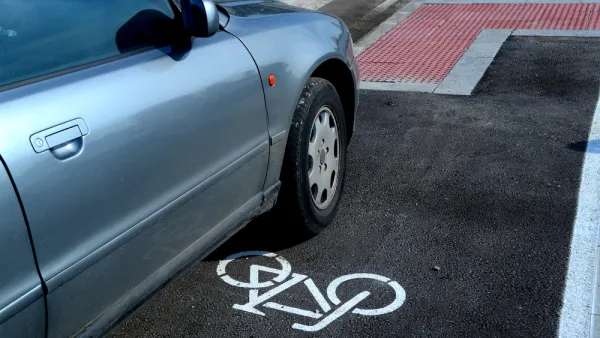
Great photos by Joe Linton of Streetsblog Los Angeles clearly showing how the protected bike lane works for cyclists and motorists parking their vehicles, though not all got it right.

New parking-protected bike lanes on Reseda Boulevard. All photos: Joe Linton/Streetsblog L.A.
Note the sign on the pole to the right of the cyclist. They are on "(n)early every other pole along Reseda Boulevard explaining the new striping," writes Linton, and how it works for motorists parking their cars, delivery drivers loading/unloading trucks or vans, cyclists, and even pedestrians, though not everyone is good at following directions. Or perhaps some motorists just insist on parking at the curb "because that's the way it's always done?" No worries, L.A.'s finest, on bikes, no less, are on top of it.

Credit: Joe Linton/Streetsblog L.A.
A commenter on the blog, Those white bollards are called K71, which self re-erect when hit by motor vehicles at over 65 mph. It comes in a variety of colors. There is also the K72 which looks more like a decorative steel post. [PDF]" I don't know if any of the armadillos make it to the final application.
The photos show a wide gutter pan between the bike lane and the curb. According to Federal Highway Administration Course on Bicycle and Pedestrian Transportation [PDF], "On streets where the bike lane is adjacent to the curb and the curb includes a 1-foot to 2-foot gutter pan, bike lanes should be a minimum of 4 feet wide (width does not include the gutter pan, since bicyclists are typically unable to use this space)." Hopefully the new lanes meets that criteria.
The similar good news on Detroit comes by way of Angie Schmitt of Streetsblog USA. "The bike lane is part of a road diet for Jefferson Avenue in the historic Jefferson-Chalmers business district." The Jefferson Ave. lanes will also be parking-protected.
Read the full story: City of L.A.’s First Parking-Protected Bike Lanes: Reseda Boulevard
Using Gas Tax Revenue to Remove Traffic Lanes Adds to Road Diet Debate
Reducing the number of traffic lanes to improve bike and pedestrian safety can be inherently controversial when auto travel times are increased, and it can upset motorists further when they learn gas taxes are funding those safety improvements.
Learning loss and urban schools, part 2
Did test scores in progressive cities drop more post-COVID than test scores in moderate ones?
Oklahoma City Begins Work on Parking-Protected Bike Lane
The project is part of the city’s broader plan to improve bike and pedestrian infrastructure and road safety.

Planetizen Federal Action Tracker
A weekly monitor of how Trump’s orders and actions are impacting planners and planning in America.

Eastern Nebraska is running out of electricity
Data centers and electrification are straining eastern Nebraska’s grid, throttling economic development.

Washington state to charge fee to drivers with fuel-efficient cars
Revenue from the fee will go towards supporting the state’s highways.

Instead of building new housing, LA developers are turning mansions into mega-mansions
In the richest areas, the number of houses valued at $30 million with demolition permits has skyrocketed since 2018.

Illinois considers spending $1 billion in taxpayer money on data center
A quantum computing campus and data center are currently under construction in Chicago.

As development costs rise, Boston moves to lessen affordable housing requirements
The Boston Zoning Commission and the City Council still need to approve Boston Mayor Michelle Wu’s proposed changes

FREE Course: Walkable City 1: Why Walkability?
After describing his path towards focusing on walkability as the essence of good planning, Jeff Speck marches through his five principal reasons for making more walkable places.
Reinventing Malls: Planning Alchemy—Turning Gray Fields Into Gold
The course focuses on the opportunities and imperatives that shape reinvention of mall sites.

City of Charlotte
City of Rosemead
Rutgers University, Edward J. Bloustein School of Planning and Public Policy
University of Michigan School for Environment and Sustainability (SEAS)
Hunter College, City University of New York (CUNY)
The Architects Foundation
University District Partnership
City of Cambridge
The Pocatello Development Authority