Under the transportation funding plan proposed by Assembly Speaker Toni Atkins, motorists would pay an annual road user charge of about $50 to help pay for the $59 billion in deferred highway and bridge maintenance that Gov. Brown noted recently.


Calling the fee a "road user charge" may cause some confusion as it is also the name of a vehicle-miles-traveled (VMT) fee used in a bill (SB 1077) passed last year that is the basis for a new pilot project in the state. Unlike a VMT fee (also called mileage-based user fee) that varies based on the distance driven, Assembly Speaker Toni Atkins' fee would be fixed at "no more than $50 per year," according to a phone conversation with Atkin's spokesman, John Casey, though it might be higher for trucks and electric vehicles that pay no gas tax.
"Atkins has said the charge could be assessed as part of vehicle registrations or insurance plans," writes Chris Nichols of U-T San Diego. "The proposal would need Republican support because a two-thirds vote of the Legislature is required to pass new fees. The charge would go into effect during the 2015-16 fiscal year, which starts July 1."
Nichols writes that the new fee is estimated to raise $800 million annually. As for the remaining $1.2 billion, the speaker mostly resorts to a "diversion" strategy. "Her plan would also free up about $1 billion per year by returning truck weight fees to transportation accounts instead of general fund debt repayment," he writes.
Casey clarified that the general fund debt was in fact from transportation bonds, particularly the $20 billion in bonds the voters approved in 2006 known as Proposition 1B: Highway Safety, Traffic Reduction, Air Quality, and Port Security Bond Act. He also viewed the redirection of the funds as more of a restoration, not a diversion, as they had originally been direct to transportation accounts.
The plan would raise revenue to help meet Gov. Brown's infrastructure goal of spending $59 billion to repair highways and bridges that he mentioned as one of three infrastructure goals in his inaugural address last month. The goal is now formalized in the state's 2014 five-year infrastructure plan [PDF].
The plan does not appear to have been assigned a bill number yet. When it does, it will be noted in comments below.
As noted on Thursday, the state Board of Equalization will be voting on Feb. 24 to reduce the gasoline tax by 7.5 cents or 21 percent, punching a huge hole in the transportation budget.
FULL STORY: Early plans to raise transportation funds

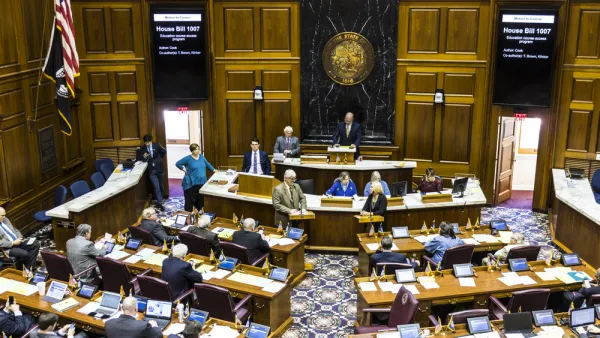
Indiana Legislature Passes 10-Cents Fuel Tax Hike on Final Day of Session
Just past midnight on Saturday morning, the Indiana State Senate passed the transportation plan after the Housed approved it Friday. It also passed a $32 billion, two-year state budget bill, then adjourned for the year, one week ahead of schedule.
Tennessee Governor Poised to Raise Gas Tax by Six Cents per Gallon
Both chambers of Tennessee's General Assembly approved Gov. Bill Haslam's transportation plan on April 19, which hikes diesel taxes by 10 cents per gallon but lowers other taxes. Indiana appears poised to follow with a 10-cent gas tax increase.
California's Road Usage Charge Pilot Program to Begin on July 1
The California Road Charge Pilot will be the nation's second road usage charge program. Unlike OReGO, which launched last July, it is a pilot program that will last nine months, but like the Oregon program, it is restricted to 5,000 volunteers.

Planetizen Federal Action Tracker
A weekly monitor of how Trump’s orders and actions are impacting planners and planning in America.

The state-sanctioned urbicide of Austin
People don’t kill cities. Freeways do.

US to reduce Colorado River water deliveries to Mexico
A new Colorado Treaty amendment reduces Mexico’s Colorado River water allocation by 250,000 acre feet.

5 New England states march closer to 800 megawatt wind energy project
Securing federal approval for the project may be complicated under the Trump administration, which has historically been hostile towards domestic wind power.

Baltimore to break ground on $50 million Transit Priority Project
The project will bring faster bus trips, safer streets and better bike connections to Baltimore.

Airbnb launches $250 million 'last-dollar financing' housing accelerator, makes first investment in Austin
The company will put $6.4 million towards affordable housing development in Texas’ capital.

FREE Course: Walkable City 1: Why Walkability?
After describing his path towards focusing on walkability as the essence of good planning, Jeff Speck marches through his five principal reasons for making more walkable places.
Reinventing Malls: Planning Alchemy—Turning Gray Fields Into Gold
The course focuses on the opportunities and imperatives that shape reinvention of mall sites.

Eagle County Government
Harvard University Graduate School of Design
Nashville Planning Department
The Architects Foundation
University of Cincinnati Online
The Pocatello Development Authority
The Urban Renewal Agency of the City of Pocatello
Journal of the American Planning Association