Instagram images and group bike rides now celebrate the Bay Bridge’s eastern span, but the bridge’s long construction process was a constant source of concern. A new report details what went wrong to (hopefully) prevent future mistakes.


A new report titled “The San Francisco Oakland Bay Bridge: Basic Reforms for the Future” produces a scathing account of the many scofflaws of the construction of the new eastern span of the Bay Bridge. The most concerning finding of the report, “an institutionalized, if not malicious, lack of transparency,” on the part of state transportation agency Caltrans.
Lee Romney writes that Caltrans isn’t the only guilt party according to the report’s account of the cost overruns, delays, and falsified reports that plagued the project. “The report spreads blame for delays among the U.S, Navy, the cities of Oakland and San Francisco, environmental groups, the Metropolitan Transportation Commission, the state Legislature and ‘actions taken at the very highest levels of the state’s executive branch [that] also cost — rather than saved — time and money.’”
Romney notes, however, that “the harshest criticism is reserved for the way Caltrans treated those who raised concerns. Among them: One respected outside engineer was told he was being ‘too rigorous’ in expressing concerns about widespread cracks in Chinese-made welds, an interview revealed. He also raised questions about the anchor rods and was told 'basically to stop bringing it up.'"
Read the full story: Bay Bridge safety critics were told to keep quiet, report finds

Bay Bridge Construction Woes Raise Earthquake Safety Concerns
One of the reasons for the $6.4 billion investment in the new eastern span of the Bay Bridge was to ensure the safety of the bridge in the even of a large earthquake.
The Many Ongoing Public Transportation Projects of the Bay Area
The San Francisco Chronicle offers a round-up of 11 big transit projects, by Caltrans, BART, SFMTA, and others, making progress around the bay.
Planning Underway for New Bay Bridge Bike Path, and a Second Transbay BART Tube
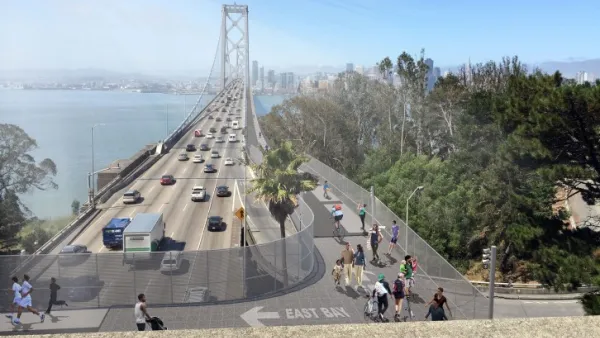
In a distant and expensive future, there are two new ways to get across the San Francisco Bay without a car. One will have a much better view.

Amtrak, CN end decades-long dispute with eight-year agreement
The new operating agreement establishes an updated framework for the companies to work together, including processes to resolve disputes.

Judges permit Denver to divert 77,000 acre feet from the Colorado River for reservoir expansion
Overuse and climate change have caused the Colorado River’s water levels to plummet.
Nation's most wind-powered state turns to coal as data centers increase energy demand
For the first time in decades, Iowa has increased its generation of coal power.

Boston has spent millions making the Green Line more accessible — and there’s no end in sight
While the city has invested millions into expanding and adding platforms to the Green Line to make it more accessible, new train cars set to arrive next year will be too tall for disabled passengers to board without raising the current platforms.

Idaho may see an 18% drop in federal surface transit funding — the largest estimated cut in the US
Transit systems in rural communities are much more reliant on federal funding to provide their services.

How ‘post-disaster gentrification’ alters neighborhoods after natural calamities
After hurricanes, fires or other calamities, the original residents of a community are often replaced by younger, wealthier residents.

FREE Course: Walkable City 1: Why Walkability?
After describing his path towards focusing on walkability as the essence of good planning, Jeff Speck marches through his five principal reasons for making more walkable places.
Reinventing Malls: Planning Alchemy—Turning Gray Fields Into Gold
The course focuses on the opportunities and imperatives that shape reinvention of mall sites.

City of Wisconsin Rapids
Harvard University Graduate School of Design
KFH Group Inc.
The Architects Foundation
University of Cincinnati Online
The Pocatello Development Authority
The Urban Renewal Agency of the City of Pocatello