More bike corrals, bike sharing, and parklets are on the way to the Golden State's capital thanks to the city council's unanimous vote on Oct. 22 with support from cyclists, pedestrians, businesses, and the regional air district.


City Beat's Ryan Lillis writes that the call for the new bike and pedestrian infrastructure comes in part, surprisingly, from merchants who historically have not always been aligned with the cycling community (e.g., the "Save Polk Street" movement in San Francisco). Joining them were pedestrian advocates and the Sacramento Metropolitan Air Quality Management District.
[T]he City Council voted unanimously Tuesday night to launch a network of bike corrals and begin a pilot program for mini-parks to be built in parking spaces near businesses. Council members also expressed encouragement for a regional bike-sharing program that has been touted by air quality officials.
However, the improvements were pegged not only as bike infrastructure, but also in the name of the "public health benefit” they would provide to the community, according to "Councilman Steve Hansen, whose office has helped develop the programs", writes Lillis. Teri Duarte, the executive director of WALKSacramento, agrees.
We think parklets are a great idea,” said Duarte. "They provide additional destinations for people to walk to, they add life to the street and they can slow down traffic.”
A similar response came from Emily Baime Michaels, the executive director of the Midtown Business Association, who saw how parklets could enhance businesses in her district. “Midtown will support something that’s an innovative use of space", she stated.
Parklets will be "built and maintained with funding from private-sector sponsorships" unlike the corrals, accommodating up to 12 bikes, that "would be funded through a grant from the Sacramento Metropolitan Air Quality Management District", writes Lillis. One corral will replace one auto parking space.
The lots [sic] were recommended to address a growing demand by bicycle users to have more secure places to leave bikes, city officials said.
Council also received an update on the proposed regional bike sharing program.
According to a staff report provided to the council, a study commissioned by the city and the air quality district recommended a network of 560 bicycles at 80 docking stations. Most of the docks would be in downtown and midtown, with additional sites in Davis and West Sacramento.
Read the full story: Council votes to launch bike corrals, plan parklets in Sacramento
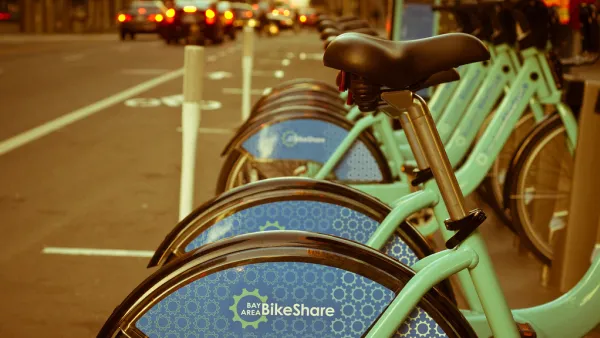
Mixed Reports on Success of Bay Area Bike Share
Depending on what media you're reading, Bay Area Bike Share is either off to a "fast start" or an "underwhelming start". We give both reviews - you judge. In addition, Sacramento looks toward BABS as a model, and expansion within SF will be proposed.
San Francisco weighs patio smoking ban
Business owners say the ban could force patrons onto sidewalks and disrupt long-standing bar culture, while proponents of the ordinance say second-hand smoke is a threat to patrons and workers.
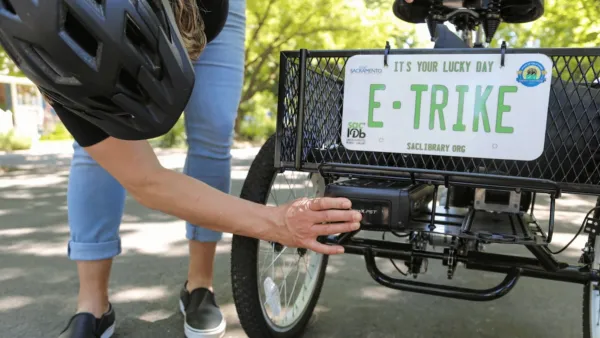
Bicycles and Books — In Sacramento, Libraries Now Offer Both
Adult library card holders can check out e-bikes and e-trikes for up to one week.

Planetizen Federal Action Tracker
A weekly monitor of how Trump’s orders and actions are impacting planners and planning in America.

California plans to bury El Niño’s downpour
If the state plays its cards right, it may be able to store a billion acre-feet of El Niño’s water in aquifers.

Desperate measures: Advocates weigh draining Lake Powell to fill Colorado River
Draining the reservoir could reduce evaporation losses by a couple hundred thousand acre-feet.

Los Angeles just elected an urban planner as its mayor
Transportation analysts are optimistic that Raman will be more aggressive in addressing transit issues than Bass.

Mamdani’s pied-à-terre tax survives legal challenge
A panel of judges found that the plaintiffs failed to demonstrate injury as a result of New York City's implementation of the tax.

Eastern Nebraska is running out of electricity
Data centers and electrification are straining eastern Nebraska’s grid, throttling economic development.

FREE Course: Walkable City 1: Why Walkability?
After describing his path towards focusing on walkability as the essence of good planning, Jeff Speck marches through his five principal reasons for making more walkable places.
Reinventing Malls: Planning Alchemy—Turning Gray Fields Into Gold
The course focuses on the opportunities and imperatives that shape reinvention of mall sites.

City of Rosemead
Rutgers University, Edward J. Bloustein School of Planning and Public Policy
One Hundred Miles
University of Michigan School for Environment and Sustainability (SEAS)
Hunter College, City University of New York (CUNY)
The Architects Foundation
City of Cambridge
Montrose County
The Pocatello Development Authority