Why measuring traffic deaths alone doesn’t paint a full picture.


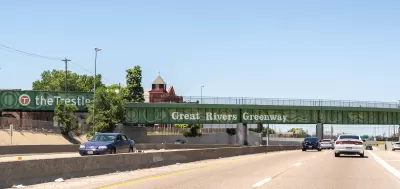
In a piece in Next STL, Christian Frommelt argues that planners and transportation officials shouldn’t rely exclusively on crash statistics to understand road safety conditions in their cities. “We need metrics that keep us accountable and crash data alone is inadequate in implementing serious, sweeping change.”
For Frommelt, “Measuring modal share—the proportion of people walking/rolling, biking, taking public transit, and driving—will help determine whether car-dominant planning continues to supplant overall health and safety.” Moreover, Census data only shows modal share for commutes to work, obscuring the many other types of trips that people take to grocery stores, schools, healthcare facilities, entertainment venues, parks, and more.
In St. Louis, where Frommelt lives, a new Complete Streets bill could help the city gather more information about those metrics and assess how infrastructure investments are paying off for pedestrians, cyclists, and other road users. Measuring mode share more accurately can also unlock federal funding opportunities.
Read the full story: Why Crash Statistics are Inadequate for Planning Safer Streets


How “Proven Safety Countermeasures” Save Lives
A bill named in honor of a U.S. diplomat killed while on her bicycle would let state DOTs access full federal funding for road safety projects.
Pedestrian Deaths Tick Down — But Rose 58 Percent in the Last Decade
Road fatalities fell by a meager 4 percent in the first half of 2023.
How Cities are Spending Safe Streets Funds
New federal grant programs are injecting millions of dollars into road safety projects in an effort to stem the alarming growth of traffic deaths on U.S. roads.

Planetizen Federal Action Tracker
A weekly monitor of how Trump’s orders and actions are impacting planners and planning in America.

California plans to bury El Niño’s downpour
If the state plays its cards right, it may be able to store a billion acre-feet of El Niño’s water in aquifers.

Desperate measures: Advocates weigh draining Lake Powell to fill Colorado River
Draining the reservoir could reduce evaporation losses by a couple hundred thousand acre-feet.

California city breaks ground on transit connector
The project includes three mobility hubs and a pedestrian bridge.

After public outcry, Massachusetts city releases housing development tracker
Cambridge’s tracker currently shows 250 housing projects in various stages of development.

40 years after approval, Chicago breaks ground on new park
The park honors Jean Baptiste Point du Sable, the city’s first permanent non-native settler.

FREE Course: Walkable City 1: Why Walkability?
After describing his path towards focusing on walkability as the essence of good planning, Jeff Speck marches through his five principal reasons for making more walkable places.
Reinventing Malls: Planning Alchemy—Turning Gray Fields Into Gold
The course focuses on the opportunities and imperatives that shape reinvention of mall sites.

City of Rosemead
Rutgers University, Edward J. Bloustein School of Planning and Public Policy
One Hundred Miles
Hunter College, City University of New York (CUNY)
The Architects Foundation
University of Cincinnati Online
City of Cambridge
Montrose County
The Pocatello Development Authority