The 405 Express Lanes will open in Orange County later this year despite the warnings from a former Huntington Beach mayor of a resident-led rebellion in response to road pricing. But will the toll lanes mitigate congestion? Academics weigh in.


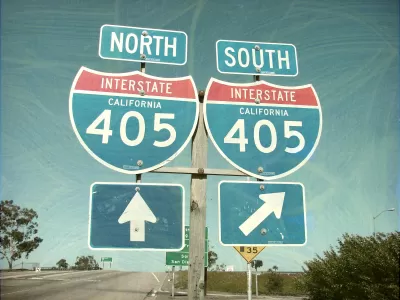
Nearly ten years ago, the Orange County Transportation Authority (OCTA) Board voted to widen the 405 Freeway (also known as Interstate 405 and the San Diego Freeway) by adding a general purpose, aka unmanaged lane, subject to approval by Caltrans, the state's transportation authority.
About 7 months later, Caltrans overrode local officials, insisting that the widening needed a high occupancy toll (HOT) lane to help pay for construction costs and to manage congestion better than high occupancy vehicle (HOV) lanes (or carpool lanes). Free for carpoolers, HOT lanes allow solo drivers to utilize the managed lane – but they are subject to a toll as payment for a faster trip.
HOT lanes today are generally referred to as express lanes by transportation agencies while express toll lanes may not exempt carpoolers from the toll, according to the Federal Highway Administration.
“They’re going to rebel”
“Huntington Beach Mayor Matthew Harper would have none of it,” according to the July 29, 2014 post.
“The state of California and those in Sacramento are trying to implement a concerted agenda to have layers of taxes, fees and tolls to extract dollars out of everyday drivers,” he said. “I think once voters realize what's coming down at them, they're going to rebel and people are going to want to keep the freeways free.”
Nine years later...
“Commuters on the 405 Freeway in Orange County could soon be driving in new lanes and paying tolls of nearly $10 to use the express lanes during peak hours," reports Summer Lin for the Los Angeles Times, the source article for this post.
The project will span 16 miles between Costa Mesa and the L.A. County line and add one regular lane in each direction, said Orange County Transportation Authority spokesperson Joel Zlotnik. It will also add a second lane that combines with the existing carpool lane to create the 405 Express Lanes.
[Note: The 405 Improvement Project will span 16 miles while the 405 Express Lanes will span 14 miles.]
Congestion pricing
Tolling will be dynamic, meaning it will increase with the level of congestion, using market forces to keep traffic flowing, as described in the project's 5-page FAQ [pdf]:
The 405 Express Lanes will use congestion management pricing. This type of pricing was pioneered on the 91 Express Lanes, also operated by OCTA.
Congestion management pricing is designed to optimize express lanes traffic at free-flow speeds. To accomplish this OCTA monitors hourly traffic volumes. Tolls are increased when traffic volumes consistently reach a trigger point where traffic flow can become unstable. If traffic drops below the optimal traffic volume, tolls are lowered to encourage usage.
“The proposed toll policy for the 405 Express Lanes is expected to be considered by the OCTA board on July 24 and unveiled at the end of 2023,” added Lin of the Times.
Will pricing mitigate induced demand?
The first of three experts cited by Lin is Brown University economics professor Matthew Turner who co-authored a 2009 study that “found that increasing road capacity in metropolitan areas by 1% eventually results in an increase in cars on the road by 1%.” Pricing, however, changes the dynamics of the lane addition(s).
Instead, he said that increasing toll pricing at peak hours, as is proposed for the 405 Express Lanes, could turn a traffic jam into free flow speeds by reducing the cars on the road by as little as 5%.
Turner is also cited in two road pricing posts in Planetizen – not about express lanes but cordon pricing:
- Will Manhattan's "Central Business District Tolling" Clear the Way for More Congestion Pricing? April 8, 2019
- Los Angeles Could Charge Non-Residents to Drive in Congested Areas, September 15, 2017
Daniel Chatman, a professor of city and regional planning at UC Berkeley, also confirmed the induced demand theory and that congestion-based tolls "have the potential to reduce traffic.”
“The fact that one of the lanes is going to be congestion-managed is helpful in terms of making it less likely for there to be congestion,” he said. “Depending on how that charge is administered, that lane may be an uncongested lane depending on compliance and enforcement.”
[Note: two lanes are being added: a general purpose lane and an express lane, and the existing HOV lane will be converted to a HOT lane, making for two express lanes on the 14-mile stretch between the SR-73 freeway in Costa Mesa and the I-605 freeway near the L.A. County line.]
Chatman is also cited in "Chariot Commuter Shuttle in San Francisco Expands 50 Percent After Ford Acquisition,” December 6, 2016.
The final expert is Dave Amos, a professor at Cal Poly’s City and Regional Planning Department and a Planetizen instructor, who was more critical of the lane additions, congestion-pricing notwithstanding.
“These are folks who are incentivized to build more highways,” he said. “You can’t take those numbers at face value. They might not be wrong, but they also might be.”
FULL STORY: Drivers on the 405 Freeway in O.C. could pay $10 tolls, get extra lanes. Would it help with traffic?

Toll Lanes Continue to Spread on Southern California Freeways
To the chagrin of many Orange County transportation leaders, two express lanes will be added to each direction on a 14-mile stretch of the 405 (San Diego) Freeway, one through conversion, and a general purpose lane funded in part by Measure M added.
Caltrans Overrides OCTA: 405 Freeway Widening Must Include Toll Lane
Transportation decisions are best made locally, not by the state DOT, right? For those advocating for tolled, managed lanes over free, general purpose lanes, the 405 Freeway in Orange County may prove the exception.
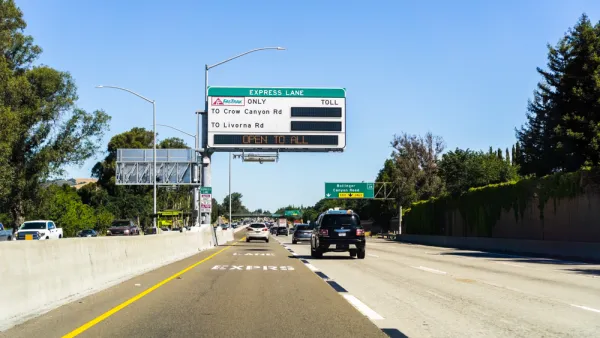
More Toll Lanes Coming to California Freeways
Solo drivers in the Golden State will have more options to escape traffic congestion on busy freeways – for a price, as transportation agencies increasing decide to convert existing carpool lanes to high-occupancy toll lanes and add new ones.

Planetizen Federal Action Tracker
A weekly monitor of how Trump’s orders and actions are impacting planners and planning in America.

The state-sanctioned urbicide of Austin
People don’t kill cities. Freeways do.

US to reduce Colorado River water deliveries to Mexico
A new Colorado Treaty amendment reduces Mexico’s Colorado River water allocation by 250,000 acre feet.

5 New England states march closer to 800 megawatt wind energy project
Securing federal approval for the project may be complicated under the Trump administration, which has historically been hostile towards domestic wind power.

Baltimore to break ground on $50 million Transit Priority Project
The project will bring faster bus trips, safer streets and better bike connections to Baltimore.

Airbnb launches $250 million 'last-dollar financing' housing accelerator, makes first investment in Austin
The company will put $6.4 million towards affordable housing development in Texas’ capital.

FREE Course: Walkable City 1: Why Walkability?
After describing his path towards focusing on walkability as the essence of good planning, Jeff Speck marches through his five principal reasons for making more walkable places.
Reinventing Malls: Planning Alchemy—Turning Gray Fields Into Gold
The course focuses on the opportunities and imperatives that shape reinvention of mall sites.

Eagle County Government
Harvard University Graduate School of Design
Nashville Planning Department
The Architects Foundation
University of Cincinnati Online
The Pocatello Development Authority
The Urban Renewal Agency of the City of Pocatello
Journal of the American Planning Association