Orange County, birthplace of the nation's first high occupancy toll (HOT) lane, may never see another. Not only did they reject a plan to add one (or two) toll lanes, to the 405 Freeway, legislation to ban them altogether may be introduced.


The nation's first HOT lane, where single occupant vehicles can use lanes reserved for carpools if they pay a toll, opened in Orange County in 1996, now known as the 91 Express Lanes. But on Dec. 9, Orange County officials may have initiated a divorce with them. Paloma Esquivel writes about the alternative selection chosen by the county transportation authority for the San Diego Freeway (I-405) Improvement Project.
Ending months of rancorous debate, Orange County Transportation Authority board members voted to pursue an expansion plan that would add one free lane in each direction along a 11-mile stretch of the 405 from the 605 Freeway to Euclid Street.
On Monday, OCTA CEO Darrell Johnson said the toll lane proposal had become so divisive that the agency was at risk of losing the confidence of voters who years ago approved a half-cent sales tax to widen the freeway.
To ensure that the county never build another HOT lane, "Assemblyman Allan R. Mansoor (R-Costa Mesa) said he expects to introduce legislation next year to block toll lanes by either barring them from the 405 or the county or requiring residents to vote to approve toll lanes," writes Esquivel.
However, Caltrans, the state's transportation authority, has to approve the selection, according to KTLA 5.
"Ryan Chamberlain, Caltrans' district director for Orange County, said federal and state gas taxes simply can't cover the cost of building and maintaining California's vast highway system. He takes issue with people who call the proposed tolls a double tax," Esquivel had written earlier.
Should the decision hold, it will go against a national trend, albeit one that began in Orange County, where states looked to HOT lanes "as a means of revenue generation as well as congestion management", as we noted here last week.
Read the full story: O.C. votes to expand 405 Freeway without adding toll lanes
Toll Lanes Continue to Spread on Southern California Freeways
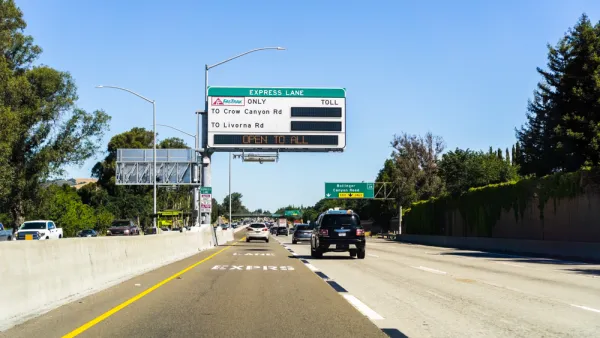
To the chagrin of many Orange County transportation leaders, two express lanes will be added to each direction on a 14-mile stretch of the 405 (San Diego) Freeway, one through conversion, and a general purpose lane funded in part by Measure M added.
Caltrans Overrides OCTA: 405 Freeway Widening Must Include Toll Lane
Transportation decisions are best made locally, not by the state DOT, right? For those advocating for tolled, managed lanes over free, general purpose lanes, the 405 Freeway in Orange County may prove the exception.
More Toll Lanes Coming to California Freeways
Solo drivers in the Golden State will have more options to escape traffic congestion on busy freeways – for a price, as transportation agencies increasing decide to convert existing carpool lanes to high-occupancy toll lanes and add new ones.

Desperate measures: Advocates weigh draining Lake Powell to fill Colorado River
Draining the reservoir could reduce evaporation losses by a couple hundred thousand acre-feet.

Eastern Nebraska is running out of electricity
Data centers and electrification are straining eastern Nebraska’s grid, throttling economic development.

Move over, LA: St. Louis gears up for Olympics, invests millions in downtown redevelopment
The Missouri city will host the 2028 Olympic soccer group stage and knockout matches.

Mass. votes against statewide minimum lot size for single-family homes
Over 2 million residents voted on Question 7; it was decided by just over 30,000 votes.

Maryland’s $15 billion bridge project gains key approval
The Maryland Transit Authority said the project will create over 60,000 jobs and add $23 billion to the local economy.

‘No clear next steps’ for Chicago's permanent festival grounds
Eleventh Ward Ald. Nicole Lee has suggested Soldier Field as a possible location for the permanent event space.

FREE Course: Walkable City 1: Why Walkability?
After describing his path towards focusing on walkability as the essence of good planning, Jeff Speck marches through his five principal reasons for making more walkable places.
Reinventing Malls: Planning Alchemy—Turning Gray Fields Into Gold
The course focuses on the opportunities and imperatives that shape reinvention of mall sites.

City of Rosemead
Rutgers University, Edward J. Bloustein School of Planning and Public Policy
One Hundred Miles
University of Michigan School for Environment and Sustainability (SEAS)
Hunter College, City University of New York (CUNY)
The Architects Foundation
City of Cambridge
Montrose County
The Pocatello Development Authority