The consequences of historic redlining continue to have consequences in the present day United States. Add another example to the list.


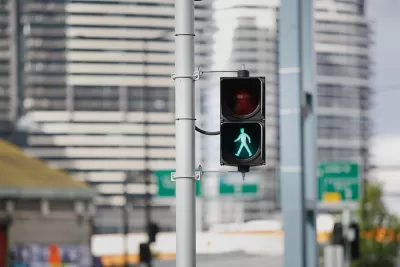
A study recently published by the American Journal of Public Health connects the discriminatory real estate practices of U.S. history to the poor pedestrian safety outcomes of contemporary life. “Historical redlining policy, initiated in the 1930s, has an impact on present-day transportation inequities in the United States,” reads the conclusion shared in the study’s abstract.
Kea Wilson picked up news of the study for Streetsblog USA, boosting the signal on the troubling findings of the report, several months after the study’s November publication. “[R]esearchers found that census tracts once marked as ‘hazardous’ or ‘grade D’ by the Home Owners’ Loan Corporation experienced a pedestrian death rate of 2.6 per 100,000 people between 2010 and 2019, compared to a rate of just 1.1 during the same period for tracts marked grade ‘A’ or ‘best,” according to Wilson’s summary of the study’s findings.
“The researchers stress that this simple and deeply racist policy helped ‘cement the racial wealth gap, that endures to this day, and remains associated with a cascade of unjust and deadly intergenerational impacts that have endured as well,” explains Wilson. Add pedestrian safety to the list that includes other contemporary public health risks, such as Covid spread, Covid fatalities, food insecurity, oil and gas facilities, air pollution, extreme heat, and housing inequality.
FULL STORY: Study: Pedestrian Death Rate More Than 2x Higher in Historically Red-Lined Neighborhoods


What Can Lessons From Traffic Safety Teach About the Covid Response?
Finger waggings aren't effective for pedestrian safety—so why should they work for public health? A "safe system" approach, created for traffic safety in Sweden, offers a model for improved pandemic public health outcomes, according to this opinion.

U.S. DOT Releases First-Ever Pedestrian Safety Plan
Record numbers of pedestrians have been killed by drivers in recent years. The federal government says a "team effort" will be necessary to stop the carnage.
State Legislation Responds to Pedestrian Safety Failures in Connecticut
So far in 2020, drivers have killed 15 pedestrians on Connecticut roads.

Planetizen Federal Action Tracker
A weekly monitor of how Trump’s orders and actions are impacting planners and planning in America.

The state-sanctioned urbicide of Austin
People don’t kill cities. Freeways do.

US to reduce Colorado River water deliveries to Mexico
A new Colorado Treaty amendment reduces Mexico’s Colorado River water allocation by 250,000 acre feet.

Mamdani overhauls NYC's Vision Zero plan with 100 new policy goals
The overhaul aims to reduce traffic deaths and make streets safer for pedestrians, cyclists and drivers through lower speed limits, new safety infrastructure and more.

Amtrak not solely to blame for New Jersey commuter rail's unreliability, report finds
A new study from the Garden State Initiative found that NJ Transit’s budget grew 20% across a 4 year period, but reliability declined significantly over the same period.

EPA erases limits on planet-warming pollution from power plants
Under Monday’s plan, power plants would still have some limits on how much mercury, arsenic and other contaminants they can emit.

FREE Course: Walkable City 1: Why Walkability?
After describing his path towards focusing on walkability as the essence of good planning, Jeff Speck marches through his five principal reasons for making more walkable places.
Reinventing Malls: Planning Alchemy—Turning Gray Fields Into Gold
The course focuses on the opportunities and imperatives that shape reinvention of mall sites.

Eagle County Government
Harvard University Graduate School of Design
Nashville Planning Department
The Architects Foundation
University of Cincinnati Online
The Pocatello Development Authority
The Urban Renewal Agency of the City of Pocatello
Journal of the American Planning Association