Finger waggings aren't effective for pedestrian safety—so why should they work for public health? A "safe system" approach, created for traffic safety in Sweden, offers a model for improved pandemic public health outcomes, according to this opinion.


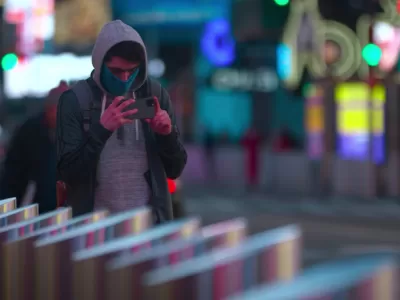
Sometimes traffic engineers try a little too hard to micromanage pedestrians. The engineers think about where pedestrians should cross, plot it out on little maps, and then forbid crossing in other places.
Then engineers sort of wash their hands of the responsibility for keeping pedestrians safe: “well they crossed outside of the crosswalk.” I’m generalizing here, a little bit, of course, but hear me out.
Of course, when people walk while just going about their lives, traffic safety usually isn’t top of mind. They have other concerns: maybe they’re late to work. Or they see their bus in the distance and are in a hurry. Maybe they’re very old and their feet hurt or they’re juggling young children and they don’t have the energy for a long detour.
There are also all kinds of situational or infrastructure considerations. Maybe it’s raining. Maybe there’s no curb cut at the crosswalk. Maybe they’ve waited at the crosswalk before, but it takes a lot of extra time and drivers turning right and left don’t yield to them when they have the “Walk” signal anyway.
People aren’t that easy to program. Real world decision making is much messier and more unpredictable. It isn’t like a video game where people are players just awaiting instruction. It’s not that their behavior can’t be influenced. People act rationally, but based on a set of variables unique to each individual and even the particular time of day.
If we spend a lot of time and effort speaking with people and studying their behavior, we might be able to predict how they’ll behave. (And for the record, I think we should aim to anticipate the places where pedestrians want to cross safe for them rather than trying to ‘play God.’) It’s frustrating from a safety perspective, but the reality is people just aren’t that easy to control.
I think about that sometimes when I people make remarks about U.S. Covid policy. It seems like the same kind of tension is at work. Some key strategies—mask mandates or vaccine mandates, for example—are based on directing people how to behave. And often we’re disappointed that compliance isn’t perfect or what we’d like.
In the same way, we can be unhelpfully quick to judge. When someone is hurt or killed while walking, the reflex can be to blame them for “not being in a crosswalk” or for “wearing dark clothing.” The charge is often that the people who aren’t complying are selfish or stupid. I understand where the impulse comes from, but I don’t think it’s very helpful for addressing the challenge at hand.
Although we have a long way to go, traffic safety practices more and more frequently reflect the harm of that kind of tough-love ('people who suffer, deserve it') approach. The new paradigm is called “safe system” thinking. It means that we don’t rely on individuals to behave perfectly, but instead expect that humans will sometimes act like humans, make mistakes, act irresponsibly, etc. So as “system designers”—that includes planners and traffic engineers—we should endeavor to make the system “forgiving” when the inevitable mistake or irresponsibility happens.
The whole safe system concept originated in Sweden, which for years was the world leader on traffic safety and has per capita traffic fatality rates about one-quarter of ours in the United States. I won’t go into a great deal of detail about how it works, but planners in Sweden work hard to limit vehicle speeds to the point where crashes will cause serious injuries or fatalities. The way traffic calming is handled depends on the type of road and the type of crash risk urban (pedestrian) or rural highways (head-on collision).
Our pandemic response could benefit from the same sort of thinking. The use of masks in certain settings like schools is very polarizing right now, and I don’t want to wade into that debate here. But even if the political conditions allowed for mask mandates, we shouldn’t expect compliance to be perfect. We’ve all heard the scolding about “masks above the nose,” etc. One way we could build in an extra layer of protection and make the system more forgiving is to focus on improving indoor ventilation, an endeavor that while not controversial in the same way as masks, does require some expense. But it does have long lasting health benefits (in addition to potentially major energy savings). This kind of “social safety net” is especially important in bars and restaurants and coffee shops or daycares, where mask use just doesn’t work as well. Even if places can’t afford expensive ventilation upgrades an open window or two could help provide some additional protection.
The most pressing challenge we face right now in our communities related to Covid is getting people vaccinated. Our political polarization among other factors has contributed to wide gaps by geography.
The vaccine researcher Heidi Larson traveled the world exploring attitudes around vaccines, and she found the strongest predictor of vaccine acceptance is trust in government. That means those of us in government work have to be especially careful to uphold and repair what she calls the “chain of trust,” which includes all the institutions involved in vaccination from doctors to biomedical companies to the governments that carry out the vaccination campaign.
It seems like a lot of people have become hopeless about our prospects for vaccinating unvaccinated people—the single most important intervention to address the ongoing pandemic. But we can’t give up. Especially in the poorest U.S. cities—Detroit, Cleveland, Rochester—vaccination rates still hover around 50 percent. It’s clear that access remains an issue, and there are many vulnerable people who might be reachable with the right approach.
After a nationwide polio vaccine boycott in 2003, health leaders in Nigeria went door to door to help end the boycott, Danielle Ofri wrote in The New York Times. That effort also included certain measures to help safeguard the reputation of vaccine efficacy in the minds of the public, including putting important religious leaders on the approval team and enlisting trusted cultural emissaries to endorse vaccination.
The most crucial demographic as far as Covid is concerned is unvaccinated seniors. These folks may be socially isolated and have mobility challenges. Targeted outreach to these people is needed to reach these people, and in June the Biden administration authorized additional Medicare payments for patients requiring in-home vaccination. In New York City, where 89% of adults have had at least one shot, the city offers free transportation to vaccination sites for those over 65 as well as in-home vaccination.
Taking vaccines to people and making it as easy and comfortable as possible to get the shot is important, says Monroe County (Rochester, New York) Legislator Rachel Barnhart. Barnhart has been promoting "Vaccination Block Parties," hosting outdoor pubic events with games for children and free food, advertising the events with fliers and on radio, and providing a $100 incentive for first time shots. Small scale community events like Vaccination Block Parties can help restore trust and rebuild frayed community ties while providing a comfortable setting for free care and low pressure discussions about vaccination. Although the window for outdoor activities may have closed for a short while in the colder parts of the country, there are still ways to apply this same kind of programming to vaccination clinics. According to Barnhart and Dr. Julia Raifman, this forum was ten times as effective as regular vaccination clinics in Lowell, Massachusetts.
We have to acknowledge that Covid safety—like traffic safety when someone is crossing the street—is one of many pressing concerns ordinary Americans are being asked to manage simultaneously. All of us face differing challenges and risk from both Covid and other preexisting threats and pressures. Moralizing won’t work. We can apply collective solutions that act as safeguards even when people don’t behave the way we want or expect them to in an ideal safety scenario. Our hope of addressing either of these problems, in my opinion, depends on it.
Angie Schmitt is a writer and planner based in Cleveland. She is the author of Right of Way: Race, Class and the Silent Epidemic of Pedestrian Deaths in America (Island Press, 2020). She is founding principal at 3MPH Planning, a small Cleveland based firm focused on pedestrian safety.

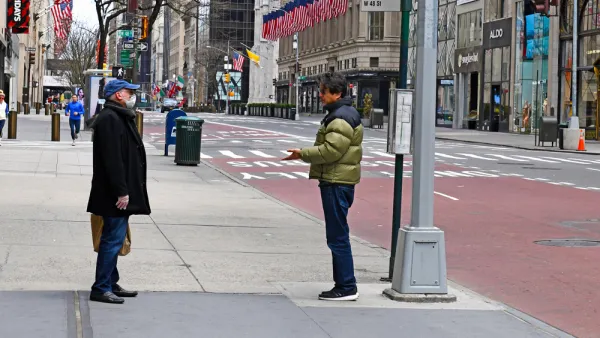
Friday Eye Candy: Covid-19, Then and Now
The New York Times compared images from readers portraying similar scenes in 2020 and 2022.
Acceptable Deaths
What can we learn from our Covid response?

Study: Poor Air Quality Fuels COVID Transmission
Communities exposed to higher levels of air pollution experience higher rates of infection, particularly in areas with high population density.

Planetizen Federal Action Tracker
A weekly monitor of how Trump’s orders and actions are impacting planners and planning in America.

Northwest rail fans eager for Sept. 30 debut of Amtrak’s Airo fleet
Get ready for that new train smell and more seats. But they won’t go faster or run more frequently on the Cascades route in Washington and Oregon.
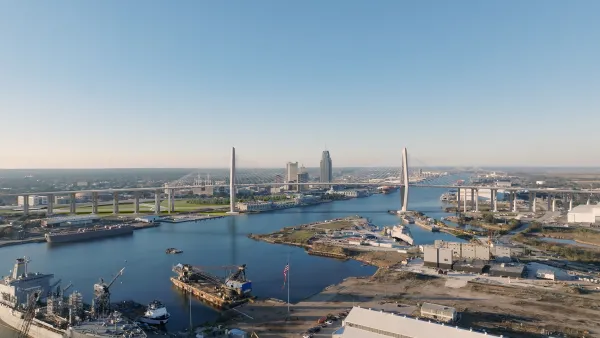
Alabama scores up to $2.5 billion federal loan for largest infrastructure project in state’s history
The Mobile River Bridge and Bayway Project aims to ease congestion at Alabama’s worst bottleneck.

Novel study finds extreme state-by-state disparity in housing construction timelines
The first comprehensive working paper on U.S. construction timelines also found that the permitting process for multi-family projects has slowed nationwide.

California may destroy its beaches trying to save homes from El Niño
Boulders and seawalls can protect homes from waves, but ultimately destroy sandy beaches.

California high-speed rail accomplishes only one legislative goal in 2026
The majority of the agency's failed pitches were never developed into written proposals.

FREE Course: Walkable City 1: Why Walkability?
After describing his path towards focusing on walkability as the essence of good planning, Jeff Speck marches through his five principal reasons for making more walkable places.
Reinventing Malls: Planning Alchemy—Turning Gray Fields Into Gold
The course focuses on the opportunities and imperatives that shape reinvention of mall sites.

City of Thousand Oaks
City of Wisconsin Rapids
Harvard University Graduate School of Design
The Architects Foundation
University of Cincinnati Online
Northern Illinois Transit Authority (NITA)
The Pocatello Development Authority
The Urban Renewal Agency of the City of Pocatello

