Hoboken has spent the past several years investing in new bike infrastructure, and traffic collisions of all kinds have since decreased.


Eve Kessler reports:
Hoboken, a New Jersey city of about 54,000 souls directly across the Hudson from New York City, shows what can be accomplished when a municipality really focuses on the zero of Vision Zero — the “Mile Square City” has recorded no traffic fatalities for three straight years.
According to Kessler's sources at the city, Hoboken has prioritized bike lane infrastructure and committed to an identity as a pedestrian-oriented city to accomplish major progress in traffic safety. From 2019 to 2020, the city saw a 35 percent reduction in the number of pedestrians struck by automobiles drivers, an 11 percent reduction in the number of bicyclists struck by automobile drivers, and a 27 percent reduction in the number of vehicle collisions.
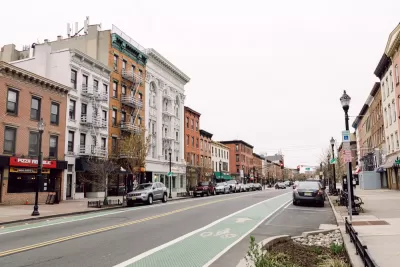
The proof of Hoboken's Vision Zero commitment is most visible on Washington Street, the city's "main drag," as Kessler describes it. "Before being redesigned last year, Washington Street had a high number of collisions and an outmoded design, with no bike facilities, no curb extensions and traffic signaling that favored the fast movement of automobiles." The redesign of the street included curb extensions, bike lanes, recalibrated traffic signals, and wider crosswalks with "retro-reflective, thermo-plastic stripes."
For more evidence that the ambitious goals of Vision Zero are possible, see also a recent Planetizen feature by Angie Schmitt.
FULL STORY: EYES ON THE STREET: How Hoboken Has Eliminated Traffic Deaths

Vision Zero at Work: Hoboken Celebrates Seven Years of Zero Traffic Deaths
The New Jersey city implemented simple yet impactful changes to eliminate traffic fatalities.
Traffic Fatalities Set Records as Pandemic-Era Road Carnage Shows No Signs of Stopping
An estimated 42,915 people died in automobile crashes in 2021, according to recent federal data. The increasing fatalities continue a trend that began with the outset of the pandemic.
New York City Traffic Fatalities Pass 2019 Totals
The visions of a car-free utopia that might have seemed like a potential silver lining in March and April have given away to a tragic reality.

Planetizen Federal Action Tracker
A weekly monitor of how Trump’s orders and actions are impacting planners and planning in America.

The state-sanctioned urbicide of Austin
People don’t kill cities. Freeways do.

US to reduce Colorado River water deliveries to Mexico
A new Colorado Treaty amendment reduces Mexico’s Colorado River water allocation by 250,000 acre feet.

Mamdani overhauls NYC's Vision Zero plan with 100 new policy goals
The overhaul aims to reduce traffic deaths and make streets safer for pedestrians, cyclists and drivers through lower speed limits, new safety infrastructure and more.

Amtrak not solely to blame for New Jersey commuter rail's unreliability, report finds
A new study from the Garden State Initiative found that NJ Transit’s budget grew 20% across a 4 year period, but reliability declined significantly over the same period.

EPA erases limits on planet-warming pollution from power plants
Under Monday’s plan, power plants would still have some limits on how much mercury, arsenic and other contaminants they can emit.

FREE Course: Walkable City 1: Why Walkability?
After describing his path towards focusing on walkability as the essence of good planning, Jeff Speck marches through his five principal reasons for making more walkable places.
Reinventing Malls: Planning Alchemy—Turning Gray Fields Into Gold
The course focuses on the opportunities and imperatives that shape reinvention of mall sites.

Eagle County Government
Harvard University Graduate School of Design
Nashville Planning Department
The Architects Foundation
University of Cincinnati Online
The Pocatello Development Authority
The Urban Renewal Agency of the City of Pocatello
Journal of the American Planning Association