When tolls rise on the 66 Express Lanes, trips decrease. according to a new report by the Virginia Department of Transportation.


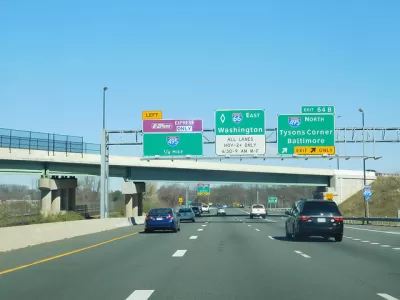
A new report from the Virginia Department of Transportation comparing the third quarter of 2019 to 2018 on the 66 Express Lanes shows that the average roundtrip toll increased by about 6% while the average number of daily trips decreased 4% to 9%, depending on direction.
Note that the toll fee didn't increase, because these express lanes lack the toll schedule or toll rate table typically associated with the nation's tolled road and bridge facilities, such as those found in the International Bridge, Tunnel and Turnpike Association's 4-page reference, "Links to Toll Rate Pages - 2017" [pdf].
In addition, the 66 Express Lanes Inside the Beltway sets no "cap" or upper limit on tolls; the dynamically-priced tolls increase and decrease with the level of congestion, changing every six-minutes so as to maintain a minimum 45 mph speed, a federal requirement for both High Occupancy Vehicle (HOV) and High Occupancy Toll (HOT) lanes.
The Virginia Department of Transportation, or VDOT, reported on the average tolls paid by drivers for three months last year: July, August, and September, and compared them with the same months in 2018. Their 6-page "Performance Report for the Third Quarter 2019 Report [pdf]" has lots of other data, including the number of trips, speed of trips, travel times, how tolls were paid, and carpooling trips. However, the data applies only to trips taken during peak hours when tolling applies:
- Eastbound: 5:30 – 9:30 a.m.
- Westbound: 3:00 – 7 p.m.
The express lanes on Interstate 66 go nine miles [png] from just north of Falls Church in the west through Fairfax and Arlington counties to Rosslyn, near the Theodore Roosevelt Bridge crossing of the Potomac River to the District of Columbia.
"During the morning tolling hours on eastbound I-66, trips decreased from 15,097 to 13,707, or 9.2 percent," reports Emily Leayman, the Patch editor for Alexandria, Falls Church and parts of Fairfax County, Virginia. "The decline for the evening tolling hours on westbound I-66 was 18,013 to 17,314, or 3.9 percent."
$40 tolls?
While the roadway gained national notoriety with it's $40 tolls on just the second day of operation (and that's just the eastbound toll in the morning), average tolls are far more reasonable, $7.46 for the quarter, compared to $7.14 in 2018. Westbound afternoon tolls were much cheaper, averaging $4.64 compared with $4.31 in 2018. But $40 tolls do occur, reports Leayman, far more often last year than in 2018.
More people paid tolls over $40 in July to September 2019 compared to these months in 2018. The 1,065 trips with tolls over $40 represents 0.16 percent of trips in these months. In July to September [2018], 315 trips had tolls over $40, or 0.05 percent.
Not your typical HOT lane
The inverse relationship between toll price and trips taken may not be transferable to other tolled facilities due to other special, if not unique, characteristics of the 66 Express Lanes Inside the Beltway.
- Unlike other high-occupancy toll (HOT) lanes, the entire nine-mile stretch of Interstate 66 "becomes HOT" during commute hours, eastbound in the morning and westbound for the afternoon commute. There are no adjacent general-purpose lanes to select to avoid the toll during peak hours. Off-peak the roadway is untolled.
- While carpools of two or more people travel toll-free with the proper E-ZPass, there are no exemptions for Clean Special Fuel License Plate vehicles, e.g., electric vehicles. Trucks are not allowed the express lanes.
"Daily carpooling trips dropped from 13,790 to 13,327 per day, or 3.4 percent," notes Leayman. However, as a percentage of trips, they increased, from almost 42 percent to 43 percent. Solo motorists paying tolls with E-ZPass comprised over 45 percent of trips.
According to a VDOT fact sheet [pdf] on the lanes released just prior to the December 2017 opening, "[t]he HOV-2 requirement will change to HOV-3+ in 2022 when the I-66 Outside the Beltway Express Lanes open, matching the current HOV-3 requirement on the I-495 and I-95 Express Lanes."
Hat tip to IBTTA Smartbrief.
Related in Planetizen:
-
Price Elasticity of Demand, Explained, December 17, 2019
-
Capitalism at Work on an Interstate Highway, June 12, 2018
-
Dynamic Tolling Done Right—VDOT Shows the Way, January 3, 2018
Read the full story: Average Toll Prices Up, Trips Down On I-66: VDOT Report

Capitalism at Work on an Interstate Highway
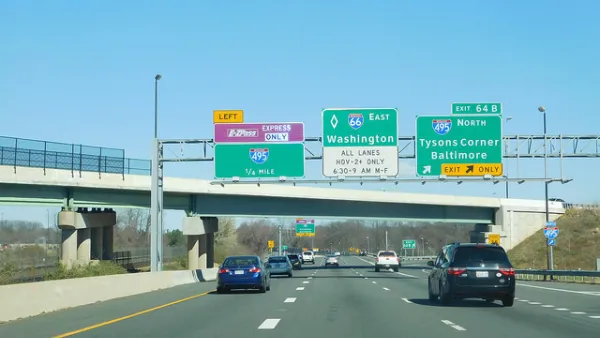
Traffic speeds during the peak eastbound commute on the 66 Express Lanes Inside the Beltway have dropped to 35 mph. "Toll-tweaking" and changing the algorithm are achieving limited success on this dynamically-tolled stretch.
Another Reason Motorists Should Support Road Tolling
Two things motorists detest: tolls and congestion. Tolls, if effectively applied, lessen congestion, but at a high cost to drivers. However, steep tolls also provide a political incentive to "fix the bottlenecks," as shown by the 66 Express Lanes.
Construction of I–66 Toll Lanes Outside the Capital Beltway Begins this Weekend
Widening of Interstate 66 for 22.5 miles in Northern Virginia will accommodate two toll lanes in each direction, accessible to trucks. The $3.7 billion project, to be built by public-private partnership at no cost to the state, will open in 2022.

Planetizen Federal Action Tracker
A weekly monitor of how Trump’s orders and actions are impacting planners and planning in America.

Amtrak, CN end decades-long dispute with eight-year agreement
The new operating agreement establishes an updated framework for the companies to work together, including processes to resolve disputes.

Northwest rail fans eager for Sept. 30 debut of Amtrak’s Airo fleet
Get ready for that new train smell and more seats. But they won’t go faster or run more frequently on the Cascades route in Washington and Oregon.

LAX SkyLink opening delayed again, contractor won’t commit to new deadline
The project was supposed to open its doors to the public in 2023.

Caltrain may slash over one-third of its stations
If Bay Area voters reject two transit tax measures, Caltrain, BART and AC Transit will see steep service cuts.

A 'dangerous' precedent: North Carolina successfully pressures communities into voting for toll roads
Two mayors resigned from the Charlotte Regional Transportation Planning Organization after it voted in favor of the toll roads.

FREE Course: Walkable City 1: Why Walkability?
After describing his path towards focusing on walkability as the essence of good planning, Jeff Speck marches through his five principal reasons for making more walkable places.
Reinventing Malls: Planning Alchemy—Turning Gray Fields Into Gold
The course focuses on the opportunities and imperatives that shape reinvention of mall sites.

City of Thousand Oaks
City of Wisconsin Rapids
Harvard University Graduate School of Design
The Architects Foundation
University of Cincinnati Online
The Pocatello Development Authority
The Urban Renewal Agency of the City of Pocatello