Several large freeway expansion projects are in various stages of planning and development in the Louisville region of Kentucky. Critics say the projects reflect an obsolete approach to planning and will hurt the state and the city.


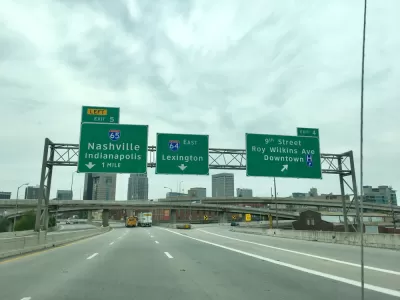
Marcus Green reports on an emerging debate and about land use and transportation in Kentucky, as the state is planning and building multiple massive highway widening projects in the Louisville area while facing financial challenges.
The big highway project closest to fruition in the Louisville area is the work of a plan called I-Move Kentucky. Green introduces the project:
Aiming to ease congestion and boost safety, Kentucky plans to launch an ambitious highway expansion project later this year called I-Move Kentucky. It would add lanes to I-71 between the Gene Snyder Freeway and Ky. 329 near Crestwood, widen parts of the Snyder and rebuild ramps at the freeway’s interchange with I-64.
While commuters are hopeful the project will reduce travel times along the corridors, advocacy organizations like Bicycling for Louisville are calling the project an example of misplaced priorities.
At the same time, the state is evaluating routes for another bypass around Louisville, including one corridor near eastern Jefferson County’s award-winning Floyds Fork parks system. Early cost estimates for the project, which has been likened to a new Snyder Freeway, range from $600 million to $1.6 billion.
As Green points out, the city has a goal to cut emissions by 80 percent by 2050, and highway projects like these won't help the city achieve those goals.
Regardless, the state will award a contract in October to launch construction in the I-Move Kentucky projects.
Read the full story: Crossroads: New interstate projects drive debate over Louisville region’s future
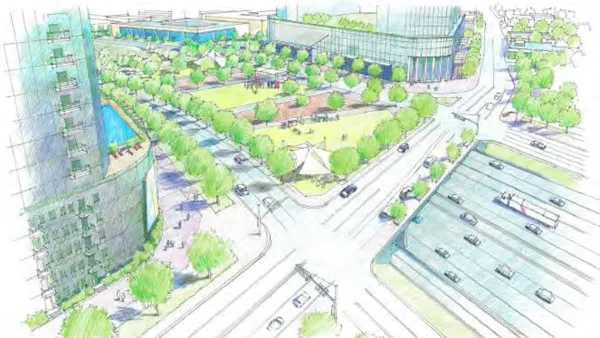
TxDOT Promises to Reverse Some of the Damage Caused by Urban Freeways in Dallas
The Texas Department of Transportation (TxDOT) is in the early stages of planning for two projects that could leverage plans to rebuild two freeways in the city with plan to reconnect the neighborhoods they severed.
$3.1 Billion for California Transportation Infrastructure
Federal and state funds were recently awarded to a large number of road projects around California.
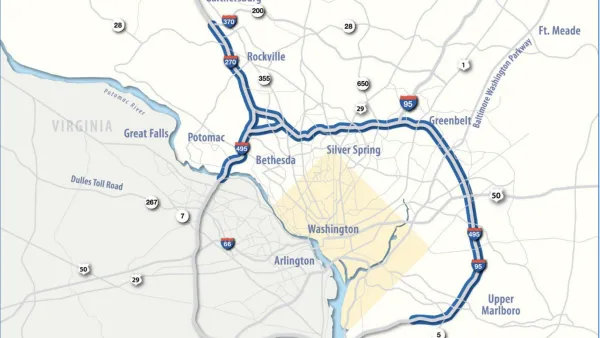
Maryland Highway Widening Plans Moving Forward Under New Governor
Maryland Governor Wes Moore is differentiating his new administration from his predecessor’s, but some projects, like the widening of federal highways in the Capital Beltway, stay the same.

Planetizen Federal Action Tracker
A weekly monitor of how Trump’s orders and actions are impacting planners and planning in America.

California plans to bury El Niño’s downpour
If the state plays its cards right, it may be able to store a billion acre-feet of El Niño’s water in aquifers.

Desperate measures: Advocates weigh draining Lake Powell to fill Colorado River
Draining the reservoir could reduce evaporation losses by a couple hundred thousand acre-feet.

US buildings threatened, destroyed by fires set to triple by 2060
Researchers found a high fire risk for socioeconomically vulnerable neighborhoods in the American West.

LA residents may be allowed to paint their own crosswalks
Councilwoman Katy Yaroslavsky put out a motion instructing the Los Angeles Department of Public Transportation to study the feasibility of allowing volunteers to paint crosswalks.

Dallas moves to overhaul its zoning code
The city's zoning reform will allow more multi-family and mixed-use developments.

FREE Course: Walkable City 1: Why Walkability?
After describing his path towards focusing on walkability as the essence of good planning, Jeff Speck marches through his five principal reasons for making more walkable places.
Reinventing Malls: Planning Alchemy—Turning Gray Fields Into Gold
The course focuses on the opportunities and imperatives that shape reinvention of mall sites.

City of Rosemead
Rutgers University, Edward J. Bloustein School of Planning and Public Policy
One Hundred Miles
Hunter College, City University of New York (CUNY)
The Architects Foundation
University of Cincinnati Online
City of Cambridge
Montrose County
The Pocatello Development Authority