Dr. Sara Cody, the Santa Clara County health officer widely credited for leading the Bay Area into issuing a 6-county shelter-in-place order on March 16, the nation's first, warns that the pace of reopening is too fast.


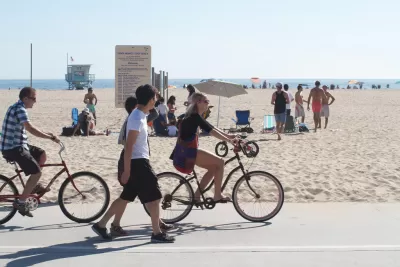
Gov. Gavin Newsom announced the reopening of the nation's largest state on May 4, although, like the rest of the nation, California hadn't met the federal guidelines requiring a 14-day downward trajectory in new coronavirus cases. Bay Area counties, which had been operating under their own stricter shelter-in-place orders issued three days before the governor's statewide stay-at-home order, would inevitably be impacted to some degree by Newsom's actions to relax social distancing restrictions by modifying his order.
"The pace at which the state has made these modifications is concerning to me," said Dr. Sara Cody, the County Health Officer at the Santa Clara County Public Health Department, in her presentation (via teleconference) to the Santa Clara County Board of Supervisors at their meeting on May 26.
"We can't see the effect of any of these changes on COVID for at least 14 days, an incubation period...The state modifications are being made without a real understanding of the consequences of what the last move has been and with the possibly serious effect for health and possibly serious risk of an exponential growth in cases and therefore a risk to social and economic well-being.
"In particular, Dr. Sara Cody, health officer for Santa Clara County — home to Silicon Valley and Northern California’s most populous county — said she was concerned by the decision to allow gatherings of up to 100 people for religious, political and cultural reasons...as it poses a very serious risk of the spread of COVID-19,” reports Rong-Gong Lin II for the Los Angeles Times.
Even if just one infected person showed up to such an event, the virus could easily be transmitted to many people and overwhelm local health officials’ ability to investigate all related cases, she warned.
New Jersey, by contrast, limits such gatherings to 25 people, and New York, 10, Cody said.
Another Bay Area health officer agrees
"Contra Costa County Health Director Dr. Chris Farnitano said he’s concerned about how fast some places in California are moving toward reopening," reported KPIX.
COVID-19 cases statewide are on an upward swing, Farnitano said, and the death rate is flat. He reiterated that he and his health official colleagues will continue with a careful, cautious approach to reopening.
“It’s going to be a lot harder to pull back than it is to move forward,” Farnitano said.
Early action by Cody
Cody is not just any county health officer. Along with her counterparts in five other Bay Area counties and the city of Berkeley, she "led the Bay Area’s push in mid-March for the country’s first 'shelter-in-place' order to control the coronavirus pandemic," according to The Mercury News. At the time, it was the hardest-hit region in California. Los Angeles is now the epicenter.
For the region's three largest cities, San Jose, San Francisco and Oakland, the 60-day orders are credited with saving almost 20,000 lives and preventing nearly 190,000 hospitalizations of COVID-19 patients, according to an analysis by the Big Cities Health Coalition, a group of leaders from America’s largest metropolitan health departments.
"As of Tuesday [May 26] night, the six Bay Area counties had reported a coronavirus death rate of six fatalities per 100,000 residents," adds Lin.
- "Los Angeles County has a death rate of 21 fatalities per 100,000 residents.
- "Statewide, California has a death rate of about 10 fatalities per 100,000 residents.
- "Across the nation, New Jersey’s is 126 fatalities per 100,000 residents, while New York’s is 149 fatalities per 100,000 residents"
100,000
While the nation collectively mourned the loss of 100,000 lives to COVID-19 on May 27, another "100,000" threshold was crossed in California the same day – the number of COVID-19 cases in the state, fourth highest after New York, New Jersey and Illinois. On May 27, there were 2,717 new confirmed cases, according to California's coronavirus dashboard, bringing the total to almost 102,000. By comparison, in the hardest-hit state, New York, there were 1,768 new cases, with almost 367,000 cases in total, according to the N.Y. dashboard.
"The Golden State’s rising case count doesn’t necessarily mean outbreaks are spreading; some officials credit the increase to the dramatic expansion of testing," reported Diya Chacko for the Times.
Churches upset too
“While most churches I’ve spoken with are grateful for the governor’s initial olive branch, it’s just not enough to satisfy the needs of the community,” said Robert Tyler, an attorney representing California churches that have challenged the governor’s stay at home order, reports the San Francisco Chronicle. “Limiting places of worship to 100 people is arbitrary, unreasonable and unconstitutional.”
CDC elite troops
A final word about Cody's background. She trained at the Centers for Disease Control and Prevention, in Atlanta, in a program known as the Epidemic Intelligence Service.
"Alumni of the E.I.S. are considered America’s shock troops in combatting disease outbreaks," wrote Pulitzer-prize winning reporter,
The program has more than three thousand graduates, and many now work in state and local governments across the country. “It’s kind of like a secret society, but for saving people,” Dr. Francis Riedo, an infectious-disease specialist, told me. “If you have a question, or need to understand the local politics somewhere, or need a hand during an outbreak—if you reach out to the E.I.S. network, they’ll drop everything to help.”
Multi-media:
- KCBS: "In Depth: "What It Will Take To Reopen Safely," conversation with Dr. Sara Cody, May 10, 2020
- Rachel Maddow: "Doctor whose prescience saved countless lives reflects on first stay-at-home order," April 23, 2020
Related in Planetizen:
-
The Rush to Open: California is No Exception, May 7, 2020
-
Bay Area Ordered to Shelter in Place, March 17, 2020
FULL STORY: California is reopening too quickly, posing ‘very serious risk,’ health officer warns


Bay Area Ordered to Shelter in Place
Six Bay Area counties have taken drastic action to curb the spread of the deadly coronavirus. "Please read this Order carefully. Violation of or failure to comply with this Order is a misdemeanor punishable by fine, imprisonment, or both."
U.S. Supreme Court Rules on State-Imposed Social Distancing Restrictions
In a 5-4 decision, the court voted to uphold the prohibition of religious services that was part of California Gov. Gavin Newsom's stay-at-home order. While the restriction had since been loosened, the plaintiff wanted all restrictions removed.
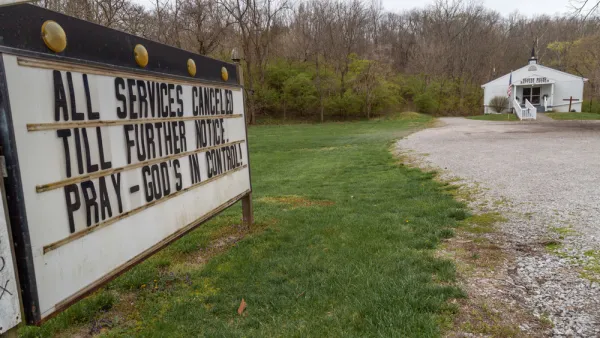
Religion in the Pandemic: First Amendment vs. Public Health and Safety
Conflicts between church and state are being decided in state and federal courts as governors act to protect their constituents from the coronavirus while religious institutions and their supporters seek exceptions from social gathering restrictions.

The state-sanctioned urbicide of Austin
People don’t kill cities. Freeways do.

US to reduce Colorado River water deliveries to Mexico
A new Colorado Treaty amendment reduces Mexico’s Colorado River water allocation by 250,000 acre feet.

New Jersey’s second-largest city bans standalone data centers
Jersey City will continue to allow co-location facilities, such as those meant for research institutions that store their own data.

Amtrak not solely to blame for New Jersey commuter rail's unreliability, report finds
A new study from the Garden State Initiative found that NJ Transit’s budget grew 20% across a 4 year period, but reliability declined significantly over the same period.

EPA erases limits on planet-warming pollution from power plants
Under Monday’s plan, power plants would still have some limits on how much mercury, arsenic and other contaminants they can emit.

Phoenix announces new on-demand transit service, more frequent RAPID buses
Both new services will launch in October, and are part of Phoenix's Project Effective Access Solutions for Easing Congestion.

FREE Course: Walkable City 1: Why Walkability?
After describing his path towards focusing on walkability as the essence of good planning, Jeff Speck marches through his five principal reasons for making more walkable places.
Reinventing Malls: Planning Alchemy—Turning Gray Fields Into Gold
The course focuses on the opportunities and imperatives that shape reinvention of mall sites.

Eagle County Government
Harvard University Graduate School of Design
Nashville Planning Department
The Architects Foundation
University of Cincinnati Online
The Pocatello Development Authority
The Urban Renewal Agency of the City of Pocatello
Journal of the American Planning Association