President Trump wants states to reopen businesses quickly but doesn't want to have the Centers for Disease Control and Prevention provide directions to business owners and transit agencies on how to open without spreading the coronavirus.


The 17-page guidance prepared by CDC, titled “Guidance for Implementing the Opening Up America Again Framework," was intended to be released on May 1, but was intentionally buried by the Trump administration. A CDC official told AP reporters Jason Dearen and Mike Stobbe that the document “would never see the light of day." The draft guidelines were sent to the White House last month.
The guidance was to meant to provide details to restaurant owners, churches, transit operators, daycare operators, et. al, on how to open safely, for both workers and customers. It was a follow-up to the White House – CDC guidance, released April 16, titled “Opening Up America Again, also known as "gating criteria", that set metrics that needed to be met before businesses could actually open.
For example, guidance for "Interim Guidance for Mass Transit Administrators" (pg. 15), states:
Mass transit is critical for many Americans to commute to and from work and to access essential goods and services. This
guidance provides considerations for mass transit administrators to maintain healthy business operations and a safe and
healthy work environment for employees, while reducing the risk of COVID-19 spread for both employees and passengers.Ensure social distancing (pg. 16)
- Institute measures to physically separate or create distance of at least six feet between all occupants. This may include:
- Asking bus passengers to enter and exit the bus through rear doors, while allowing exceptions for persons with disabilities.
- Closing every other row of seats.
- Reducing maximum occupancy of buses and individual subway and train cars and increasing service on crowded routes as appropriate.
Public health experts are very concerned, if not alarmed, by the intentional silencing of the nation's public health agency.
“CDC has always been the public health agency Americans turn to in a time of crisis,” said Dr. Howard Koh, a Harvard professor and former health official in the Obama administration during the H1N1 swine flu pandemic in 2009. “The standard in a crisis is to turn to them for the latest data and latest guidance and the latest press briefing. That has not occurred, and everyone sees that.”
The silencing of CDC fits a pattern where the administration wants to ensure that the responsibility for handling the pandemic falls in the hands of "the governors," illustrated by Trump's claim on April 27 that "the federal government should act as the 'supplier of last resort' for the [coronavirus diagnostic] tests as it works with states to ramp up a testing regime that health experts say is necessary before a national reopening," as reported by CNN.
The federal guidance was meant to assist state departments of public health as they work with businesses in their states to provide for safe environments for workers and customers.
“States and local health departments do need guidance on a lot of the challenges around the decision to reopen,” said Dr. Marcus Plescia, chief medical officer of the Association of State and Territorial Health Officials. “You can say that restaurants can open and you need to follow social distancing guidelines. But restaurants want to know, ‘What does that look like?’”
Maggie Haberman and Abby Goodnough of The New York Times report that "White House and other administration officials rejected the recommendations over concerns that they were overly prescriptive, infringed on religious rights and risked further damaging an economy that Mr. Trump was banking on to recover quickly."
"The C.D.C.’s director, Dr. Robert R. Redfield, and other leaders of the agency have had almost no public platform during the pandemic," they add. The two public health experts who have become familiar to Americans watching the briefings by the White House Coronavirus Task Force are Dr. Deborah L. Birx, an infectious diseases expert and Dr. Anthony S. Fauci, the longtime director of the National Institute of Allergy and Infectious Diseases.
This week, the White House signaled it would wind down its coronavirus task force only to reverse course amid a public outcry.
The rejection of the C.D.C.’s guidelines for reopening is the latest confusing signal as the Trump administration struggles to balance the president’s desire to quickly reopen the country against the advice of public health experts, who have counseled reopening methodically through a series of steps tied to reduced rates of infection and expanded efforts to control the spread of the coronavirus.
"A CDC spokesperson said the agency is working with all 50 states and providing recommendations and guidance on how to respond to the virus, including best practices for reopening," reports Brianna Ehley for POLITICO. "It is unclear if or when the agency will release revised formal guidelines for businesses and other establishments."
Related in Planetizen:
- President Trump's Plan to Reopen the Economy Rests with States, April 20, 2020
FULL STORY: Trump administration buries detailed CDC advice on reopening


President Trump's Plan to Reopen the Economy Rests with States
After initially saying that he had total authority on how and when to reopen the economy, Trump handed the responsibility to the 50 governors to make their own decisions and offered guidance in the form of a three-phase plan that relies on testing.
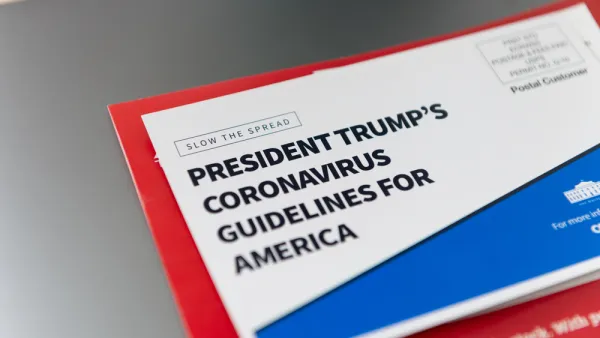
President Extends Coronavirus Guidelines; No Packed Churches Expected on Easter
Shortly after the two health experts on his task force estimated that the COVID-19 death toll could reach 200,000 and that no metro area would be spared, President Trump announced on Sunday that he would extend the 15-day guidelines through April.
White House Could End 'Slow the Spread' Coronavirus Guidelines
President Trump signaled that he was considering lifting the public health guidelines at the end of the 15-day period on March 30 due to the severe economic impacts caused by containment strategies despite mounting deaths caused by the pandemic.

The state-sanctioned urbicide of Austin
People don’t kill cities. Freeways do.

US to reduce Colorado River water deliveries to Mexico
A new Colorado Treaty amendment reduces Mexico’s Colorado River water allocation by 250,000 acre feet.

New Jersey’s second-largest city bans standalone data centers
Jersey City will continue to allow co-location facilities, such as those meant for research institutions that store their own data.

Amtrak not solely to blame for New Jersey commuter rail's unreliability, report finds
A new study from the Garden State Initiative found that NJ Transit’s budget grew 20% across a 4 year period, but reliability declined significantly over the same period.

EPA erases limits on planet-warming pollution from power plants
Under Monday’s plan, power plants would still have some limits on how much mercury, arsenic and other contaminants they can emit.

Phoenix announces new on-demand transit service, more frequent RAPID buses
Both new services will launch in October, and are part of Phoenix's Project Effective Access Solutions for Easing Congestion.

FREE Course: Walkable City 1: Why Walkability?
After describing his path towards focusing on walkability as the essence of good planning, Jeff Speck marches through his five principal reasons for making more walkable places.
Reinventing Malls: Planning Alchemy—Turning Gray Fields Into Gold
The course focuses on the opportunities and imperatives that shape reinvention of mall sites.

Eagle County Government
Harvard University Graduate School of Design
Nashville Planning Department
The Architects Foundation
University of Cincinnati Online
The Pocatello Development Authority
The Urban Renewal Agency of the City of Pocatello
Journal of the American Planning Association