The Chicago Sun-Times responds to two Illinois state legislators who have recently proposed bills that would ban red light cameras statewide.



Chicago Sun-Times Editorial Board writes in favor of reforming red light camera programs in Illinois, rather than ending them altogether:
Rather than a ban, the cameras should be limited to carefully chosen sites where they can provide clear-cut safety benefits. And no government official, company executive or sales rep should get a cut of the money every time a red-light camera is installed or issues a ticket. That’s an invitation to corruption.
The editorial board is responding to a movement in Illinois to ban red light cameras, currently manifesting as bills by two state legislators.
Planetizen has covered the general issue of red light cameras on numerous occasions in the past, and research precedent is available to inform an opinion on the subject:
- Red Light Cameras [Planetizen Tag]
- The Case For and Against Red Light Cameras [August 2015]
- Disabling Red Light Cameras Increases Traffic Fatalities [July 2016]
- Chicago Settles Red Light Camera Lawsuit for $37.5 Million [July 2017]
- Red Light Cameras Decline While Pedestrians Killed by Red Light Runners Increase [August 2018]
Read the full story: Regulate red-light cameras better; don’t ban them
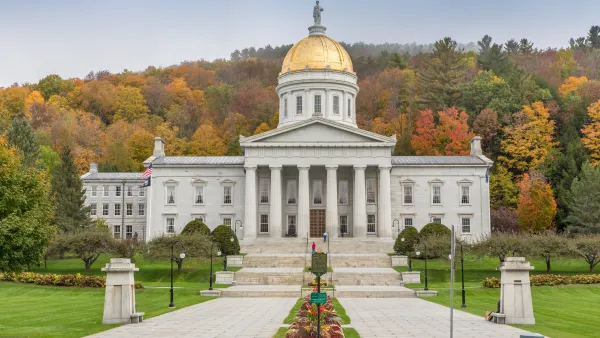
Vermont Next State in Line to End Single-Family Zoning, Ease Parking Requirements
Both houses in the Vermont Legislature have approved legislation to preempt local land use regulations by rescinding single-family zoning and easing parking requirements throughout the state.

Housing Reform Package Under Consideration by Rhode Island General Assembly
The Rhode Island House Speaker has introduced a package of 14 bills intended to ease housing construction without stepping on any toes at the local level.

Virginia Law Granting Local Authority for Energy Efficiency Rejected Due to Housing Affordability Concerns
The state preemption pendulum swings again—this time in favor of state preemption of energy efficiency standards in Virginia.

Planetizen Federal Action Tracker
A weekly monitor of how Trump’s orders and actions are impacting planners and planning in America.

California plans to bury El Niño’s downpour
If the state plays its cards right, it may be able to store a billion acre-feet of El Niño’s water in aquifers.

Desperate measures: Advocates weigh draining Lake Powell to fill Colorado River
Draining the reservoir could reduce evaporation losses by a couple hundred thousand acre-feet.

Mamdani’s pied-à-terre tax survives legal challenge
A panel of judges found that the plaintiffs failed to demonstrate injury as a result of New York City's implementation of the tax.

Eastern Nebraska is running out of electricity
Data centers and electrification are straining eastern Nebraska’s grid, throttling economic development.

Seattle passes record-breaking transit services expansion
Proposition 1 will double the city’s transit tax to add 95,000 more bus trips and preserve 180,000 bus trips annually.

FREE Course: Walkable City 1: Why Walkability?
After describing his path towards focusing on walkability as the essence of good planning, Jeff Speck marches through his five principal reasons for making more walkable places.
Reinventing Malls: Planning Alchemy—Turning Gray Fields Into Gold
The course focuses on the opportunities and imperatives that shape reinvention of mall sites.

City of Rosemead
Rutgers University, Edward J. Bloustein School of Planning and Public Policy
One Hundred Miles
University of Michigan School for Environment and Sustainability (SEAS)
Hunter College, City University of New York (CUNY)
The Architects Foundation
City of Cambridge
Montrose County
The Pocatello Development Authority