Forget bike counts. The new thing in bike advocacy is cars-blocking-the-bike-lane counts.


"[M]ore than 60 people spread out across DC for a coordinated effort to capture in real-time just how many cars and trucks block bike lanes during busy times," report Mark Sussman and Rachel Maisler.
The findings of that effort justify a lot of the public frustration of people on bikes about the inadequacies of painted bike lanes: "Volunteers submitted nearly 700 bike violations," on one day, May 15, 2019. That's "25% of the 2,900 citations that the city issued for blocked bike lanes in all of 2018," according to the article.
Volunteers used the How’s My Driving App to report the violations. "The app, launched in January, allows people to capture driving behavior like standing in a bike lane or blocking a crosswalk. The app draws data from the DC DMV website and shows the user a summary of how many tickets a vehicle has. It also generates a report they can tweet at DC 311," according to Sussman and Maisler.
The volunteers are calling the effort the Data-Protected Bike Lane project.
Read the full story: Residents tracked nearly 700 vehicles blocking bike lanes in one day

DDOT's 2015 Goal: Filling Gaps in Bike Infrastructure
The District Department of Transportation's plans for 2015 include closing critical gaps in the District's bike infrastructure network.
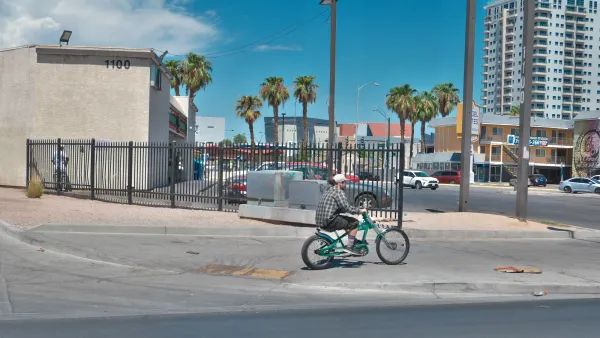
Las Vegas is building its first protected bike lane
The new lane connects Henderson and the Las Vegas Raiders headquarters via Starr Avenue.

Nashville installs concrete barriers to protect bike lanes
The new 'Toronto barriers' provide a physical buffer between cars and bike lanes.

Planetizen Federal Action Tracker
A weekly monitor of how Trump’s orders and actions are impacting planners and planning in America.

The state-sanctioned urbicide of Austin
People don’t kill cities. Freeways do.

US to reduce Colorado River water deliveries to Mexico
A new Colorado Treaty amendment reduces Mexico’s Colorado River water allocation by 250,000 acre feet.

Nation's most wind-powered state turns to coal as data centers increase energy demand
For the first time in decades, Iowa has increased its generation of coal power.

NYC cools commuters with city's first rain garden above a bus stop
New York City officials say the plants in the rain garden can absorb 16 gallons of rainwater during heavy storms.

Brightline West’s future may rely on $6 billion federal loan
The company has until Nov. 2 to make a $400 million equity investment into its proposed high-speed rail line.

FREE Course: Walkable City 1: Why Walkability?
After describing his path towards focusing on walkability as the essence of good planning, Jeff Speck marches through his five principal reasons for making more walkable places.
Reinventing Malls: Planning Alchemy—Turning Gray Fields Into Gold
The course focuses on the opportunities and imperatives that shape reinvention of mall sites.

Greater Baltimore Committee
Eagle County Government
Harvard University Graduate School of Design
The Architects Foundation
University of Cincinnati Online
The Pocatello Development Authority
The Urban Renewal Agency of the City of Pocatello
Journal of the American Planning Association