Neighborhood electric vehicles may become more popular in California's second most populous county thanks to legislation signed by Gov. Jerry Brown. The small zero-emission vehicles are prohibited from crossing streets with speed limits above 35 mph.


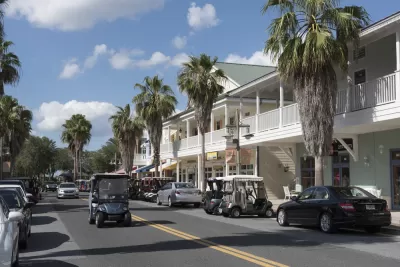
A July 2011 feature post warned that "dismissing neighborhood electric vehicles (NEVs) is a mistake," and that "planners can use NEV planning to make more walkable urban centers." Thanks to a bill by Senator Patricia Bates (R-Laguna Niguel), we may see if these low-speed, zero-emission vehicles can offer environmentally-friendly mobility options to residents beyond those living in master-planned retirement communities with golf courses.
The bill "[d]efines a neighborhood electric vehicle, also known as a low-speed vehicle, as a motor vehicle that is four-wheeled, can attain a speed of at least 20 but not more than 25 miles per hour, and has a gross vehicle weight rating of less than 3,000 pounds."
"Driving around in a neighborhood electric vehicle is a good way to run errands in your neighborhood without having to drive in your car," states Bates in her press release thanking Gov Jerry Brown (D) for signing Senate Bill 1151 – Neighborhood electric vehicles: County of San Diego on Sept. 19. She touted the reduction of greenhouse gas emissions** offered by these lower-priced zero-emission vehicles, though a regional plan envisions them as shared vehicles.
Transportation plan needed
Sponsored by the San Diego Association of Governments (SANDAG), SB 1151 allows the county and any of its 18 cities to adopt a Neighborhood Electric Vehicle transportation plan by January 1, 2029, in consultation with SANDAG "and any agency having traffic law enforcement responsibilities in an entity included in the plan area," according to the California Association of Councils of Governments. Within two years of adoption, a report on the plan would have to be submitted to the state legislature.
"The new law allows a city to develop a plan that will provide for safe crossing of the arterials, making a much larger territory accessible via NEV," explained David Grubb, transportation chair of the San Diego Chapter of the Sierra Club, which supported the bill, in an email.
One example is the city of Coronado, where NEV's are very popular. The main street all the way through town cannot be crossed by a NEV, blocking most residents from driving their NEV to the grocery store. Coronado pushed hard to get this legislation, and will soon have a plan that makes the whole city NEV-accessible.
SANDAG notes that the 2019-2050 Regional Plan known as San Diego Forward, "envisions the expansion of publicly-shared NEVs as a way to provide a clean, economical, and convenient transportation alternative for neighborhood trips or connecting to transit."
Much potential, but a poor legislative track record of implementation
SB 1151 has had many predecessors for different regions, but only one jurisdiction has actually had a NEV transportation plan approved by the legislature, according to the Aug. 31 legislative analysis:
Since 2004, the Legislature has passed many similar bills with widespread bipartisan support authorizing NEV transportation plans to be adopted in jurisdictions throughout California, including the cities of Fresno, Jackson, Lincoln, Rocklin, and Sutter Creek, the counties of Amador and Riverside, and a planned community in Orange County. However, only the City of Lincoln has implemented a plan. The City of Lincoln reported that its plan has “generally been successful” and recommended state-wide authorization.
The award-winning plan [pdf] for the fast-growing small city in Placer County was the topic of a February 2007 Western City article, "Lincoln Puts Neighborhood Electric Vehicles on the Road."
A more recent Neighborhood Electric Vehicle (NEV) Plan [pdf] was prepared for the Coachella Valley Association of Governments (Riverside County) in March 2015. Although there doesn't appear to be corresponding state legislation for the plan, it points to other NEV plans:
A number of local cities and counties in California (Lincoln, Rocklin, Western Riverside County, Rancho Mission Viejo, Coronado, and Playa Vista), have developed NEV Plans with various goals such as reducing reliance on gasoline, reducing vehicle emissions, reducing roadway wear and tear, and creating more sustainable communities.
NEV posts in Planetizen
- Mainstreaming the Golf Cart, October 12, 2015. [Read perceptive reader comment].
- Golf Carts: California's Latest Transit Trend, August 19, 2002
FULL STORY: Gov. Brown Signs Bill Granting San Diego County Neighborhood Electric Vehicle Plan

220,000 EV Drivers in California to Lose Carpool Lane Perk in 2019
The good news: the Clean Air Vehicle program for electric vehicles will be extended for at least three years. The bad news: not all EVs that have a decal now will be able to be renewed. Congestion on HOV and HOT lanes is a major concern.
California to Study a Ban on Sales of Cars with Internal Combustion Engines
California Assemblyman Phil Ting has tried unsuccessfully for the last two years to end the sale of new gas and diesel-powered passenger motor vehicles by 2040. He achieved some success by securing funds in an approved budget bill to study a ban.
Legislation to End Sales of Gas and Diesel Passenger Vehicles in California Reintroduced
Assemblymembers Phil Ting and Ash Kalra have reintroduced the Clean Cars 2040 Act with the goal of banning the sale of passenger vehicles powered by internal combustion engines by 2040, with the California Air Resources Board playing a lead role.

Planetizen Federal Action Tracker
A weekly monitor of how Trump’s orders and actions are impacting planners and planning in America.

The state-sanctioned urbicide of Austin
People don’t kill cities. Freeways do.

US to reduce Colorado River water deliveries to Mexico
A new Colorado Treaty amendment reduces Mexico’s Colorado River water allocation by 250,000 acre feet.

Amtrak not solely to blame for New Jersey commuter rail's unreliability, report finds
A new study from the Garden State initiative found that NJ Transit’s budget grew 20% across a 4 year period, but reliability declined significantly over the same period.

EPA erases limits on planet-warming pollution from power plants
Under Monday’s plan, power plants would still have some limits on how much mercury, arsenic and other contaminants they can emit.

Phoenix announces new on-demand transit service, more frequent RAPID buses
Both new services will launch in October, and are part of Phoenix's Project Effective Access Solutions for Easing Congestion.

FREE Course: Walkable City 1: Why Walkability?
After describing his path towards focusing on walkability as the essence of good planning, Jeff Speck marches through his five principal reasons for making more walkable places.
Reinventing Malls: Planning Alchemy—Turning Gray Fields Into Gold
The course focuses on the opportunities and imperatives that shape reinvention of mall sites.

Eagle County Government
Harvard University Graduate School of Design
Nashville Planning Department
The Architects Foundation
University of Cincinnati Online
The Pocatello Development Authority
The Urban Renewal Agency of the City of Pocatello
Journal of the American Planning Association