The investment comes not from the state legislature but from two regulatory bodies, the Air Resources Board and the Public Utilities Commission, authorizing the expenditure of VW settlement funds and utility ratepayer funds, respectively.


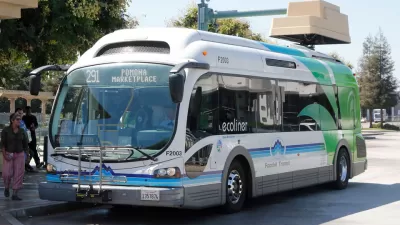
"Today, after years of drafting this blueprint, the California Public Utilities Commission (CPUC) approved the largest single investment in charging infrastructure in U.S. history," writes Adrian Martinez, staff attorney for Earthjustice on May 31. "The $738 million investment [pdf], combined with the $300 million in zero-emissions VW 'Dieselgate' funds approved last week, means California decided to go all in with a jaw-dropping billion dollars approved for electric vehicles in this month alone."
"The programs unanimously approved Thursday by the California Public Utilities Commission focus on creating the infrastructure to support charging stations particularly for electric trucks and buses, in contrast to previous expenditures, which have focused more on cars," reports David R. Baker who covers electric vehicles for the San Francisco Chronicle. Funded by the utilities’ customers, the projects "place an emphasis on installing charging stations in disadvantaged communities or in facilities — such as ports — that tend to be located near low-income neighborhoods."
Baker lists the investments to be made by big-three investor-owned utilities in the state: Pacific Gas and Electric Co., Southern California Edison, and San Diego Gas & Electric Co.
Gov. Jerry Brown has set a goal of having 5 million zero-emission vehicles on California roads by 2030, a steep jump from the 369,300 pure electrics and plug-in hybrids now registered in the state.The programs come in response to a 2016 California law — SB 350 — that directed the commission and the utilities to develop ways to electrify transportation across all sectors of the economy.
[See Planetizen: "Will Electric Utilities Disrupt the Oil Industry in California?" October 29, 2015: A key bill had language allowing public utilities to enter into the electric vehicle charging industry—overlooked by the oil industry and a game-changer for EVs as it tackles one of their most formidable challenges.]
Controversy on Volkswagen Environmental Mitigation Trust spending plan
The CARB vote on May 25 to approve the "Beneficiary Mitigation Plan for the State’s $423 million allocation of the Volkswagen Environmental Mitigation Trust" [pdf] was 12 to 2, unlike the unanimous CPUC vote on May 31.
"Some pushback came from several of CARB's 16 board members, echoed in public comments during the Friday session," reports Russ Mitchell for the Los Angeles Times on May 25.
They said CARB is focusing too much on electric vehicle development and not enough on near-term policies that would convert diesel engines to natural gas, which they said would clear that air faster and cheaper. Because all-electric vehicles cost so much more than retrofits, not enough will be sold in coming years to match retrofits for far cheaper emissions reductions, some contend.
Only $60 million of the $423 million will be spent on making existing diesel heavy vehicles more efficient, through modifications including a conversion to natural gas, although that approach will account for 70% of nitrogen oxide emission cuts.
The issue is important when placed into context with the state's total VW settlement award of $1.3 billion, with $800 million targeted for zero-emission vehicle investment, and "about $422 million to California to replace older, dirtier heavy-duty vehicles and equipment with cleaner versions," according to CARB's July 27, 2017 press release.
New York and New Jersey investments in electric charging infrastructure
"In New York, the governor’s office announced a pledge of up to $250 million through 2025 to its electric vehicle expansion initiative, EVolve NY, [a program of the New York Power Authority]" reports Sean O'Kane for The Verge on June 1.
New Jersey’s biggest utility owner Public Service Enterprise Group (PSEG) announced a $300 million pledge to build out up to 50,000 charging stations along highways, in residential areas, and at workplaces.
Correspondent's note to clarify CPUC expenditure plan: The Chronicle lists $768 million while Earthjustice indicates $738 million. "The budget for these projects is approximately $738 million, with a further $29.5 million for program evaluation," according to CPUC.
FULL STORY: Energy revolution: California approves $768 million for electric vehicles

Coming in 2020: Electrification of Transportation, Including Trucks
Auto manufacturers will offer more battery and plug-in hybrid models this year, and the nation's largest state is expected to approve a new regulation requiring medium and heavy-duty truck manufacturers to sell zero-emission vehicles.
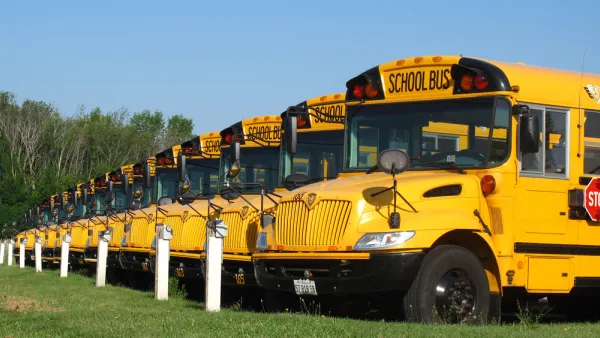
Campaign Launched to Electrify School Buses
U.S. PIRG wants states to use funding from multi-billion dollar Volkswagen settlements to convert the nation's school bus fleet, 95% of which is diesel-powered, to zero-emission buses to reduce children's exposure to toxic air pollution.
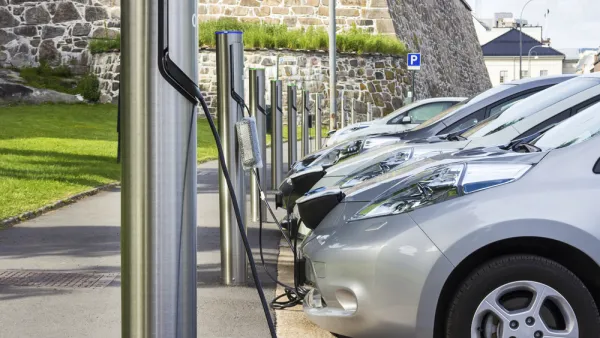
Electrifying California: Volkswagen Settlement Approved
The biggest obstacle to the adoption of electric vehicles in California, a shortage of charging infrastructure, just became a lot more manageable thanks to $200 million from Volkswagen stemming the from the dieselgate settlement.

The state-sanctioned urbicide of Austin
People don’t kill cities. Freeways do.

US to reduce Colorado River water deliveries to Mexico
A new Colorado Treaty amendment reduces Mexico’s Colorado River water allocation by 250,000 acre feet.

New Jersey’s second-largest city bans standalone data centers
Jersey City will continue to allow co-location facilities, such as those meant for research institutions that store their own data.

Amtrak not solely to blame for New Jersey commuter rail's unreliability, report finds
A new study from the Garden State Initiative found that NJ Transit’s budget grew 20% across a 4 year period, but reliability declined significantly over the same period.

EPA erases limits on planet-warming pollution from power plants
Under Monday’s plan, power plants would still have some limits on how much mercury, arsenic and other contaminants they can emit.

Phoenix announces new on-demand transit service, more frequent RAPID buses
Both new services will launch in October, and are part of Phoenix's Project Effective Access Solutions for Easing Congestion.

FREE Course: Walkable City 1: Why Walkability?
After describing his path towards focusing on walkability as the essence of good planning, Jeff Speck marches through his five principal reasons for making more walkable places.
Reinventing Malls: Planning Alchemy—Turning Gray Fields Into Gold
The course focuses on the opportunities and imperatives that shape reinvention of mall sites.

Eagle County Government
Harvard University Graduate School of Design
Nashville Planning Department
The Architects Foundation
University of Cincinnati Online
The Pocatello Development Authority
The Urban Renewal Agency of the City of Pocatello
Journal of the American Planning Association