Congressional leaders agreed to include $540 million, not the original $900+million that could be used for the Hudson River tunnel project, in the $1.3 trillion omnibus spending bill. President Trump is opposed to any Gateway funding.


Dana Rubinstein and Ryan Hutchins report on the agreement for POLITICO New Jersey at noon, EDT, on Wednesday.
The still-tentative deal could offer an end-run around President Donald Trump, who had vowed to veto the spending bill if it included a $900 million earmark sought by Senate Minority Leader Chuck Schumer and other New York and New Jersey lawmakers.
The $540 million would not go directly to the project but would be kept out of the hands of the federal Department of Transportation according to the sources, neither of whom was authorized to speak publicly.
That's important because Transportation Secretary Elaine Chao has not spoken favorably about the project, or more specifically, on its financing, rejecting a decision reached by the prior administration with the states of New York, New Jersey, and the Port Authority of New York and New Jersey.
Under the terms agreed to by congressional leaders — who are said to be closing in on a final, $1.3 trillion spending bill — most of the $540 million would be provided to Amtrak for upgrades on the Northeast Corridor, according to one of the sources.
In addition, the omnibus spending bill also directs "$2.9 billion in discretionary grants to U.S. DOT that could be used to fund a portion of Gateway, the sources said."
Rubinstein and Hutchins note that replacing the century-old, swing-span Portal Bridge over the Hackensack River, a $1.7 billion project, is even more pressing. Both projects are part of the massive $30 billion Gateway Program, vital for maintaining, and ultimately improving, Amtrak's Northeast Corridor train service, as well as northeast regional commuter rail service.
Congress must pass the $1.3 trillion omnibus spending bill, designed to keep the government funded through September, before Saturday. It then goes to the president. A veto would likely mean that basic governmental services would shut down this weekend.
FULL STORY: Congressional leaders etch deal to make $540M available to Gateway

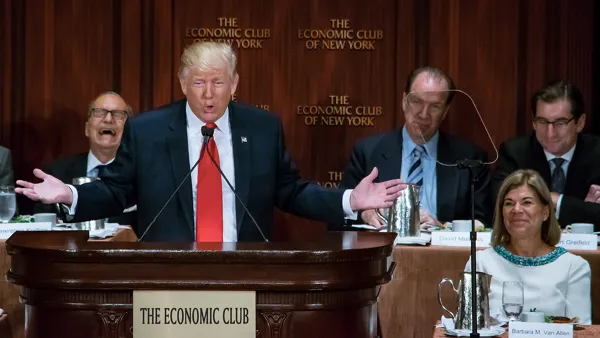
Trump Threatens Government Shutdown if Congress Funds Amtrak Gateway Tunnel
Trump's animus towards using federal funds to replace a century-old, hurricane-damaged rail tunnel under the Hudson River is so strong that he warned Congress he will veto a spending bill they must pass by March 23 to keep the government operating.
Northeast Rail Corridor Woes Extend Far Beyond Hudson River Tunnels
While Amtrak's century-old Hudson River rail tunnels may capture the public's attention, particularly when they are closed, infrastructure problems on the Northeast Corridor also plague the line from Rhode Island to Washington, D.C.
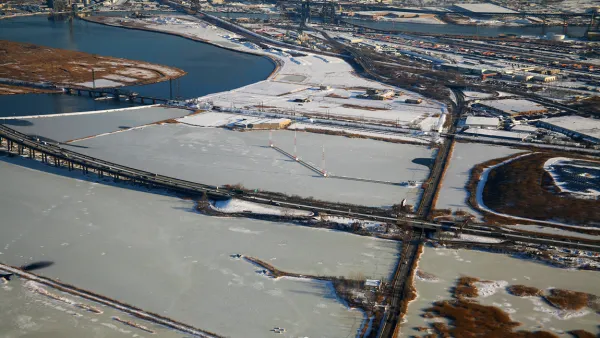
Amtrak's Achilles Heel, Infrastructurally Speaking
Aging, obsolete, and deteriorating bridges affect both road and rail. The 104-year-old Portal Bridge, a swing bridge over the Hackensack River in New Jersey that frequently fails to close properly, tops Amtrak's list for replacement.

The state-sanctioned urbicide of Austin
People don’t kill cities. Freeways do.

US to reduce Colorado River water deliveries to Mexico
A new Colorado Treaty amendment reduces Mexico’s Colorado River water allocation by 250,000 acre feet.

New Jersey’s second-largest city bans standalone data centers
Jersey City will continue to allow co-location facilities, such as those meant for research institutions that store their own data.

Amtrak not solely to blame for New Jersey commuter rail's unreliability, report finds
A new study from the Garden State Initiative found that NJ Transit’s budget grew 20% across a 4 year period, but reliability declined significantly over the same period.

EPA erases limits on planet-warming pollution from power plants
Under Monday’s plan, power plants would still have some limits on how much mercury, arsenic and other contaminants they can emit.

Phoenix announces new on-demand transit service, more frequent RAPID buses
Both new services will launch in October, and are part of Phoenix's Project Effective Access Solutions for Easing Congestion.

FREE Course: Walkable City 1: Why Walkability?
After describing his path towards focusing on walkability as the essence of good planning, Jeff Speck marches through his five principal reasons for making more walkable places.
Reinventing Malls: Planning Alchemy—Turning Gray Fields Into Gold
The course focuses on the opportunities and imperatives that shape reinvention of mall sites.

Eagle County Government
Harvard University Graduate School of Design
Nashville Planning Department
The Architects Foundation
University of Cincinnati Online
The Pocatello Development Authority
The Urban Renewal Agency of the City of Pocatello
Journal of the American Planning Association