News of the details of the negotiation between Taiwan-based Foxconn and the state of Wisconsin have revealed ideas about transportation planning that are either ambitious or delusional, depending on your opinion.


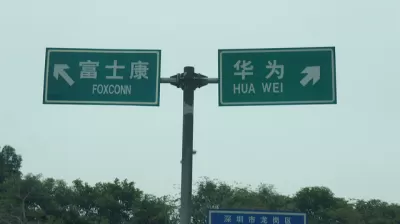
"Foxconn Technology Group asked for an autonomous vehicle lane to be included in the expansion of Interstate 94 North-South in Racine County," reports Arthur Thomas.
The Foxconn deal made national news as Wisconsin Governor Scott Walker touted the company's decision to locate in the state as evidence of his administration's success in economic development. President Trump also chimed in, telling residents of upstate New York to move after Oneida County failed to land the deal.
"The special session legislation setting up Foxconn’s $3 billion in tax credits and breaks also authorized $252.4 million in borrowing to complete the expansion of I-94 in Racine County, but that money cannot be spent without an award of federal funding for the project," adds Thomas.
The article includes soundbites from Milwaukee Association of Commerce president Tim Sheehy, Wisconsin Department of Transportation spokesperson Michael Pyritz, and Waukesha County Board Chair Paul Decker. Decker, for instance, argues that the state will have to rethink its approach to transportation planning and start thinking about funding on a regional level, rather than a local level, to make large projects like I-94 a reality.
Hat tip to Kim Slowey for sharing the article.
Read the full story: Foxconn wants autonomous vehicle lane as part of I-94 expansion
Wisconsin's $1.1 Billion Highway Widening Project on the Ropes
The proposed widening of I-94 in Milwaukee is a $1.1 billion chunk of a $6.4 billion road widening program in the region. The NAACP sued the project as a matter of environmental justice.
Revisiting Wisconsin's Foxconn Deal, Now Called a 'Boondoggle'
Wisconsin taxpayer will be paying the bill for the deal to bring Foxconn to Racine "for decades, if not generations, to come."
Nine Highway Expansions Identified as Worst Boondoggles of 2018
In a new report, U.S. PIRG and the Frontier Group describe nine costly highway projects amounting to $30 billion in their fourth annual "Highway Boondoggles" report. All share the theme of induced travel demand.

Planetizen Federal Action Tracker
A weekly monitor of how Trump’s orders and actions are impacting planners and planning in America.

California plans to bury El Niño’s downpour
If the state plays its cards right, it may be able to store a billion acre-feet of El Niño’s water in aquifers.

Desperate measures: Advocates weigh draining Lake Powell to fill Colorado River
Draining the reservoir could reduce evaporation losses by a couple hundred thousand acre-feet.

Chicago voters approve permanent festival grounds, penalty for vacant property owners
Currently, major summer and fall festivals take over public parks for weeks at a time, drawing criticism from nearby residents

NYC votes to cut outdoor dining red tape, speed up permitting
New York City also voted to allow the Department of Transportation to begin work on urgent projects before notifying elected officials.

California appears to reject Prop. 45
The proposition would have expanded the projects that qualify for a streamlined environmental review, effectively paring down the California Environmental Quality Act.

FREE Course: Walkable City 1: Why Walkability?
After describing his path towards focusing on walkability as the essence of good planning, Jeff Speck marches through his five principal reasons for making more walkable places.
Reinventing Malls: Planning Alchemy—Turning Gray Fields Into Gold
The course focuses on the opportunities and imperatives that shape reinvention of mall sites.

City of Rosemead
Rutgers University, Edward J. Bloustein School of Planning and Public Policy
One Hundred Miles
Hunter College, City University of New York (CUNY)
The Architects Foundation
University of Cincinnati Online
City of Cambridge
Montrose County
The Pocatello Development Authority