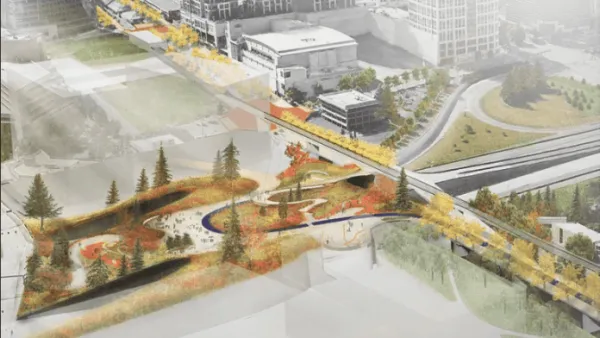
The idea is still very preliminary, but the city of Bellevue, Washington is circulating a plan that could create a freeway cap park spanning the I-405 freeway as a component of a new bike and pedestrian path.


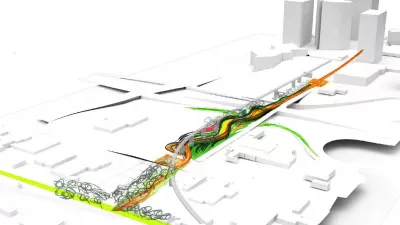
"The City of Bellevue [Washington] is in the early stages of charting future development that could include a 'lid' connecting two areas of the community that are now divided by Interstate 405," reports Michele Chandler.
The lid, or freeway cap park, is one of three options for spanning I-405 as part of the proposed Grand Connection, a "1.5-mile pedestrian and bicycle path would wind from Meydenbauer Bay Park at Lake Washington, connect through the downtown core and ultimately terminate at the regional multi-use Eastside Rail Corridor."
Other options for spanning I-405 include a sculptural bridge and a stand-alone bridge. The Grand Connection Framework Plan, made public in June 2017, is careful to note that the Framework Plan would not constitute a decision regarding any those options. The I-405 crossing will, however, "be evaluated as part of the Wilburton Commercial Area Environmental Impact Statement," writes Chandler. That planning effort is a two-phase project, including the Grand Connection urban design work and land use and transportation plan for the Wilburton commercial area. "The city will release a draft Environmental Impact Survey for the Wilburton commercial area and the I-405 crossing segment in late September," adds Chandler.
Still, the I-4-5 lid is likely to remain a hot topic. The lid idea is not the only such idea in the region. Seattle residents and designers proposed the Seattle C.A.P. Park for I-5 in that city's downtown in late 2015. Several other major cities around the country have freeway cap parks at various levels of concept, design, and planning, including Philadelphia, Pittsburgh, Atlanta, Dallas, and Denver.
Read the full story: Bellevue’s Grand Connection Envisions a Bold Take on City’s Future

Poised for a New Era of Parks Planning in Bellevue, Washington
The last round of capital investment made possible by a 2008 parks levy offers a chance to look further into the future in Bellevue, Washington.
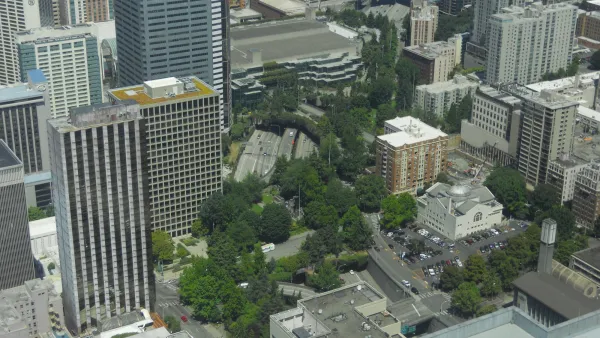
I-5 Study Shows Benefits of Capping Urban Freeways
Putting a lid on the interstate through downtown Seattle could create new space for parks and housing, reduce pollution, and reconnect the disrupted street grid.
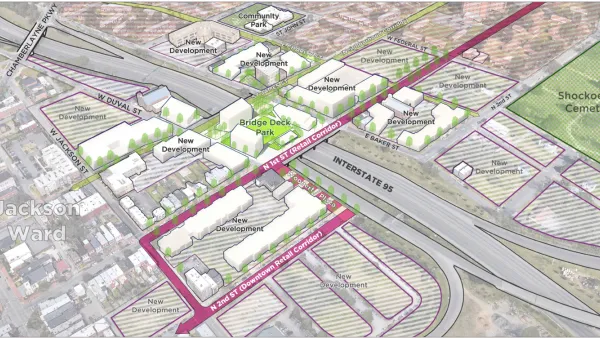
Richmond 300 Plan Update Includes New Cap Park, Form-Based Code
Richmond, Virginia is hoping to make some big changes in time for its tricentennial in 2037, including a new cap park and a new form-based code.

Planetizen Federal Action Tracker
A weekly monitor of how Trump’s orders and actions are impacting planners and planning in America.

Amtrak, CN end decades-long dispute with eight-year agreement
The new operating agreement establishes an updated framework for the companies to work together, including processes to resolve disputes.

Judges permit Denver to divert 77,000 acre feet from the Colorado River for reservoir expansion
Overuse and climate change have caused the Colorado River’s water levels to plummet.

NYC DOT wants faster, more permanent street upgrades
The city is examining ways to build more concrete infrastructure without getting entangled in 'decades-long' projects.

'Something we’ve never seen before:' rising utility rates could strain city finances nationwide
Data centers, climate change and other factors have caused utility rates in the United States to increase by 38% since 2020.

Trump to overrule local leaders, lease millions of acres of America’s Pacific Island territories’ seafloors to mining companies
International law says that the Indigenous people of America’s territories have a right to prior and informed consent regarding projects that impact their countries.

FREE Course: Walkable City 1: Why Walkability?
After describing his path towards focusing on walkability as the essence of good planning, Jeff Speck marches through his five principal reasons for making more walkable places.
Reinventing Malls: Planning Alchemy—Turning Gray Fields Into Gold
The course focuses on the opportunities and imperatives that shape reinvention of mall sites.

Harvard University Graduate School of Design
KFH Group Inc.
Greater Baltimore Committee
The Architects Foundation
University of Cincinnati Online
The Pocatello Development Authority
The Urban Renewal Agency of the City of Pocatello