Other cities have taken notice of the smashing success of Klyde Warren Park in Dallas, Texas. Atlanta now wants a downtown cap park of its own.


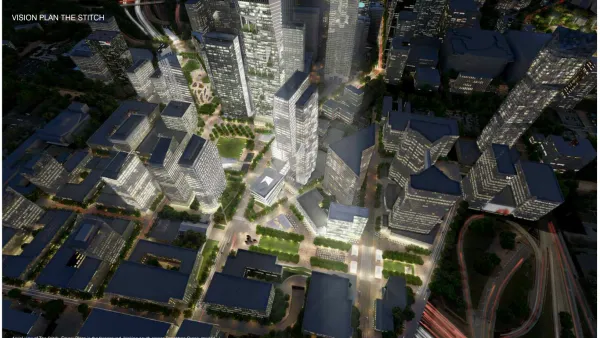
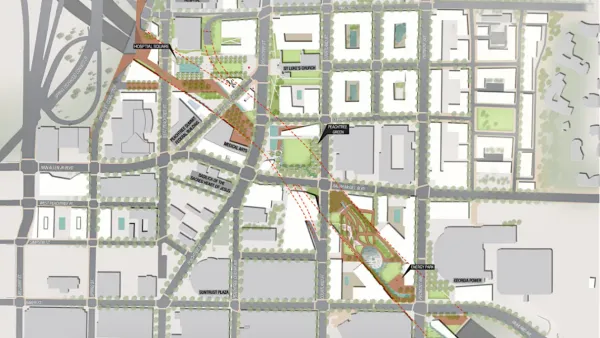
Scott Henry reports on the proposal for "the Stitch," a plan "to cap the Downtown Connector by building concrete decking over the top of I-75/85 from the Spring Street flyover southeast to the Piedmont Avenue bridge."
The proposal is the work of Central Atlanta Progress (CAP), a nonprofit devoted to promoting economic development downtown, and an alliance of neighborhood boosters and downtown landowners. So far CAP has spent "close to $100,000 to commission the 114-page study from the Atlanta office of Jacobs, a global engineering company based in Pasadena" and is currently seeking another $1 million for preliminary engineering work. In total, the project is expected to cost about $300 million—a figure calculated based on the cost of Klyde Warren Park in Dallas.
If built, the Stitch will also owe a spiritual debt to Klyde Warren Park.
Although the name is new, the idea behind the Stitch has been around for years, appearing in previous planning documents and maps published by CAP. But the striking success of Klyde Warren Park has helped spur interest in highway-capping projects in cities around the country.
The hope for the Stitch is for it to it "bring about a fresh renaissance in Atlanta’s urban core and finally erase the half-century-old barrier between downtown and Midtown," according to Henry. The article includes lots of renderings of the conceptual plan for the cap park.
FULL STORY: The Stitch: An ambitious proposal to build parks and housing above The Connector

Keeping the Dream Alive of a Downtown Freeway Cap in Atlanta
Advocates and experts are still working to further the idea of capping a Downtown freeway connector in Atlanta—a project called "The Stitch."
Atlanta Freeway Cap Among Reconnecting Communities Awards
The infusion of $1.1 million in federal funding helps move the project along, but the total cost remains far beyond the city’s current budget.

Atlanta Launches Website for Highway Cap Project
Residents can view plans for the 14-acre project that include public plazas and green spaces connecting local landmarks, employment centers, and transit stations.

The state-sanctioned urbicide of Austin
People don’t kill cities. Freeways do.

US to reduce Colorado River water deliveries to Mexico
A new Colorado Treaty amendment reduces Mexico’s Colorado River water allocation by 250,000 acre feet.

New Jersey’s second-largest city bans standalone data centers
Jersey City will continue to allow co-location facilities, such as those meant for research institutions that store their own data.

Amtrak not solely to blame for New Jersey commuter rail's unreliability, report finds
A new study from the Garden State Initiative found that NJ Transit’s budget grew 20% across a 4 year period, but reliability declined significantly over the same period.

EPA erases limits on planet-warming pollution from power plants
Under Monday’s plan, power plants would still have some limits on how much mercury, arsenic and other contaminants they can emit.

Phoenix announces new on-demand transit service, more frequent RAPID buses
Both new services will launch in October, and are part of Phoenix's Project Effective Access Solutions for Easing Congestion.

FREE Course: Walkable City 1: Why Walkability?
After describing his path towards focusing on walkability as the essence of good planning, Jeff Speck marches through his five principal reasons for making more walkable places.
Reinventing Malls: Planning Alchemy—Turning Gray Fields Into Gold
The course focuses on the opportunities and imperatives that shape reinvention of mall sites.

Eagle County Government
Harvard University Graduate School of Design
Nashville Planning Department
The Architects Foundation
University of Cincinnati Online
The Pocatello Development Authority
The Urban Renewal Agency of the City of Pocatello
Journal of the American Planning Association