The infusion of $1.1 million in federal funding helps move the project along, but the total cost remains far beyond the city’s current budget.


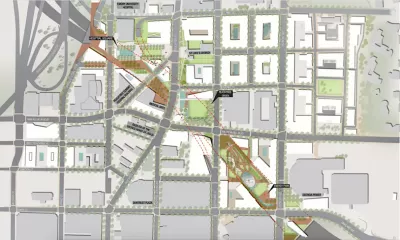
A proposed freeway cap over Atlanta’s Downtown Connector dubbed The Stitch is one recipient of the recently announced first round of the federal Reconnecting Communities grants, reports Josh Green in Urbanize Atlanta.
While the $1.1 million grant is only a small part of the total funding needed for the project, which is estimated at $713 million, it will be put toward engineering work, Green explains. “The Stitch, if fully realized, would be nearly as large as 16-acre Rodney Cook Sr. Park, located in Vine City on the flipside of downtown. It’s one of three major highway-capping proposals in the city currently in fundraising mode. The others are Buckhead’s HUB404 and the largest (but now smaller) Midtown Connector concept.”
The Stitch could be completed, at the earliest, in 2032. “As of November, the city, ADID, and federal government officials had channeled about $15 million toward making The Stitch a reality. Other potential funding sources could include philanthropy and mechanisms such as tax allocation districts.”
More on The Stitch:
Read the full story: Downtown's 'Stitch' concept scores another boost of federal cash


Atlanta Launches Website for Highway Cap Project
Residents can view plans for the 14-acre project that include public plazas and green spaces connecting local landmarks, employment centers, and transit stations.

Take a Look at Midtown Atlanta's Proposed Freeway Cap Park
Inspiration for the cause of putting a 25-acre park on top of a 14-lane freeway.
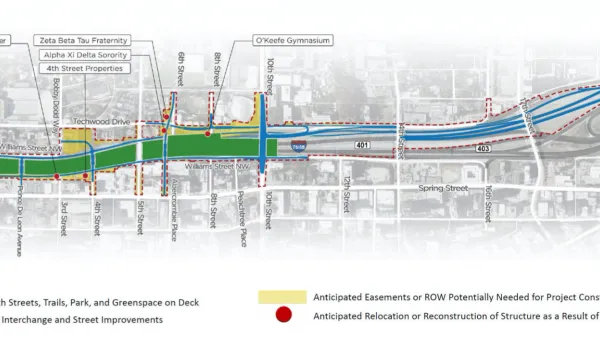
Atlanta Weighs 'Midtown Connector' Freeway Cap
The billion-dollar project would create a 25-acre park and 3.5 miles of new bike and pedestrian routes.

Planetizen Federal Action Tracker
A weekly monitor of how Trump’s orders and actions are impacting planners and planning in America.

California plans to bury El Niño’s downpour
If the state plays its cards right, it may be able to store a billion acre-feet of El Niño’s water in aquifers.

Chicago breaks ground on $3 billion megadevelopment
The new neighborhood, titled Foundry Park, will one day host 3,700 residences.

California High-Speed Rail Authority CEO resigns after $600,000 scandal
Under Ian Choudri, the authority used taxpayer dollars to fund first class flights and trips to nightclubs.

Want to study the Missouri River? Soon, you may need unanimous approval from 10 states
Legislation would require 10 governors’ permission to study or build projects moving water outside the basin.

Desperate measures: Advocates weigh draining Lake Powell to fill Colorado River
Draining the reservoir could reduce evaporation losses by a couple hundred thousand acre-feet.

FREE Course: Walkable City 1: Why Walkability?
After describing his path towards focusing on walkability as the essence of good planning, Jeff Speck marches through his five principal reasons for making more walkable places.
Reinventing Malls: Planning Alchemy—Turning Gray Fields Into Gold
The course focuses on the opportunities and imperatives that shape reinvention of mall sites.

City of Rosemead
Rutgers University, Edward J. Bloustein School of Planning and Public Policy
One Hundred Miles
Hunter College, City University of New York (CUNY)
The Architects Foundation
University of Cincinnati Online
City of Cambridge
Montrose County
The Pocatello Development Authority